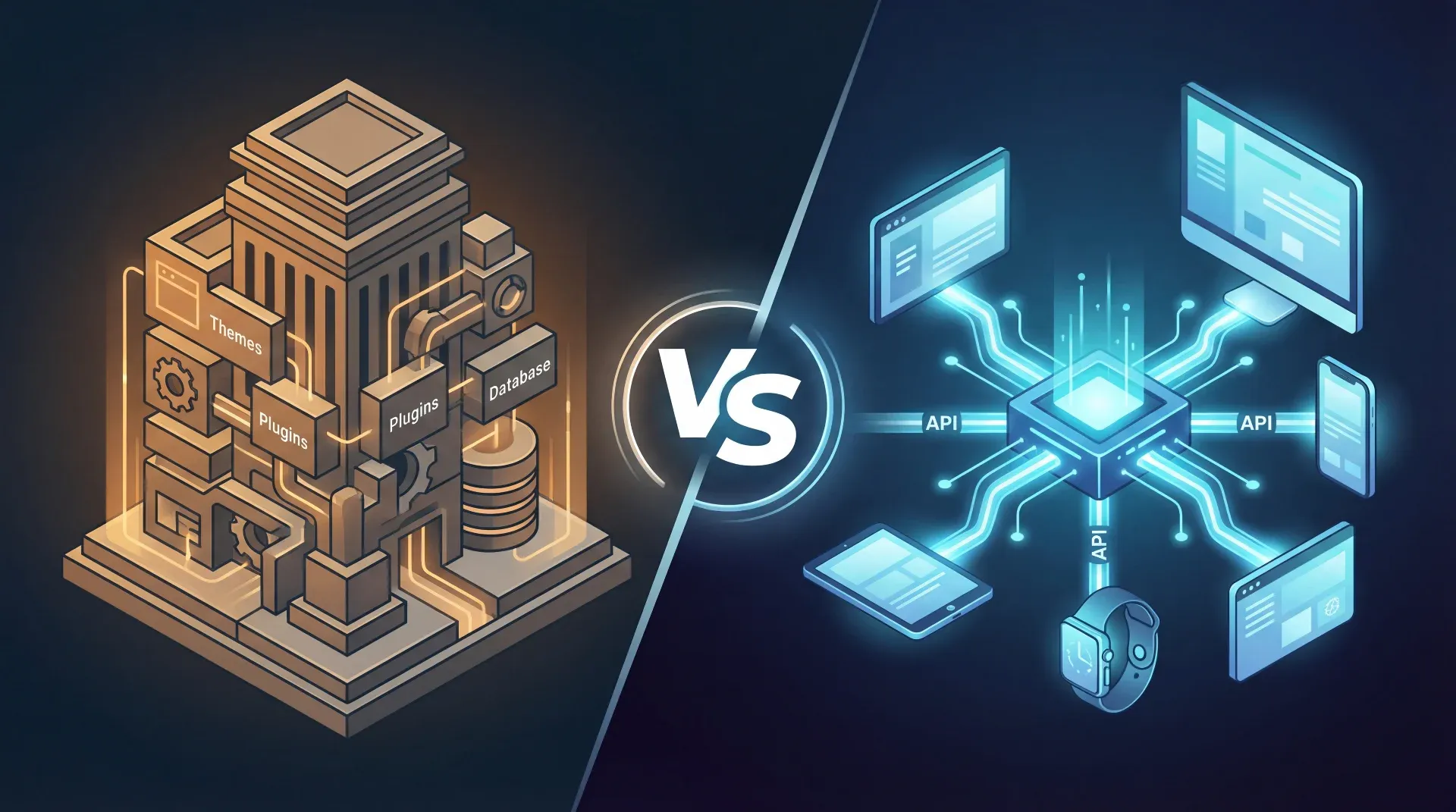
Headless CMS for Lovable Sites: When It's Worth It – and Which One Fits

TL;DR: „A Lovable site doesn't strictly need an external headless CMS – Lovable Cloud (Supabase) covers 80% of cases. But once non-technical editors need to maintain content, a multi-channel setup is in play, or existing editorial workflows must keep running, a dedicated headless CMS like Sanity, Strapi, or Payload becomes the better choice."
— Till FreitagThe Setup: Lovable + Headless CMS Sounds Logical – But It Isn't Always
Lovable generates a React/Vite/Tailwind app with real code. The frontend can consume anything that speaks an API. Headless CMS speak APIs. Match made in heaven?
Not quite. Before you bolt Sanity, Strapi, or Contentful onto your Lovable site, an honest question is in order: Do you actually need it? We've written a separate article on that – it's the more honest bridge. This one assumes you've already decided yes.
Three Constellations Where a Headless CMS for Lovable Sites Makes Sense
1. Editors Without Lovable Access
Lovable is a builder, not an editorial system. If your marketing team wants to change text daily, swap images, or spin up landing pages – without someone opening the Lovable project every time – you need an editor UI that isn't the Lovable editor.
2. Multi-Channel Content
The same content on website, newsletter, app, and partner portal? Then content must live centrally and ship via API everywhere. A pure Lovable site with Lovable Cloud is enough as long as there's only one site. The moment a second consumer joins, a real CMS wins.
3. Existing Editorial Workflows
If your team already lives in Contentful, Sanity, or Storyblok – respect it. Migrating is expensive and political. Wiring Lovable as a frontend to an existing CMS is trivial; swapping the CMS for Lovable Cloud is a change-management project.
Which Headless CMS Fits a Lovable Site?
Lovable sites are React-Vite SPAs that get pre-rendered to static HTML via Playwright and deployed on Vercel Edge (that's how this project runs). The key selection criteria:
- API quality (REST or GraphQL, ideally type-safe)
- Free tier that's usable for real projects
- GDPR compliance / EU hosting option
- Editor UX non-technical people actually use
Sanity – the Pragmatic Default
- ✅ Generous free tier (3 users, unlimited content)
- ✅ Real-time collaboration, solid editor studio
- ✅ TypeScript SDK,
@sanity/clientintegrates with Vite without drama - ⚠️ US hosting (EU region is paid)
- 👉 Good for: marketing sites, blogs, portfolios
Strapi – When You Want to Self-Host
- ✅ Open source, self-hosted on your own infra
- ✅ REST + GraphQL out of the box
- ✅ Full data sovereignty, GDPR unproblematic
- ⚠️ You operate a Node server – maintenance, updates, security
- 👉 Good for: agencies, regulated industries, larger setups
Payload CMS – the TypeScript-First Option
- ✅ Code-driven config (no click studio), fits the builder mindset
- ✅ TypeScript end-to-end, excellent DX
- ✅ Self-hosted or Payload Cloud
- ⚠️ Younger ecosystem, fewer plugins than Strapi
- 👉 Good for: developer-driven teams who treat their CMS like code
Storyblok – When Editors Need Visual Editing
- ✅ Real visual editor (click element = edit)
- ✅ EU hosting available
- ⚠️ Visual editing needs a live preview setup in the Lovable project
- 👉 Good for: marketing-heavy teams who miss WYSIWYG
For a full comparison of all options – including Contentful, Hygraph, and Ghost – see the Headless CMS Hub for AI First Builders.
Integration into a Lovable Site: The Pattern
Whichever CMS you pick, the pattern is always the same:
// src/lib/cms.ts
import { createClient } from "@sanity/client"

export const cms = createClient({
  projectId: import.meta.env.VITE_SANITY_PROJECT_ID,
  dataset: "production",
  apiVersion: "2024-01-01",
  useCdn: true,
})

export async function getPosts() {
  return cms.fetch(`*[_type == "post"] | order(date desc)`)
}
In a Lovable component:
const { data: posts } = useQuery({
  queryKey: ["posts"],
  queryFn: getPosts,
})
That's it. React Query (shipped by default in Lovable projects) handles caching, the CMS client handles the API.
Build-Time vs. Runtime
Two strategies:
- Runtime fetching (as above): content loads live in the browser. Simple, but every visit triggers API calls.
- Build-time fetching (Static Site Generation): content is fetched at deploy and baked into the bundle. Faster, SEO-strong, but updates require a re-deploy.
For most marketing sites, SSG is the right answer. This blog does exactly that – markdown gets rendered at build time, Vercel deploys static HTML. With a headless CMS it works identically: webhook from CMS → Vercel deploy → done.
Lovable Cloud as an Alternative – Don't Forget
Before you pull in an external CMS: Lovable Cloud vs. Supabase explains why the built-in database is enough for many content use cases. A posts table with RLS, a simple admin interface in the same Lovable project, done. No second vendor, no second bill, no second login.
Rule of thumb: If only you or 2-3 technical people maintain content, Lovable Cloud is enough. Once non-technical editors join or multiple frontends need to be served, the jump to a headless CMS pays off.
A Special Case: CMS at the Edge
If you're already deploying to Cloudflare/Vercel Edge, take a look at newer options like Cloudflare's own approach – we examined Emdash CMS on Cloudflare in detail. Interesting because it solves content storage and edge delivery in one step.
Bottom Line: Not Every Lovable Project Needs a CMS – But If It Does, Pick the Right One
Headless CMS for Lovable sites work great technically – React Query plus API client plus typed content is a robust setup. The real question isn't which CMS, it's whether.
For 80% of Lovable projects, Lovable Cloud is enough. For the remaining 20% – marketing sites with editorial workflows, multi-channel setups, existing CMS investments – Sanity is the pragmatic default, Payload the developer favorite, and Strapi the self-hosted answer.
Planning a Lovable site with an editorial content workflow? Talk to us – we help with stack decisions and integration.
📚 More on this topic: Find all articles on headless CMS, Jamstack & API-first in our Headless CMS Hub for AI First Builders.
Related Articles
Do You Even Need a CMS When You Build with Lovable?
Lovable ships with a database, an editor, and Git integration. Do you even need a classic CMS on top? An honest decision…
Read moreHeadless CMS vs. Traditional CMS – When Is It Worth Switching?
WordPress, Drupal, Typo3 – or a Headless CMS? We compare monolithic and decoupled content architectures and show when sw…
Read more Deep Dive
Lovable Feature Roundup: What actually mattered in May and June 2026
Subagents, native Claude MCP, the Preview Toolbar, Publish-from-chat, slow-query analysis in Lovable Cloud: in six weeks…
Read more
Website Builders vs. AI-Native Stack: Which Path Wins in 2026?
Wix, Squarespace, Jimdo & co. vs. an AI-native stack with Lovable, Cloud and edge hosting – when does each really pay of…
Read more
Cloudflare vs. Vercel – Which One Should You Use When?
Vercel or Cloudflare? Both host your modern web app at the edge – but they pursue fundamentally different strategies. We…
Read more
Vibe Coding & SEO: Why AI-Generated Apps Stay Invisible – And How We Fix It
Lovable, Bolt, v0 – Vibe Coding tools produce SPAs that Google can't see. Our playbook makes them SEO-ready: SSG, Schema…
Read more
Google Search Console for Vibe Coding Projects: Setup, Debugging & Indexing
Your Lovable app is live on Vercel – but Google isn't indexing anything? How to set up Search Console, debug crawling is…
Read more
OG-Image Best Practices for SPAs: Making Your Vibe Coding Projects Shareable
When you share a link from your Lovable app, LinkedIn shows an empty box. Why SPAs don't deliver social previews – and h…
Read more
Build Forms in Lovable: React Hook Form, zod & Lovable Cloud Step by Step
Part 2 of the Lovable Forms series: how to build forms directly in Lovable – with React Hook Form, zod, shadcn/ui and Lo…
Read more