Agentic Engineering.
AI thinks. AI builds.
Beyond code generation – AI agents that plan, decide, and implement autonomously. From understanding requirements to finished implementation.
What is Agentic Engineering?
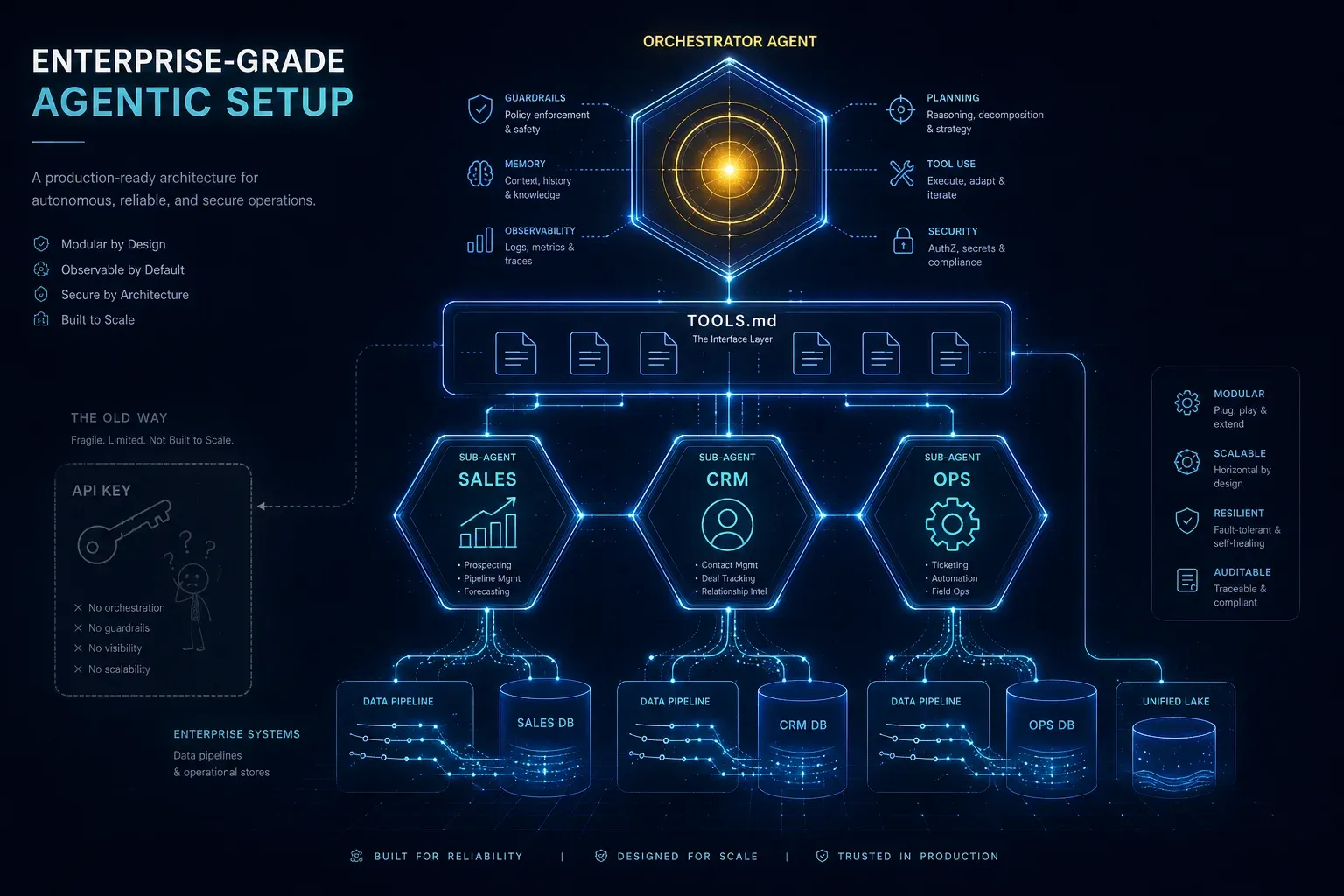
Agentic Engineering describes an approach where AI systems don't just generate code snippets, but autonomously plan, make decisions, and execute multi-step tasks.
Instead of waiting for each prompt, AI agents work autonomously toward a goal – from understanding requirements to finished implementation with tests and documentation.
"Write me a login page with Tailwind."
"Implement user auth with OAuth, session management, and tests."
Vibe Coding vs. Agentic Engineering
| Vibe Coding | Agentic Engineering | |
|---|---|---|
| Control | Human directs every step | AI plans and decides autonomously |
| Interaction | Prompt → Result → Prompt | Goal → AI works autonomously |
| Context | Single file or snippet | Entire repo, specs, tests |
| Output | Code snippet, component | Feature branch with tests & docs |
| Errors | Human fixes manually | Agent detects and fixes itself |
How it works
The core principles of Agentic Engineering.
Spec-Driven Development
Requirements are transformed into structured specs – user stories, acceptance criteria, design docs – before any code is written.
Autonomous Code Agents
AI agents understand entire repositories, modify code across multiple files, and validate through tests – without human intervention.
Parallel Task Execution
Modern agents handle multiple tasks simultaneously in isolated sandboxes – while you work on one feature, the agent builds the next.
Guardrails & Review
Autonomy doesn't mean blind trust. Clear boundaries, code reviews, and defined scope limits remain essential.
Why it matters for teams
Multiply Speed
One developer with AI agents does the work of a small team. Boilerplate, tests, and docs are generated automatically.
Quality Through Structure
Spec-driven approaches enforce clear requirements before implementation – fewer misunderstandings, better code quality.
Automate Knowledge Transfer
Agents generate specs and docs, automatically creating a knowledge base for new team members.
Accelerate Junior Devs
AI agents as 24/7 pair-programming partners – with best practices, code reviews, and improvement suggestions.
The best tools
Our recommendations for Agentic Engineering.
Claude Code
Agentic CLIOur go-to agent. Understands entire codebases, works autonomously across files, and validates changes through tests.
Kiro (AWS)
Spec-Driven IDETurns requirements into structured specs and generates code with tests. Ideal for process quality and traceability.
ChatGPT Codex
Cloud AgentOpenAI's cloud agent for autonomous coding tasks. Works in isolated sandboxes and handles multiple tasks in parallel.
Best Practices
Define clear goals – the more precise, the better the agent performs
Set guardrails – define which files the agent may modify
Review remains mandatory – code reviews are still essential
Specs before code – invest time in requirements before the agent starts
Increase autonomy iteratively – start supervised, then fully autonomous
Ready for Agentic Engineering?
We help you effectively integrate AI agents into your workflow – from tool selection to process optimization.
Just getting started? Begin with Vibe Coding
Vibe Coding is the perfect starting point: you prompt, AI builds. Ideal for quick prototypes, MVPs, and your first AI-assisted development.
FAQ
Related Articles
Insights and guides on the topics that matter here.