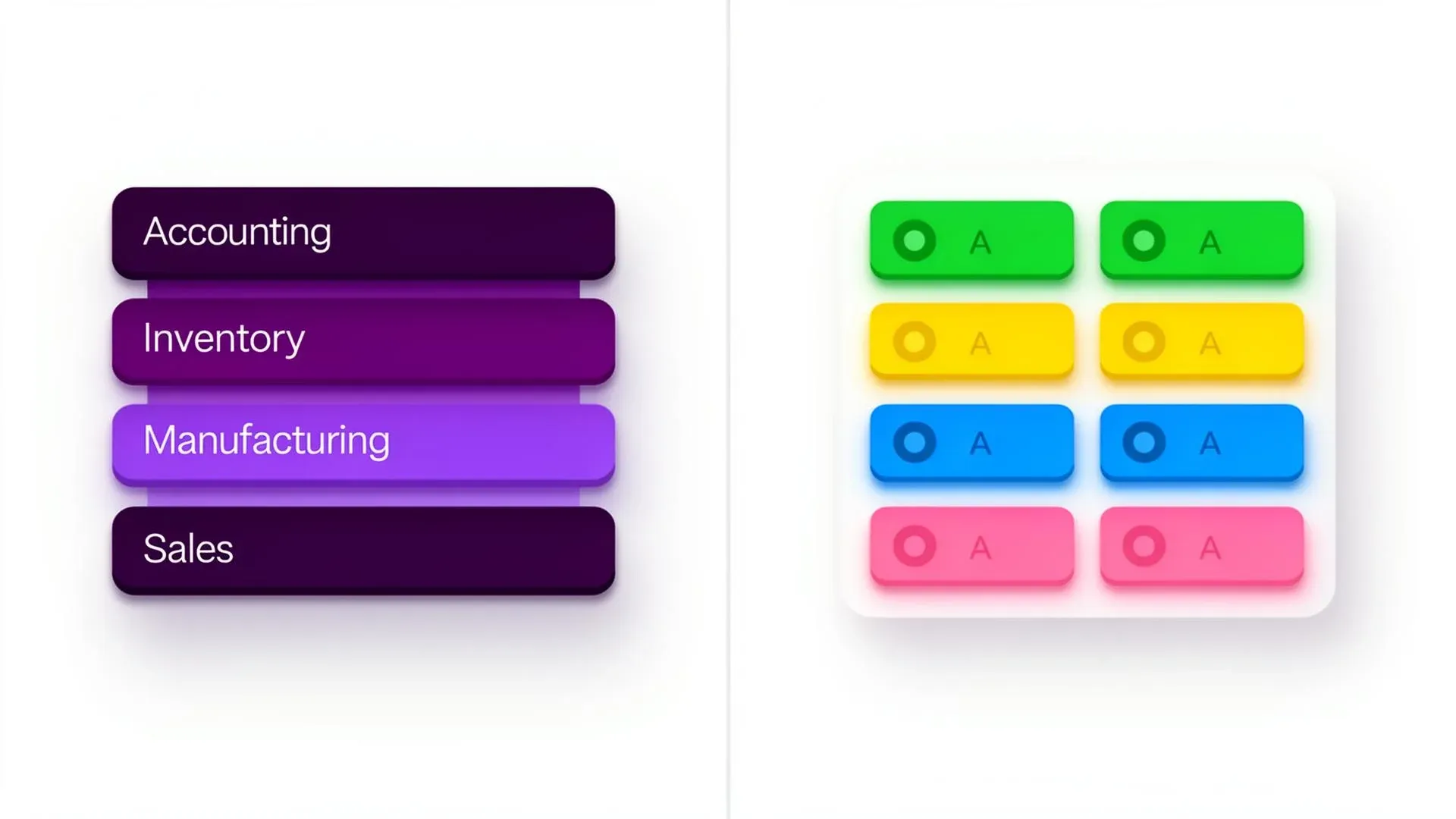
Odoo vs. monday.com – ERP Suite or Work OS? (Honest 2026 Comparison)

TL;DR: „Odoo is a complete open-source ERP suite for companies that want accounting, inventory and manufacturing in one system. monday.com is a Work OS for teams that need to model processes flexibly and adapt fast. Two very different worlds – the right choice depends on whether you need ERP depth or operations flexibility."
— Till FreitagTwo Platforms, Two Worlds
Odoo is a modular open-source ERP suite with 40+ integrated apps – from accounting and inventory to manufacturing, CRM and e-commerce. monday.com is a Work Operating System that lets teams model any workflow as boards – CRM, projects, service, dev.
Both tools are excellent at what they do. But they solve different problems. Here's our honest comparison.
Companies at a Glance
| Metric | monday.com | Odoo |
|---|---|---|
| Founded | 2012 | 2005 |
| Headquarters | Tel Aviv, Israel | Brussels, Belgium |
| Employees | ~2,200 | ~5,000 |
| Revenue (2025) | ~$1.2B | ~€700M |
| Customers | 225,000+ | 12M+ users, 60,000+ app installs |
| Status | NASDAQ (MNDY) | Private |
| Valuation / Funding | ~$15B market cap | ~€5B (Summit Partners, 2023) |
| Open Source | ❌ | ✅ (Community Edition, LGPLv3) |
Odoo is an established open-source suite with a massive community. monday.com is a publicly traded cloud platform focused on work management. Both are serious – but strategically very different.
Odoo – The Open-Source ERP Suite
Strengths
- Full ERP depth: Accounting, inventory, MRP/manufacturing, purchasing, POS, e-commerce, HR, projects, CRM – all in one data base
- Open source: Community Edition is free, full source-code access, large developer community, local partners everywhere
- Real integration: A stock movement directly affects accounting, e-commerce and purchasing – no sync issues
- Self-hosting possible: Full control over data and infrastructure, on-prem or your own cloud
- Very cheap entry: One Odoo Online app is free forever, the Standard plan is cheaper than most ERPs
- Highly customizable: Python-based framework, Studio no-code editor, custom modules possible
Weaknesses
- Steep learning curve: ERP logic is complex – journal entries, inventory rules and workflows need setup expertise
- UI modernity: Functional but not as polished or intuitive as monday – looks like ERP, feels like ERP
- Rarely "out of the box": Serious deployments usually need an Odoo partner (€10k–€100k+ projects are normal)
- Version dependency: Yearly major releases, community modules often break – upgrades can be expensive
- CRM functionality is solid, not outstanding: A byproduct of the suite, not best-in-class
- Collaboration & work management: The Project app exists but is no replacement for a real Work OS
monday.com – The Flexible Work OS
Strengths
- Maximum workflow flexibility: Model any process as boards – without code
- One platform for all teams: CRM, project management, service, dev, marketing, HR processes
- Fast adoption: Teams are productive in days, not months
- No-code automations: Drag-and-drop automations, monday AI for intelligent workflows
- Top dashboards & reporting: Visual reporting that actually gets used
- EU data residency: GDPR-compliant with EU server location
- 200+ native integrations: HubSpot, Salesforce, Slack, Outlook, Teams, Stripe, Shopify
Weaknesses
- No ERP depth: No real accounting, no MRP, no inventory module with stock management – must be solved via integrations or third-party systems
- Not built for financial accounting: Tax, statutory accounts, audit trails need a dedicated system (DATEV, Xero, NetSuite, Odoo …)
- Scales through complexity, not data model: Highly normalized data models with relations hit limits
- No open-source option: Closed SaaS platform
- Minimum 3 seats: Unnecessarily expensive for 1–2 person teams
Feature Comparison
| Feature | Odoo | monday.com |
|---|---|---|
| Accounting / Finance | ✅ Full | ❌ |
| Inventory | ✅ Best-in-class | ❌ |
| Manufacturing / MRP | ✅ | ❌ |
| Procurement | ✅ | ⚠️ Via boards |
| E-commerce / POS | ✅ Native | ❌ |
| CRM | ✅ Solid | ✅ Very good |
| Project management | ⚠️ Basic | ✅ Best-in-class |
| Work management / boards | ❌ | ✅ Best-in-class |
| Automations | ✅ (Server Actions, Python) | ✅ (No-code, AI) |
| Dashboards & reporting | ⚠️ Functional | ✅ Excellent |
| AI features | ⚠️ Growing | ✅ monday AI |
| Open source | ✅ | ❌ |
| Self-hosting | ✅ | ❌ |
| EU data residency | ✅ | ✅ |
| API | ✅ XML-RPC + REST | ✅ REST + GraphQL |
| Integrations | ✅ 60,000+ community apps | ✅ 200+ native |
| Mobile app | ✅ | ✅ |
| Time-to-value | Weeks to months | Days to weeks |
Pricing 2026
Odoo
| Plan | Price/user/month | Highlights |
|---|---|---|
| One App Free | €0 | One app unlimited, online hosting |
| Standard | ~€19.90 | All apps, online hosting |
| Custom | ~€29.90 | All apps, Studio, custom code, multi-company, external API |
Plus: implementation and partner costs (often €10k–100k+), depending on scope.
monday.com
| Plan | Price/user/month | Highlights |
|---|---|---|
| Basic | €9 (Work Mgmt) / €12 (CRM) | Boards, dashboards |
| Standard | €12 / €17 | Automations, integrations |
| Pro | €19 / €28 | Forecasting, advanced analytics |
| Enterprise | On request | SSO, HIPAA, advanced permissions |
Pricing reality: Odoo looks cheap on license but is expensive in implementation. monday looks more expensive per seat but is usually live in days. Calculate Total Cost of Ownership honestly.
When Odoo Is the Better Choice
- You need a real ERP with accounting, inventory and manufacturing in one data base
- You're in manufacturing, retail or logistics with physical goods flows
- You want open source and full data control, possibly self-hosting
- You have budget for implementation (in-house tech lead or Odoo partner)
- You want to avoid SAP complexity but keep ERP functionality
- You need multiple entities / companies in one system
When monday.com Is the Better Choice
- Your main requirement is work management, CRM or projects – not accounting
- You want teams productive fast, without months of setup
- Visual dashboards & reporting matter to you
- You need maximum workflow flexibility without developers
- You're a services, marketing or tech company without inventory logic
- You already have a finance system (DATEV, Xero, NetSuite) you don't want to replace
- Time-to-value matters more than ERP depth
The Honest Assessment
Odoo and monday.com are not real competitors – they solve different problems. Whoever compares them as alternatives is usually asking the wrong question.
The right question is: Do we need an ERP backbone or an operations tool?
- If accounting, inventory, manufacturing or multi-entity setup are involved → Odoo (or a classic ERP)
- If it's about CRM, projects, service, marketing, workflows → monday.com
- For many companies the honest answer is: both – Odoo (or another ERP) in the back office, monday in the operational front office
| Criterion | Winner |
|---|---|
| ERP depth (finance, inventory, MRP) | Odoo |
| Open source & self-hosting | Odoo |
| Native e-commerce / POS | Odoo |
| Work management & boards | monday |
| Dashboards & reporting | monday |
| Time-to-value | monday |
| CRM UX | monday |
| No-code automations | monday |
| Integration ecosystem | Tie |
| EU data residency | Tie |
| Price (license) | Odoo |
| Price (total cost of ownership) | It depends |
Bonus: Combine Odoo + monday?
We see this in practice more often: Odoo as ERP backbone (accounting, inventory, invoicing), monday as the operational layer for sales, projects and service. Via the Odoo API or Make/n8n you can sync documents, contacts and deals. Effort-intensive – but for many SMBs the most pragmatic middle ground between ERP depth and operations flexibility.
Not sure which platform fits your setup? We advise honestly – even when the answer isn't monday.
Related Articles
Microsoft Dynamics 365 vs. monday CRM – Honest CRM Comparison 2026
Microsoft Dynamics 365 or monday CRM? The honest comparison – features, pricing, strengths and a clear recommendation fo…
Read more
Insightly vs. monday CRM – Honest CRM Comparison 2026
Insightly or monday CRM? An honest comparison – features, pricing, project management integration and a clear recommenda…
Read more
Freshsales vs. monday CRM – Honest CRM Comparison 2026
Freshsales or monday CRM? We compare features, pricing, and AI capabilities – and show which CRM really fits your team i…
Read more
monday CRM vs. Bigin by Zoho – CRM Comparison 2026
monday CRM or Bigin by Zoho? An honest comparison – features, pricing, scalability and which CRM is actually worth it in…
Read more
Zoho CRM vs. monday CRM – Honest CRM Comparison 2026
Zoho CRM or monday CRM? An honest comparison – features, pricing, ecosystem and a clear recommendation for 2026.…
Read more
Attio vs. monday CRM – Honest CRM Comparison 2026
Attio or monday CRM? We compare both systems honestly – data model, AI, pricing, and which CRM is really worth it in 202…
Read more
folk vs. monday CRM – Honest CRM Comparison 2026
folk or monday CRM? We compare both systems honestly – relationship CRM vs. all-in-one platform. Features, pricing, and …
Read more
Salesforce vs. monday CRM – Honest CRM Comparison 2026
Salesforce or monday CRM? We compare the CRM giant with the agile platform – honestly, with pricing, features, and a cle…
Read moreClose vs. monday CRM – Honest Comparison 2026
Close or monday CRM? We compare both systems honestly – features, pricing, strengths, and which tool is actually the rig…
Read more