
Lovable in Practice: From Prompt to Production App


TL;DR: „Lovable is the best tool for prompt-to-app MVPs – but production requires professional cleanup. We show how we combine both."
— Till FreitagWhy We Rely on Lovable
Over the past 12 months, we've shipped 30+ projects with Lovable – from landing pages and internal tools to full SaaS MVPs. Our own agency website? Also built with Lovable.
This isn't a sponsored post. It's an honest workshop report.
What Lovable Is – and What It Isn't
Lovable is an AI App Builder that generates working React applications from natural language. In essence:
- Input: Describe what you need – as text, screenshot, or Figma link
- Output: A deployable React + TypeScript + Tailwind app with optional backend
What Lovable isn't: An IDE for experienced developers who need full control over every line. That's what Cursor and Claude Code are for.
The Features That Make the Difference
1. Prompt-to-App in Minutes
The most obvious advantage: Describe an app and get a working version within minutes. Not a wireframe, not a mockup – a running application with real code.
Our workflow:
- Draft a rough concept as a prompt
- Generate the first version
- Refine iteratively: "Make the header sticky", "Add a search function"
- Deploy or export via GitHub
2. Real React Under the Hood
The decisive difference from many competitors: Lovable generates real, exportable code. No proprietary framework, no vendor lock-in.
- React + TypeScript + Tailwind CSS
- shadcn/ui components
- TanStack Query for data fetching
- Vite as build tool
This means: Any React developer can pick up the code immediately.
3. Integrated Backend (Lovable Cloud)
With Lovable Cloud, many projects no longer need a separate backend:
- Database: PostgreSQL with auto-generated schemas
- Auth: Email, social login, magic links
- Storage: File upload and management
- Edge Functions: Serverless logic for payments, emails, AI features
- Secrets Management: Secure API key storage
For MVPs and internal tools, this covers 90% of use cases.
4. Visual Edits
An underrated feature: Click elements directly on the page and edit them – text, colors, spacing. No prompt needed, no credits consumed. Perfect for quick design iterations.
5. GitHub Integration
Code doesn't live in Lovable – it lives in your repository. Export with one click, deploy via Vercel, Netlify, or any other host. Essential for teams using Lovable as a starting point, not a final destination.
Our Agency Use Cases
Use Case 1: Company Website (This Website)
Starting point: Complete redesign of our agency website – away from WordPress, toward a modern, performant solution.
Result:
- 60+ pages (services, solutions, blog, tools)
- Bilingual content (DE/EN)
- Markdown-based content system
- Performance score: 95+ across all metrics
- Development time: 4 weeks instead of estimated 12
Use Case 2: SaaS MVP for a Startup
Starting point: A founder with a validated idea but no technical team. Budget for 3 months of development, time pressure from a planned funding round.
Result:
- Working MVP in 2 weeks
- User auth, dashboard, CRUD operations
- Stripe integration for payments
- Subsequent production cleanup by our team (3 weeks)
Use Case 3: Internal Tools for Mid-Sized Companies
Starting point: A company with 200 employees needs an internal planning tool. IT department overloaded, ticket wait time: 4 months.
Result:
- Prototype in 3 days, production version in 2 weeks
- Connection to existing APIs
- Significantly cheaper than in-house development or enterprise software licenses
Use Case 4: Rapid Prototyping for Client Workshops
Starting point: Strategy workshops generate ideas that should be tangible immediately – not as slides, but as clickable prototypes.
Workflow:
- Prompt live in Lovable during the workshop
- Client sees the idea take shape in real time
- End of workshop: A working prototype instead of a 50-page concept document
Strengths: What Lovable Does Really Well
| Strength | Details |
|---|---|
| Speed | From prompt to running app in minutes |
| Code quality | Clean React/TypeScript code, no proprietary constructs |
| Iteration speed | Changes via prompt, instantly visible |
| Backend integration | DB, auth, storage out-of-the-box |
| No vendor lock-in | GitHub export, standard tech stack |
| Learning curve | Productive even for non-developers |
Weaknesses: Where Lovable Hits Its Limits
We wouldn't be an honest agency if we didn't name the weaknesses:
1. Complex Business Logic
Lovable shines with UI-heavy applications. For complex backend logic – e.g., multi-step workflows, complex calculations, or data processing – it reaches its limits. That's where we turn to Claude Code or Cursor.
2. Large Existing Codebases
Lovable is optimized for new projects. Onboarding an existing monolith with 100,000 lines of code? Not what it's built for.
3. Framework Lock on React
If you need Vue, Angular, or Svelte, Lovable isn't for you. Not a problem for us – we're a React shop. But it is a constraint.
4. Production Readiness
The generated code works – but it's not automatically production-ready. Typical follow-up work:
- Security hardening (RLS, auth checks, input validation)
- Performance optimization (code splitting, lazy loading)
- Error handling and monitoring
- Testing (unit, integration, E2E)
This isn't a bug, it's by design. Lovable optimizes for speed, not production perfection. And that's exactly where we come in.
How We Help Businesses Use Lovable
For Founders & Startups
Problem: You have an idea but no technical team.
Our solution:
- MVP Sprint (1–2 weeks): We build your MVP with Lovable – fast, affordable, functional
- Production Cleanup (2–4 weeks): We make the code production-ready – security, performance, testing
- Handover: You get clean code, documentation, and can build your own team
For Mid-Sized & Enterprise Companies
Problem: IT department is overloaded, but business units need solutions quickly.
Our solution:
- Rapid Prototyping Workshops: Ideas become clickable prototypes in hours
- Internal Tool Development: Internal apps in days instead of months
- Vibe Coding Enablement: We train your teams so they can work with Lovable independently
For Agencies & Freelancers
Problem: More projects, same capacity.
Our solution:
- White-Label Development: We build MVPs under your brand
- Vibe Coding Workshops: Your team learns to use Lovable productively
- Code Review & Cleanup: We make Lovable output production-ready
Lovable vs. Alternatives: When to Use What?
| Scenario | Our tool of choice |
|---|---|
| New MVP / website | Lovable |
| Evolving existing code | Cursor + Claude Code |
| Designing UI components | v0 |
| Quick throwaway prototype | Bolt.new |
| Complex refactoring | Claude Code |
The truth: No single tool can do everything. In our agency, we use 3–4 tools in parallel – and Lovable is where most projects start.
Our Lovable Workflow Tips
1. Prompt in Steps, Not Novels
❌ "Build me a complete e-commerce platform with shopping cart, checkout, admin panel, and reporting"
✅ "Create a product overview page with filter functionality and grid layout"
2. Use Screenshots and References
Lovable understands visual references. A screenshot of "this is how it should look" is often more effective than 500 words of description.
3. Iterate Instead of Wanting Everything at Once
The best results come from 10 small prompts, not one big one. Each prompt builds on the previous one.
4. Export Early and Often
Activate GitHub integration and commit regularly. That way you always have a fallback version.
5. Plan for Cleanup
An MVP in 2 weeks with Lovable + 3 weeks of production cleanup is still faster and cheaper than 4 months of traditional development.
Conclusion: Lovable Is a Game-Changer – With Caveats
Lovable has fundamentally changed how we work. Projects that used to take months, we now deliver in weeks. Clients who couldn't afford custom development now get professional solutions.
But: Lovable is a starting point, not an endpoint. The generated code is an excellent foundation – but real production applications need professional cleanup, security hardening, and testing.
The combination of AI speed and professional substance – that's what we offer our clients.
Further Reading: SEO for Lovable Apps
Lovable generates SPAs – and those are invisible to Google. In our comprehensive guide, we show how we solved this: Vibe Coding SEO – Why Your AI-Generated App Is Invisible on Google. Including Playwright SSG, JSON-LD automation, and the complete Lovable → GitHub → Vercel workflow.
👉 Free SEO Audit for your Lovable project →
Want to use Lovable for your project – or make your existing Lovable project production-ready? Talk to us – we'll give you honest advice on what makes sense and what doesn't.
Related Articles

Base44 vs. Lovable 2026 – An Honest Comparison
Base44 and Lovable both promise prompt-to-app magic – but they take very different approaches. We compare code ownership…
Read more
MVP to Production: Why Your Vibe Code Project Needs Experienced Developers
Your MVP works – but is it production-ready? Why AI-generated code needs professional cleanup before real users arrive.…
Read more
Ponytail: The Best Code Is the Code You Never Wrote
A dev built Ponytail because his AI agents wrote 500 lines for a 5-line problem. The result: 80-94% less code, 47-77% ch…
Read more
Lovable Skills: Repetition Turns Into Reusable Playbooks
Lovable just rolled out Skills – Anthropic's format for reusable agent instructions. What Skills are, how they differ fr…
Read more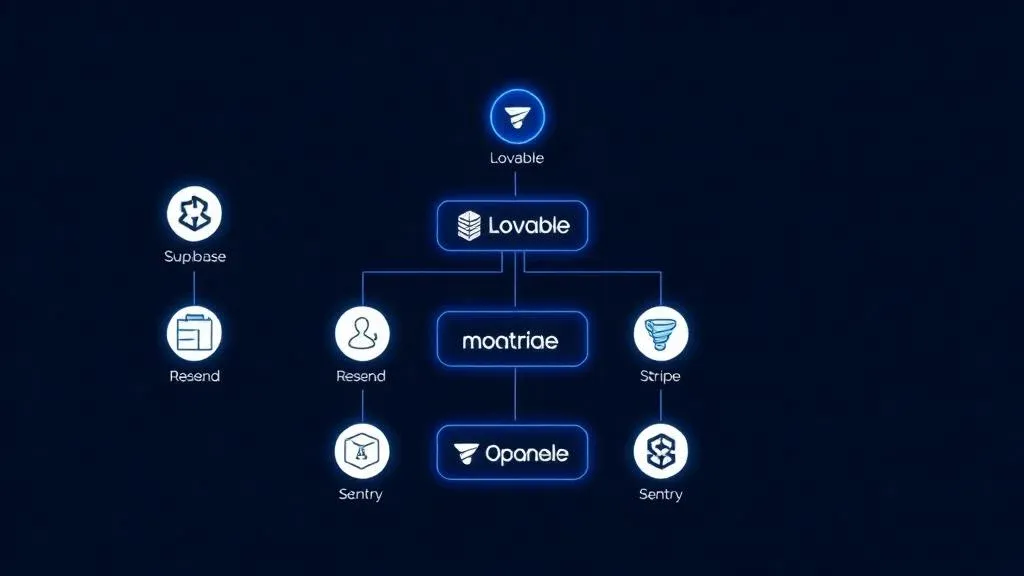
The Vibe Coding Stack 2026: Lovable, Supabase, Resend – And What's Still Missing
This is the tech stack we use to build full-stack apps in 2026 – without a traditional dev team. Three core tools, two f…
Read more
Getting Started with Lovable – Your First React App in 30 Minutes
Lovable makes full-stack development accessible: In this tutorial, you'll build your first React app step by step – no c…
Read more
Lovable Pricing & Plans Explained – Is It Worth It?
What does Lovable actually cost? We break down all plans, credits, and hidden costs – with honest assessments of which p…
Read more
Lovable vs. Bolt vs. v0 – Which AI Web Builder Is Right for You?
Lovable, Bolt.new, or v0? We compare the three most popular AI web builders – with honest assessments, pricing, and clea…
Read more Deep Dive
Vibe Coding Tools Compared: Cursor vs. Lovable vs. Kiro vs. Claude Code vs. Trae (2026)
Which vibe coding tool is right for you? We compare 15+ tools across 7 categories – from AI IDEs to agentic coding tools…
Read more