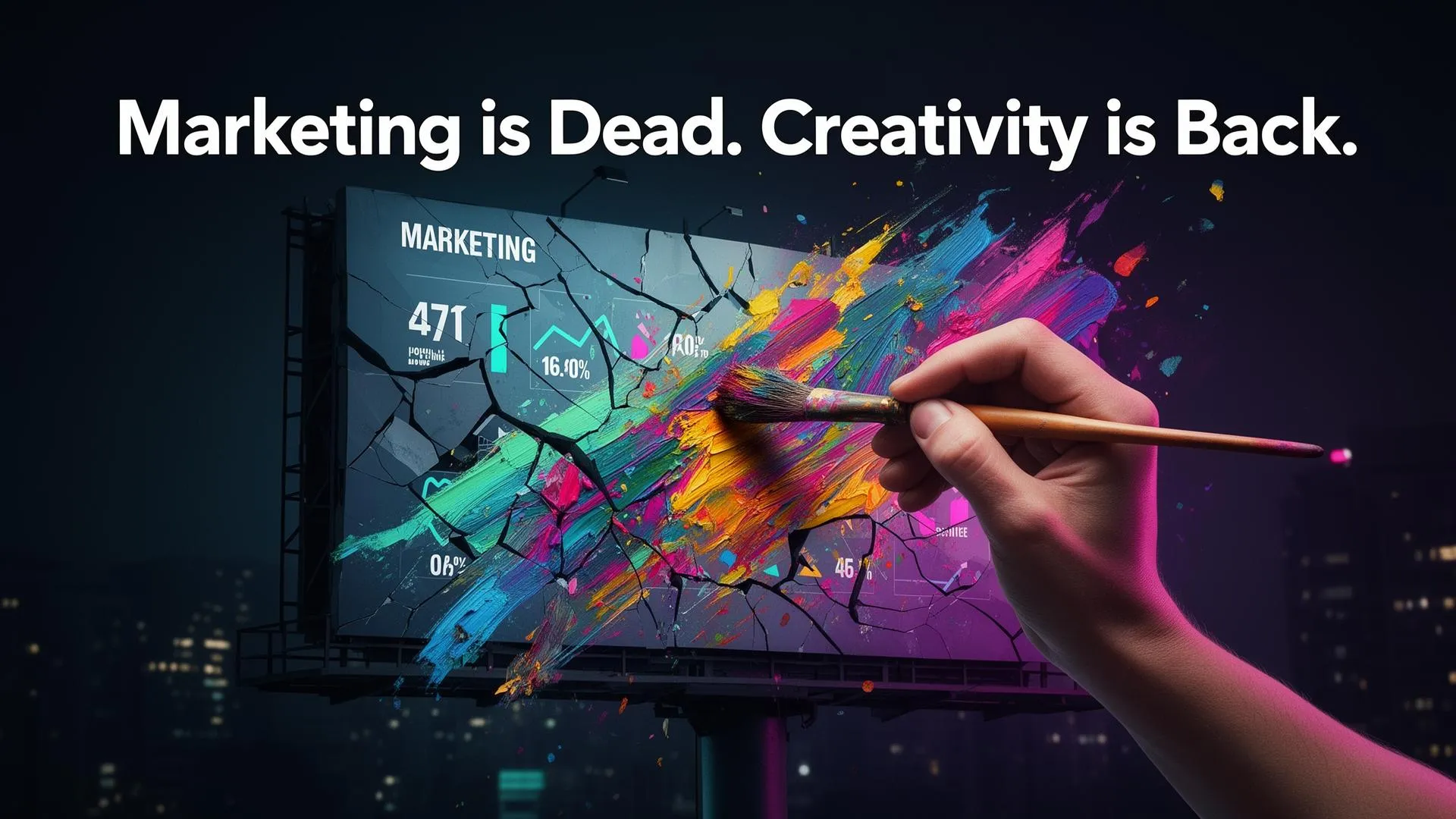

TL;DR: „Performance marketing is commoditized. AI writes better ads than most agencies. The winners of the next era won't be the ones who optimize harder – they'll be the ones who dare to be genuinely creative again."
— Till FreitagLet's be honest.
Most marketing today is garbage.
Not because marketers are bad at their jobs. They're too good at their jobs. They've optimized every funnel, A/B tested every headline, and squeezed every last drop out of the playbook. The result? A sea of sameness. An internet full of content that looks like it was generated by – well, it probably was.
Here's the uncomfortable truth: the marketing machine ate itself.
The Template Era Is Over
For the last decade, digital marketing followed a simple formula:
- Find a keyword
- Write a blog post about it
- Gate it behind a form
- Nurture the lead with 7 emails
- Hand it to sales
- Repeat
It worked. Until everyone did it. Until AI did it faster, cheaper, and – let's be real – better than most content teams.
Today, ChatGPT can produce a "Top 10 Tips for [Industry]" article in 12 seconds. It can write email sequences, social captions, ad copy, and landing pages. It does it without lunch breaks, without creative blocks, and without asking for a raise.
So if a machine can do what your marketing team does... what exactly is your marketing team for?
The Great Commoditization
Here's what happened:
- SEO content became a commodity. Everyone ranks for everything. Nobody reads anything.
- Performance ads hit a wall. CPMs are up, attention is down, and iOS privacy changes torched the targeting playbook.
- Email marketing is drowning in noise. The average professional gets 121 emails per day. Your "just checking in" template isn't special.
- Social media became a pay-to-play hamster wheel where organic reach is a rounding error.
The tools got better. The results got worse. Why?
Because marketing stopped being about ideas and started being about execution velocity. Ship more. Test more. Optimize more. The creative brief became a Jira ticket. The brand voice became a Notion doc that nobody reads.
AI Didn't Kill Marketing. Marketing Killed Itself.
AI is just the final nail in a coffin that was already sealed.
When your entire strategy is built on templates and frameworks, you've already lost. You just didn't know it yet. AI made it obvious by doing the template work better and faster than humans ever could.
But here's the thing most people miss: AI can't do what marketing was supposed to do.
It can't make someone feel something unexpected. It can't create a brand moment that people talk about at dinner. It can't take a weird, risky, slightly uncomfortable idea and turn it into something that defines a company for a decade.
That's not a prompt engineering problem. That's a human problem. And it's the most valuable skill in the market right now.
Creativity Was Always the Point
Remember when marketing was exciting?
When Apple's "Think Different" campaign made you want to change the world? When Dollar Shave Club's launch video made you laugh so hard you actually bought razors from a startup? When Patagonia told you not to buy their jacket – and you loved them more for it?
Those weren't template plays. Those were creative bets. Human bets. They worked because they were bold, authentic, and slightly insane.
The irony is thick: we spent a decade building systems to remove creativity from marketing – to make it predictable, scalable, measurable. And now that AI can run those systems without us, we're suddenly realizing that creativity was the only thing that mattered.
What "Creativity is Back" Actually Means
This isn't a call to fire your data team and hire poets. It's a call to rebalance.
Here's what the next era of marketing looks like:
1. Brand > Performance
Performance marketing isn't dead, but it's table stakes. Everyone can run ads. The companies that win will be the ones with brands so strong that people seek them out instead of being interrupted by them.
Your brand is the moat. Not your CAC.
2. Story > Content
Stop producing "content." Start telling stories. Nobody wakes up wanting to read your whitepaper. But they'll spend 20 minutes on a story that moves them – if it's real, if it's honest, if it respects their intelligence.
3. Taste > Volume
The age of "publish 4 blog posts a week" is over. One genuinely great piece beats 50 mediocre ones. Every time. AI raised the floor of content quality, which means the ceiling is the only place left to compete.
4. Human Signals > Metrics Theater
CTR, MQLs, engagement rates – most of these metrics are vanity in disguise. The real signal is simpler: Do people talk about you when you're not in the room? That's brand. That's creative work. And it's almost impossible to measure with a dashboard.
5. Weird > Safe
The safest marketing strategy is now the riskiest one. If your content looks like everyone else's, you're invisible. The brands that break through will be the ones willing to be weird, polarizing, and unapologetically themselves.
The AI-Creativity Stack
Here's the nuance: AI isn't the enemy of creativity. It's the enabler.
The best creative teams will use AI to:
- Kill the busywork. Let AI write the first draft, the brief summary, the meeting notes. Free humans for the work that matters.
- Prototype faster. Test 10 creative concepts in a day instead of one per sprint.
- Find patterns. Use AI to surface insights from data so humans can make unexpected leaps from those insights.
- Scale the good stuff. Once a creative idea lands, use AI to adapt it across channels, languages, and formats.
The formula: AI handles execution. Humans handle invention.
That's not a step backward. That's marketing finally becoming what it should have been all along.
What This Means for Your Business
If you're running a business in 2026, here's the blunt version:
- Your marketing team's job just changed. If they're still producing template content and running playbook campaigns, they're already being replaced – not by AI, but by competitors who use AI and think creatively.
- Your brand is either an asset or a liability. There's no middle ground anymore. Generic brands get drowned out by AI-generated noise.
- You need fewer marketers – but better ones. The 10x marketer isn't the one who ships more. It's the one who has the taste, instinct, and courage to do something that hasn't been done before.
The Provocation
Here's our challenge to every founder, CEO, and marketing leader reading this:
When was the last time your marketing made someone feel something?
Not click something. Not fill out a form. Feel something. Surprise, delight, provoke, inspire – any of it.
If you can't answer that question, your marketing is already dead. The good news? Creativity never left. You just stopped looking for it.
The playbook is dead. Long live the idea.
At Till Freitag, we build systems that free teams from busywork – so they have time for the work that actually matters. If you're ready to stop optimizing and start creating, let's talk.
Verwandte Artikel
Redesign Series Part 2: Strategy – Positioning, Target Audiences and Content Architecture
Before a single line of code was written, we faced the most important question: what do we actually stand for? Part 2 of…
WeiterlesenRedesign Series Part 1: Why 'Working 2.0' Needed a New Home
Vision Working 2.0 meets Till Freitag 1.0 – why our old look no longer matched what we actually do. The opening of our R…
Weiterlesen
Technology Isn't the Problem Anymore. Adoption Is.
Most digital transformations fail not because of bad tools – but because nobody uses them. Why change management matters…
Weiterlesen
AI Transformation: Roadmap, Change Management & Implementation Phases for Companies
AI Transformation is more than handing out ChatGPT licenses. An honest roadmap with five phases, change management princ…
Weiterlesen
monday Vibe Pricing 2026 – The Big May 6 Update Explained
On May 6, 2026, monday.com fundamentally changed Vibe pricing: publishing is now bundled with the AI Credits add-on, eve…
Weiterlesen
Meta Muse Spark: Impressive at Health, Weak at Coding – and a Strategic Problem
Meta's first model from the Superintelligence Labs is here. Muse Spark shines at health benchmarks and multimodal vision…
Weiterlesen
The AI Race in 41 Milestones: The Complete OpenAI vs. Anthropic Timeline
From GPT-4o to Project Glasswing: Every acquisition, model launch, and product release from OpenAI and Anthropic on an i…
Weiterlesen
Google's $185 Billion Bet: How Gemini 3.1 Pro, Vertex AI, and the Largest Infrastructure Offensive in Tech History Are Reshaping the AI Race
Alphabet is investing up to $185 billion in AI infrastructure – more than the GDP of 140 countries. Gemini 3.1 Pro doubl…
Weiterlesen
OpenAI Buys a TV Show. Anthropic Builds the Future of Software. And Google? It's Playing a Different Game Entirely.
OpenAI buys TBPN, a Jony Ive hardware startup, and builds a desktop superapp. Anthropic turns Claude into a Developer OS…
Weiterlesen