
Tool Selection: Finding the Needle in the Haystack – Our Evaluation Framework


TL;DR: „Tool selection isn't a gut feeling. We evaluate systematically against 7 hard criteria – from API docs to roadmap – then validate the shortlist through our real-world network."
— Till FreitagThe Problem: 14,000 SaaS Tools and They All Sound the Same
Every week, dozens of new tools launch. Each one claims to be "the best". Landing pages shine, feature lists are endless, and somewhere it always says "AI-powered".
But anyone choosing a tool their team will use daily needs more than marketing promises. They need a system.
In this article, I'll show you how we evaluate software tools at Till Freitag – from initial screening to final recommendation. No gut feeling – a framework proven across 400+ projects.
Phase 1: The Longlist – 7 Non-Negotiable Criteria
Before a tool even makes our shortlist, it must pass seven hard criteria. Each one is a knockout criterion.
1. API First & API Documentation
If a tool doesn't have an open API, it's a silo.
This is our strictest rule. A tool without an API can't be integrated into existing workflows – and will sooner or later become a bottleneck.
What we check:
- Is there a REST or GraphQL API?
- Is the documentation current, complete, and includes examples?
- Are there SDKs or official client libraries?
- What does rate limiting look like?
- Are there webhooks for event-based integration?
Red Flag: API docs that haven't been updated in 18 months are a clear warning sign.
2. AI Features & AI Readiness
AI is no longer a nice-to-have – it's a differentiator that shows how future-proof a product is.
What we check:
- Which AI features are natively integrated?
- Are they actually useful or just marketing?
- Is there an AI API (e.g. for custom agents or automations)?
- How transparent is the vendor about data processing?
- Can the tool be combined with external LLMs (e.g. via MCP, API)?
Our benchmark: monday.com demonstrates what native AI integration looks like with Sidekick, Workflows AI, and the Agent SDK – without needing a data science team.
3. Reviews & User Feedback
Landing pages lie. User reviews don't – at least not all of them.
What we check:
- G2, Capterra, TrustRadius: overall rating and trend
- How does the vendor respond to negative feedback?
- Are there recurring complaints (e.g. performance, support)?
- How many reviews are there – and are they recent?
Pro tip: Filter reviews by company size and use case. A tool rated 5 stars by 5-person teams can be a disaster for 500-person organisations.
4. Pricing Model & Total Cost of Ownership
The list price is never the real price.
What we check:
- Pricing structure: per user, per feature, flat rate?
- Hidden costs: add-ons, API calls, storage, premium support?
- Is there a free tier or a genuine trial period?
- What's the pricing history? (Regular price increases?)
- Exit costs: how easy is data export?
What many forget: The most expensive tools aren't the ones with the highest list price – they're the ones where you realise after 2 years that you're locked in.
5. Company Size & Stability
We don't recommend tools from companies that might not exist next year.
What we check:
- Employee count and growth trend
- Funding: bootstrapped, VC-funded, profitable?
- Customer count and reference customers
- Location and jurisdiction (GDPR relevance)
- Is there an EU data centre?
Why this matters: A 12-person startup with €3M in funding can build a brilliant product – but if the runway ends in 8 months, you have a problem.
6. Current Roadmap & Release Velocity
A great product today is worthless if it stagnates tomorrow.
What we check:
- Is there a public roadmap?
- How often are features released? (Monthly? Quarterly?)
- Are community requests implemented?
- Is there a changelog or release notes?
- How does the product team respond to market changes?
Best practice: monday.com regularly publishes comprehensive product updates through monday Elevate and monday Evolve and keeps the roadmap transparent.
7. Number & Quality of Developers
The developer community is an early indicator of a tool's future viability.
What we check:
- How many developers work on the product? (Indicates investment)
- Is there a developer ecosystem (marketplace, apps, extensions)?
- How active is the community (GitHub, forum, Discord)?
- Are there official partners and integrators?
- How quickly are bug fixes and security patches rolled out?
Phase 2: From Longlist to Shortlist
After Phase 1, typically 3–5 tools remain. Now it gets personal.
Network Validation
The best due diligence is a call with someone who's been using the tool for 2 years.
What we do:
- Ask active users in our network – honest feedback on strengths and weaknesses
- Search specialist communities (LinkedIn groups, Slack channels, Reddit) for experience reports
- Leverage the monday.com community and partner network for insider perspectives
- Contact the vendor's reference customers – but with our own questions, not the prepared sales pitch
Hands-on Testing
No tool makes our recommendation list without us using it ourselves.
Our test protocol:
- 14-day deep dive with real use cases (no sandbox data)
- Test integration into existing workflows (Make, n8n, API)
- Document onboarding experience: how quickly is a new user productive?
- Test support quality: submit a ticket and measure response time
- Check mobile experience – is the app actually used or merely tolerated?
Scalability Check
What we simulate:
- How does the tool behave at 10x data volume?
- Is there performance degradation with many concurrent users?
- Does automation work reliably at high volumes?
- How well does pricing scale with usage?
Vendor Conversation
Finally, we talk to the vendor directly – but not about features.
Our questions:
- What does your infrastructure strategy look like for the next 24 months?
- How do you handle enterprise vs. SMB customers?
- What is your biggest technical weakness – and what are you doing about it?
- What does your security audit process look like?
Our Evaluation Scorecard
In the end, everything flows into a weighted scorecard:
| Criterion | Weight |
|---|---|
| API & Integrability | 20% |
| AI Features & Future-Proofing | 15% |
| User Feedback & Reputation | 10% |
| Pricing Model & TCO | 15% |
| Company Stability | 10% |
| Roadmap & Innovation | 15% |
| Developer Ecosystem | 15% |
The weighting adapts to the client context. For a startup with 10 employees, pricing weighs more heavily. For an enterprise with 5,000 users, API depth is decisive.
Conclusion: System Beats Gut Feeling
Finding the needle in the haystack isn't a gamble – it's a craft. With a clear framework, honest user feedback, and hands-on testing, you dramatically reduce the risk of a wrong decision.
Three takeaways:
- Phase 1 is binary. A tool without an API or with a stagnating roadmap is out – no matter how good the demo was.
- Phase 2 is analogue. No dashboard replaces a conversation with real users.
- No tool is perfect. It's about finding the tool whose weaknesses you can best compensate for.
Facing a tool decision and need a second opinion? Get in touch – we've guided 400+ projects and know the strengths and weaknesses of most platforms first-hand.
More on this topic: Our Tool Philosophy · AI Tool Selection Strategy · Why we rely on monday.com
Verwandte Artikel
 Deep Dive
Why You Can't Do Without Middleware Beyond a Certain Point
Native integrations only get you so far. Why middleware like make.com or n8n becomes the indispensable backbone of your …
Weiterlesen
Lean CRM Teams: The 3-Step Framework for 80% Less Manual Work
'We have too many people in our CRM team, we work inefficiently, and we have nothing going on with AI.' That's the exact…
Weiterlesen
AI Will Kill Software? History Says: No.
Every generation of technology adds an abstraction layer – and gets declared the death of everything beneath it. Assembl…
Weiterlesen
Why Your Company Needs an OS, Not More SaaS
Mercury, Rippling, Stripe – they're all becoming compound startups. What happens when your company takes the same approa…
Weiterlesen Deep Dive
Is SaaS Dead? monday.com CEO on Vibe Coding, Agents and the Future of Enterprise Software
monday.com is under massive pressure – stock down 60% from IPO, Vibe Coding as a threat, AI agents as disruption. CEO Er…
Weiterlesen
monday.com + OpenClaw: How monday.com Becomes the Brain of Your AI Agent
monday.com is more than a project management tool – it can serve as the long-term memory and execution log for an AI age…
Weiterlesen
We're Not a Web Agency – And That's the Point
Looking for a web agency? You're in the wrong place. Looking for someone to solve your digital problem? You've found us.…
Weiterlesen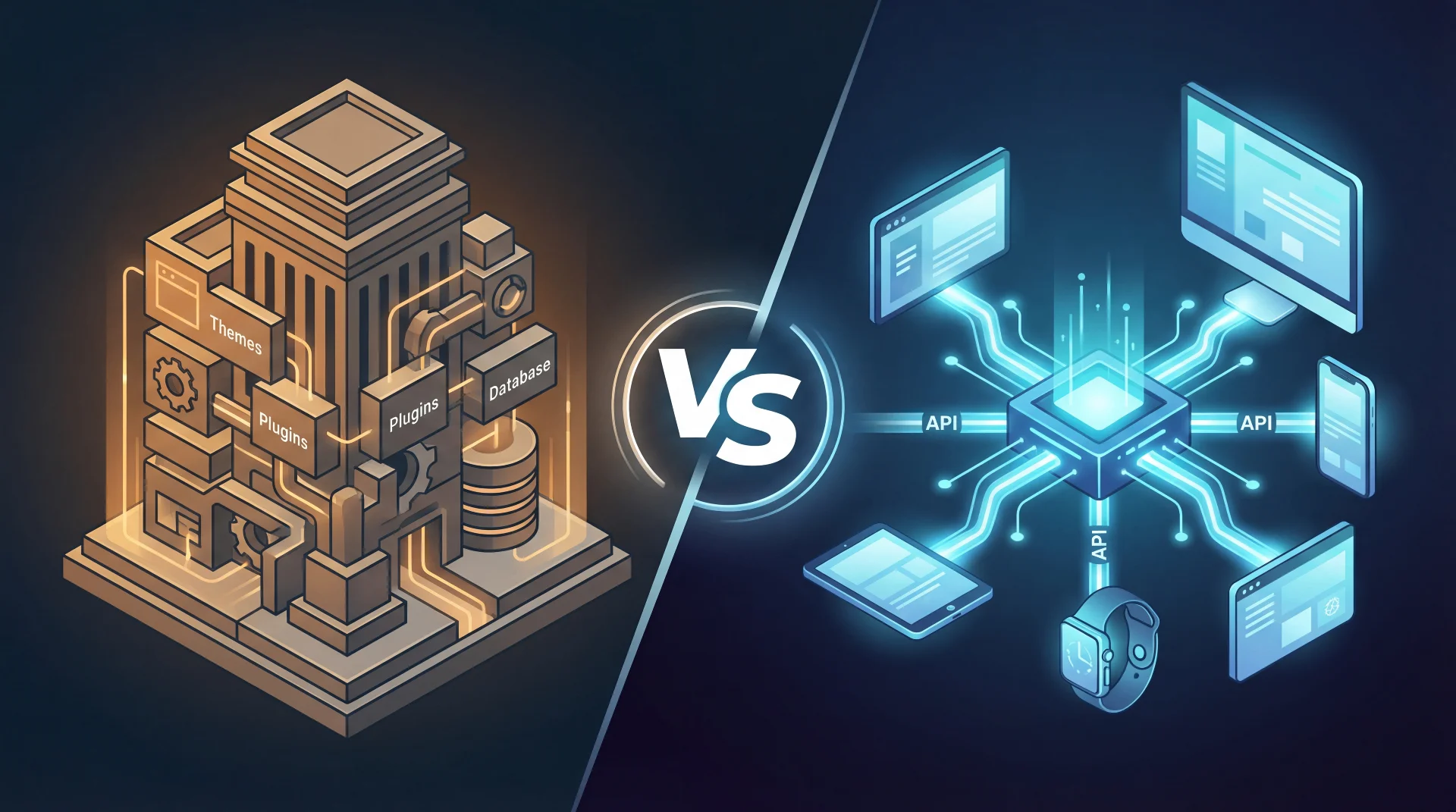
Headless CMS vs. Traditional CMS – When Is It Worth Switching?
WordPress, Drupal, Typo3 – or a Headless CMS? We compare monolithic and decoupled content architectures and show when sw…
Weiterlesen
Web Scraping 2026: Classic vs. AI – And Why You Need Both
Web scraping isn't a niche topic anymore. Whether classic with selectors or AI-powered with LLMs – we compare both appro…
Weiterlesen