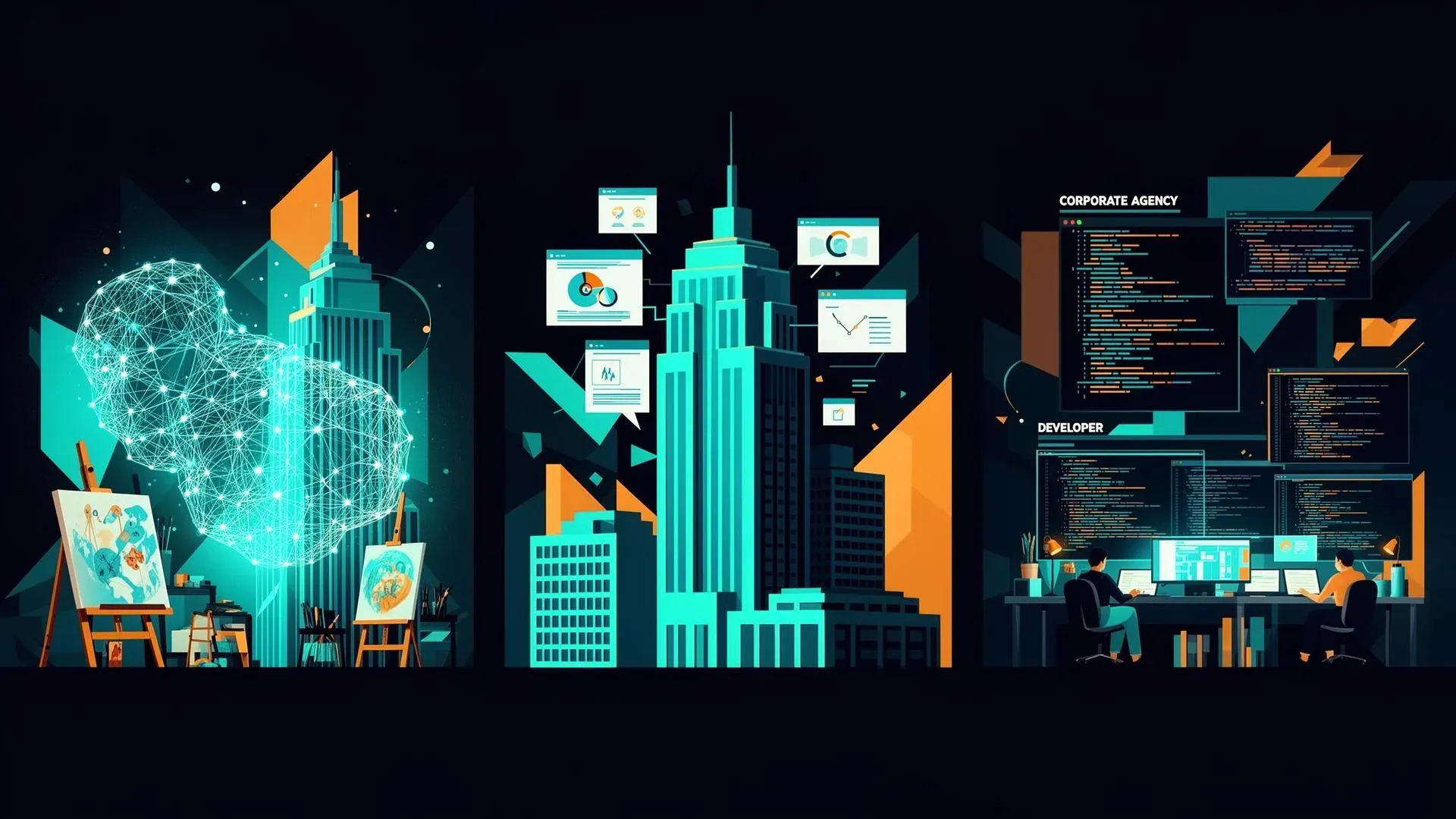
AI Product Studio vs. AI Agency vs. Dev Shop – What's the Difference?

TL;DR: „Three models, three mindsets: AI agencies deliver individual services, dev shops deliver code to spec, AI product studios think and build end-to-end. The right choice depends on your project's maturity."
— Till FreitagThree Models – One Promise?
Every company looking to build an AI product in 2026 faces the same question: With whom? The answer is harder than it sounds. The market has differentiated – and the gaps between an AI agency, a dev shop, and an AI product studio are wider than their similar-sounding pitch decks suggest.
The Three Models at a Glance
AI Agency
An AI agency is the natural evolution of the digital agency. It brings strategic competence, understands use-case evaluation, and creates proof-of-concepts. The strength: broad network, fast orientation, solid workshops.
Typical output: Strategy paper, PoC, vendor shortlist, implementation roadmap.
The challenge: When it comes to building, things get thin. Many AI agencies don't have their own engineering team – they broker out or work with freelancers. That means: additional handoffs, longer feedback loops, knowledge transfer losses.
Dev Shop
A dev shop (or software agency) delivers code. Reliably, to specification, often at attractive rates. Nearshore teams in Eastern Europe or Latin America have made the model scalable.
Typical output: Finished software to spec, API integrations, mobile apps.
The challenge: Dev shops are executors, not co-thinkers. They need a detailed brief to get started. Strategic questions ("Should we really build a custom app or would a monday.com workflow suffice?") are rarely asked. When scope changes – and with AI projects, it always does – costs escalate.
AI Product Studio
An AI Product Studio combines the depth of a consultancy with the delivery capability of a dev shop. Strategy, design, and engineering come from one source. There's no handoff between "the consultant" and "the developer" because both sit on the same team.
Typical output: Production-ready products, AI-native workflows, technical architecture + UX as one cohesive package.
The challenge: Higher entry price than a pure dev shop. Not scalable for 50-developer projects. Works best for focused, strategically important initiatives.
The Detailed Comparison
| Criterion | AI Agency | Dev Shop | AI Product Studio |
|---|---|---|---|
| Core competency | Strategy & consulting | Code delivery | End-to-end product development |
| Delivers | Slides, PoCs, roadmaps | Software to spec | Production-grade products |
| Co-thinks? | Yes, strategically | No, executes | Yes, strategically + technically |
| Own engineering | Rarely | Always | Always |
| Own design | Sometimes | Rarely | Always |
| Iteration capability | Low (project phases) | Medium (change requests) | High (sprint-based) |
| AI expertise | Broad but shallow | Framework-specific | Deep + applied |
| Risk | PoC dies in a drawer | Over-engineering | Higher entry price |
| Ideal for | Orientation & strategy | Well-defined features | New AI products & platforms |
When to Choose Which Model
Choose an AI agency when…
- You don't yet have a clear vision and need strategic orientation
- It's about a workshop or an AI readiness assessment
- You need a vendor comparison or technology evaluation
Choose a dev shop when…
- The specification is locked and you need pure coding capacity
- It's about clearly scoped feature development
- Budget matters more than strategic co-thinking
Choose an AI product studio when…
- You want to build a new AI-powered product from scratch
- Strategy, design, and technology need to be unified
- You need rapid iteration because scope is still evolving
- The result needs to go to production – not end up as a slide deck
The Reality: Hybrid Paths
In practice, many companies use combinations. A typical path:
- Discovery with an AI agency – Identify and prioritize use cases
- MVP with an AI product studio – Build the strategically most important product end-to-end
- Scale with a dev shop – Replicate proven patterns, extend the team
The mistake we see most often: companies start with a dev shop before the strategic questions are answered. The result is technically clean software that nobody uses.
Our Approach: Build > Advise
At Till Freitag, we work as an AI Product Studio. Concretely, that means:
- No slides without code. Every strategy session results in a technical spike.
- No handoffs. The person who designs the architecture also writes the first commit.
- No hourly rates. We work with project fees or sprint-based models.
Not because the other models are bad – but because we believe AI products need to be built differently: iteratively, with strategic depth, and with a team that understands technology and business simultaneously.
Conclusion
The choice between an AI agency, dev shop, and AI product studio isn't a question of "better or worse." It's a question of maturity:
- Need orientation? → AI Agency
- Spec is locked? → Dev Shop
- Building something new? → AI Product Studio
The most dangerous decision is no decision – and then losing three months with the wrong partner.
Wondering which model fits your project? Let's talk.
Related Articles
 Deep Dive
Copilot vs. OpenClaw vs. Claude: Enterprise AI Agents Compared 2026
Three philosophies, one goal: AI agents in the enterprise. Microsoft Copilot (platform), OpenClaw (open source), Claude …
Read more
Coding-Agent Layer 2026: OpenCode, Aider, Continue.dev & Co. Compared
Deep dive into the coding-agent layer: which OpenClaw coding rival fits which workflow? OpenCode, Aider, Continue.dev, S…
Read moreMulti-Agent Layer 2026: AG2, LangGraph, SuperAGI & AWS Strands Compared
When one agent isn't enough: AG2, LangGraph, SuperAGI and AWS Strands compared. Which multi-agent stack fits which workf…
Read moreSelf-Hosted & Privacy Layer 2026: Ontheia, Anything LLM & Privacy Router
If you take GDPR seriously, there's no way around self-hosting. Ontheia, Anything LLM, NanoClaw and the Privacy Router c…
Read more
Desktop Agents Showdown: Dispatch, Manus, Perplexity Computer & DIY – Honest Assessment
Four desktop agents shipped in one week. None of them lead on every axis. Here's what actually works, what doesn't, and …
Read more
Business App Builders Compared: monday Vibe vs. Retool vs. Softr vs. Glide
Four business app builders, four philosophies. We compare monday Vibe, Retool, Softr, and Glide – for ops teams that nee…
Read more
Claude Managed Agents vs. LangGraph vs. CrewAI: Agent Runtimes for Production Compared
Three paths to production agents: Anthropic's hosted runtime, LangGraph's graph orchestration, or CrewAI's role-based te…
Read more
The Cofounder Mindset: Why We Work Like Co-Founders – Not Vendors
Agencies deliver projects. We solve problems – with the same urgency as your co-founders. What that means in practice an…
Read more
Make vs. Claude Code vs. OpenClaw – Picking the Right Orchestration Layer (2026)
Make.com, Claude Code, or OpenClaw? Three tools, three layers of the stack. Here's when to pick which orchestration tool…
Read more