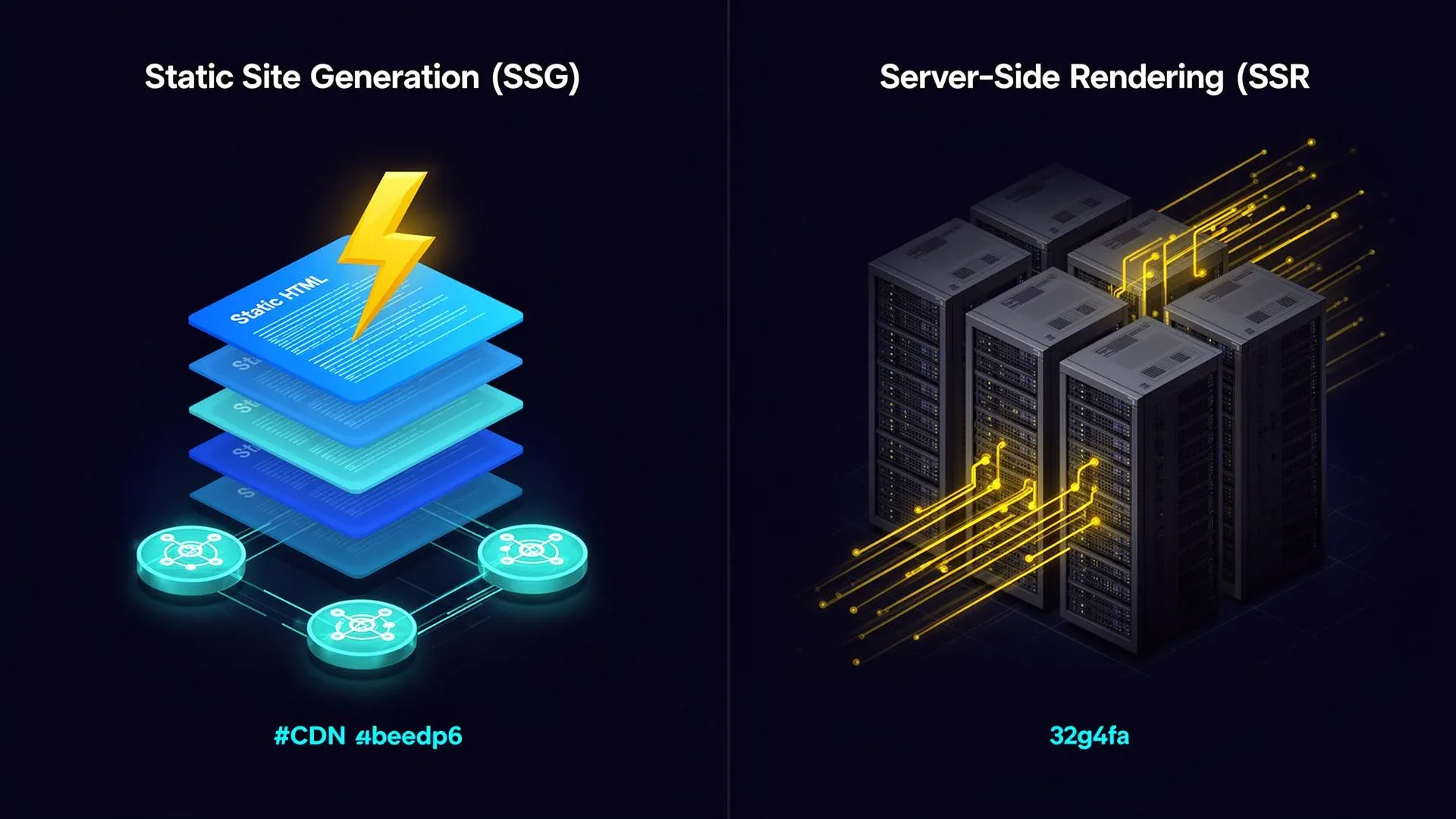
SSR or Pre-Rendering? What We Evaluated for Mykeythai vs. Our Default Approach

TL;DR: „For a villa platform like Mykeythai, pre-rendering remains the right default. Use SSR only where it truly needs to be dynamic – availability, inquiries, agent portal."
— Till FreitagContext: On May 13th, Lovable released Discoverability – including real server-side rendering via TanStack Start. Right after, we sat down with the Mykeythai team and asked: do we switch? Here's the answer.
The Starting Point
Mykeythai is a curated villa platform for Thailand: villa detail pages, destination hubs, things-to-do, a journal, SEO landing pages, agent PDFs. A classic content-heavy travel setup with selective dynamics (availability, inquiries, pricing).
So far the site runs – like all our builds – on our Playwright SSG pipeline: React SPA, rendered to static HTML per route at build time, JSON-LD and meta tags injected, deployed to the edge network.
With the Lovable release, a real SSR path suddenly became available. So: evaluate.
The Quick Comparison
| Pre-Rendering / SSG | Server-Side Rendering (SSR) | |
|---|---|---|
| Speed | Very fast | Often slower |
| Hosting cost | Low | Higher |
| Scaling | Easy | More complex |
| SEO | Very good | Very good |
| Core Web Vitals | Usually better | More variable |
| Dynamic content | Worse | Excellent |
| Cacheability | Excellent | More complex |
| Failure modes | Few | More |
| TTFB | Very low | Higher |
| Hydration issues | Fewer | More common |
On paper this looks like a clear-cut decision. In practice it depends entirely on the use case.
Why Mykeythai Is SSG-Friendly
Let's look at what makes the site:
- Villa detail pages – change maybe weekly
- Journal articles – one publish event per piece
- Destination hubs – curated content, rarely updated
- Things-to-do – editorially maintained
- Areas / regions – static content
- SEO landing pages – optimized for search intent, stable
- About / Brand – changes quarterly
This is textbook content for pre-rendering. Content doesn't change by the second, SEO and performance matter more than real-time data, every single page has a clear URL and a clear search intent.
That's exactly why references like Plum Guide, Le Collectionist or Airbnb's SEO landing pages feel so fast: aggressive static rendering plus a global CDN. Nobody renders a villa detail page live on a Node server when the content is identical 99% of the time.
Where SSR Still Makes Sense
There are areas where static rendering isn't enough:
- Authenticated dashboards – different per user
- Personalized content – e.g. "Recommended for you"
- Live availability – calendars, booking slots
- Search & filter with many combinations
- Dynamic pricing – season, occupancy, promotion
- User-specific data – agent portals, saved favorites
For Mykeythai this concretely means: availability calendar, inquiry forms, pricing requests, agent portal, search/filter, possibly live weather data.
The Architecture We Chose
Instead of "all SSR" or "all SSG", we split the site into two zones:
Pre-Rendered (SSG)
/                       → Home
/villas/[slug]          → Villa Detail
/journal/[slug]         → Journal articles
/destinations/[slug]    → Destination hubs
/things-to-do/[slug]    → Activities
/areas/[slug]           → Regions
/lp/[slug]              → SEO landing pages
/agents/pdf/[id]        → Agent PDFs
/about, /brand          → Brand pages
→ Build-time rendering, JSON-LD injected, delivered from the edge. TTFB < 50ms globally.
Dynamic (SSR / Edge Functions / Client)
/api/availability       → Calendar, edge function
/api/inquiry            → Inquiry form, serverless
/api/pricing            → Pricing request, edge
/agent/portal/*         → SSR (auth-gated)
/search                 → Client-side against edge search
→ Only these routes need a live server. The rest stays static.
This is the dynamic islands logic: 95% of the site is static, small interactive islands (calendar, pricing box) fetch their data client-side. No reason to SSR-render an entire villa detail page just because there's an availability calendar at the bottom.
The Typical Mistake in the Lovable/Vercel/Supabase Stack
In audits we regularly see the same pattern: projects render way too much via SSR. The symptoms are always the same:
- higher TTFB
- white screens on load
- duplicate requests (SSR + client refetch)
- "page disappears and reloads" after hydration
- inconsistent Cache-Control headers
- worse Lighthouse scores despite strong hardware
This matches observations the Mykeythai team had already made on other platforms: temporary white screen, reload, inconsistent caching headers. Classic symptoms of SSR + client hydration mismatches, unnecessary runtime requests, or streaming/edge mismatches.
With the Lovable release, SSR is now easy to enable – but that doesn't make it the right choice automatically.
Why This Matters for GEO / AI Search Too
LLMs and AI crawlers (ChatGPT, Perplexity, Claude, Google AI Overviews) prefer stable, fast, immediately available HTML content. They don't wait for hydration. They don't follow useEffect chains. They see what's in the first response.
Pre-rendering is structurally favored here: complete HTML, deterministic, with JSON-LD in <head>. Exactly what we treat as the default in our SEO master strategy and what we describe in detail in the Vibe Coding SEO guide.
The Decision for Mykeythai
We stick with the pre-rendering default and add selectively:
- All content routes stay on Playwright SSG (unchanged)
- Availability / pricing as edge functions called client-side
- Agent portal as an isolated SSR route (auth-gated, separate bundle)
- Search client-side against an edge search index (Typesense / Algolia / Cloudflare)
This keeps Core Web Vitals high, hosting costs low, and crawler output clean – without giving up dynamic features where they're actually needed.
Takeaways for Other Projects
- SSR is not an upgrade. It's a trade-off. More dynamism, more complexity, higher cost, more failure modes.
- The default should be SSG. Only add SSR when a concrete use case breaks static rendering.
- Think in zones, not in "the whole app". Most pages are 95% static.
- Lovable makes both easy. The release is great – but you still have to make the architecture decision yourself.
If you're facing the same question right now: we'll show the pipeline live at TokenMade in Hamburg – including the Mykeythai architecture as a case.
Related Articles

Lovable SEO/AEO: Every App Discoverable by Google and ChatGPT From Day 1
Lovable ships server-side rendering, pre-rendering for existing apps, Semrush directly in the builder chat, and an on-de…
Read more
Prerendering: How to Turn a React SPA Into a Google-Friendly Site
React SPAs are invisible to crawlers. Prerendering fixes that – without Next.js, without an SSR server. How our Playwrig…
Read more
GPTBot, ClaudeBot, PerplexityBot: What AI Crawlers Really See With Prerendering
We analyzed three months of edge logs: who actually crawls, who executes JavaScript, and who relies entirely on the HTML…
Read more
Vibe Coding & SEO: Why AI-Generated Apps Stay Invisible – And How We Fix It
Lovable, Bolt, v0 – Vibe Coding tools produce SPAs that Google can't see. Our playbook makes them SEO-ready: SSG, Schema…
Read more
AI Website Builder Compared: Framer vs. Webflow AI vs. Wix AI vs. Durable vs. Lovable Stack
Five ways to build a website compared on SEO: Framer, Webflow AI, Wix AI, Durable – and the Lovable + GitHub + Vercel st…
Read more
Agent Harness as a Category: Why the Harness Is the New Product
The harness — skills, sandbox, subagents, memory, channel routing — is the real product layer above the model. A map of …
Read more
Cloudflare vs. Vercel – Which One Should You Use When?
Vercel or Cloudflare? Both host your modern web app at the edge – but they pursue fundamentally different strategies. We…
Read more
Do You Even Need a CMS When You Build with Lovable?
Lovable ships with a database, an editor, and Git integration. Do you even need a classic CMS on top? An honest decision…
Read morePlaywright SSG Tutorial: How to Make Lovable Apps Visible to Google
SPAs are invisible to search engines. With Playwright, you can render any Lovable app into static HTML – automated, on e…
Read more