

TL;DR: „Airtable is the better Excel for business teams. Supabase is the database for developers who don't want Firebase. Both are great – for fundamentally different problems."
— Till FreitagThe Short Answer
Airtable and Supabase get mentioned together because both "store data." That's a bit like comparing a delivery van to a race car because both have four wheels.
Airtable is a spreadsheet-database for business teams. Think: tracking projects, managing editorial calendars, running inventory – zero code required.
Supabase is an open-source backend platform for developers. Think: PostgreSQL database, auth, realtime subscriptions, storage – everything you need to ship an app.
The question isn't "Which is better?" It's "What do I actually need?"
Airtable Up Close
Where Airtable Shines
Airtable feels like Excel with superpowers:
- Visual interfaces: Kanban, calendar, gallery, Gantt – all built in
- Forms: Collect data without writing a line of code
- Automations: If X happens, do Y – right inside the platform
- Linked records: Connect tables like a real database
- Collaboration: Your whole team works in the same base simultaneously
The sweet spot: Marketing teams tracking campaigns. Agencies managing client projects. Startups prototyping a workflow before committing to custom software.
Where Airtable Hits Its Ceiling
- 100,000 rows per base – sounds like a lot, isn't when you're scaling for real
- No real backend – you can't build an app that serves 10,000 concurrent users on it
- Pricing escalates – Pro runs $20/user/month, Enterprise more
- Vendor lock-in – your data lives in Airtable's world, export options are limited
- Performance – complex views with heavy linked records get noticeably sluggish
Supabase Up Close
Where Supabase Shines
At its core, Supabase is a managed PostgreSQL database with batteries included:
- Real SQL database: PostgreSQL – the gold standard, scales as far as you need
- Auth out of the box: Email, OAuth, magic links – all built in
- Realtime: Live updates via WebSocket, no server to manage
- Storage: File uploads with CDN, permissions baked in
- Edge Functions: Serverless backend logic in TypeScript/Deno
- Row Level Security: Granular access control at the database layer
The sweet spot: Developers building an app who don't want Firebase. Teams that need open source and data sovereignty. Projects that need to scale from 10 to 10,000 users.
Where Supabase Gets Tricky
- No visual interface – without code, you're limited to the Table Editor
- Learning curve – SQL, RLS policies, migrations – this is developer territory
- Self-hosting takes effort – yes it's possible, no it's not one click
- No built-in project management – Supabase manages data, not workflows
Head-to-Head Comparison
| Criterion | Airtable | Supabase |
|---|---|---|
| Target audience | Business teams, Ops, Marketing | Developers, technical teams |
| Data model | Spreadsheet with relations | True relational DB (PostgreSQL) |
| Scale | 100K rows/base | Practically unlimited |
| Auth | Interface-level only | Full auth system |
| Realtime | Limited | Native WebSocket-based |
| API | REST (rate-limited) | REST + GraphQL + Realtime |
| Price (team) | ~$20/user/month | Free tier + $25/month Pro |
| Open source | No | Yes (self-hostable) |
| No-code | ✅ Core feature | ❌ Requires code |
| Vendor lock-in | High | Low (PostgreSQL standard) |
When Airtable Is the Better Pick
- Your team doesn't write code – and shouldn't have to
- You need fast internal tools – editorial calendar, lightweight CRM, inventory tracker
- Visual presentation matters – Kanban boards, calendar views, galleries
- Collaboration is the priority – multiple teams, one shared workspace
- Prototyping – you want to validate an idea before building a real app
When Supabase Is the Better Pick
- You're building an app – SaaS, web app, mobile app with a real backend
- Scale is on the horizon – more than 100K records, many concurrent users
- Auth and access control are critical – multi-tenant, role-based
- Open source / data sovereignty – you want to own your data
- Realtime features – live dashboards, chat, collaborative editing
The Hybrid Play
In practice, it's rarely either/or. What we see with our clients:
- Airtable for planning + Supabase as app backend – marketing plans in Airtable, the product runs on Supabase
- Airtable as prototype → Supabase in production – validate the idea, then migrate
- Airtable + make.com + Supabase – Airtable as the business-facing layer, make.com as middleware, Supabase as the data engine
Our Take
Airtable and Supabase aren't competitors – they solve fundamentally different problems.
Airtable is for teams that want to organize, visualize, and collaborate on data – without developers. It's the best tool in its class.
Supabase is for developers who need a complete backend – with auth, realtime, and a proper database. It's the best open-source Firebase alternative out there.
The real question is: Are you building an internal workflow tool or a scalable application? Your answer to that is your answer to Airtable vs. Supabase.
Not sure which tool is right for you? In a free intro call, we'll look at your use case together and find the best fit – whether that's Airtable, Supabase, or a combination of both.
Verwandte Artikel
Lovable Cloud vs. Supabase – Why We (Almost) Always Use Supabase Directly
Lovable Cloud is built on Supabase – but when does using Supabase directly make more sense? We explain why we almost alw…
Weiterlesen
Business App Builders Compared: monday Vibe vs. Retool vs. Softr vs. Glide
Four business app builders, four philosophies. We compare monday Vibe, Retool, Softr, and Glide – for ops teams that nee…
Weiterlesen
Replit 2026 – The All-in-One Platform for AI-Powered Development
Replit combines a code editor, hosting, database, and AI agent in one browser platform. Here's what Replit can do in 202…
Weiterlesen
Base44 vs. Lovable 2026 – An Honest Comparison
Base44 and Lovable both promise prompt-to-app magic – but they take very different approaches. We compare code ownership…
Weiterlesen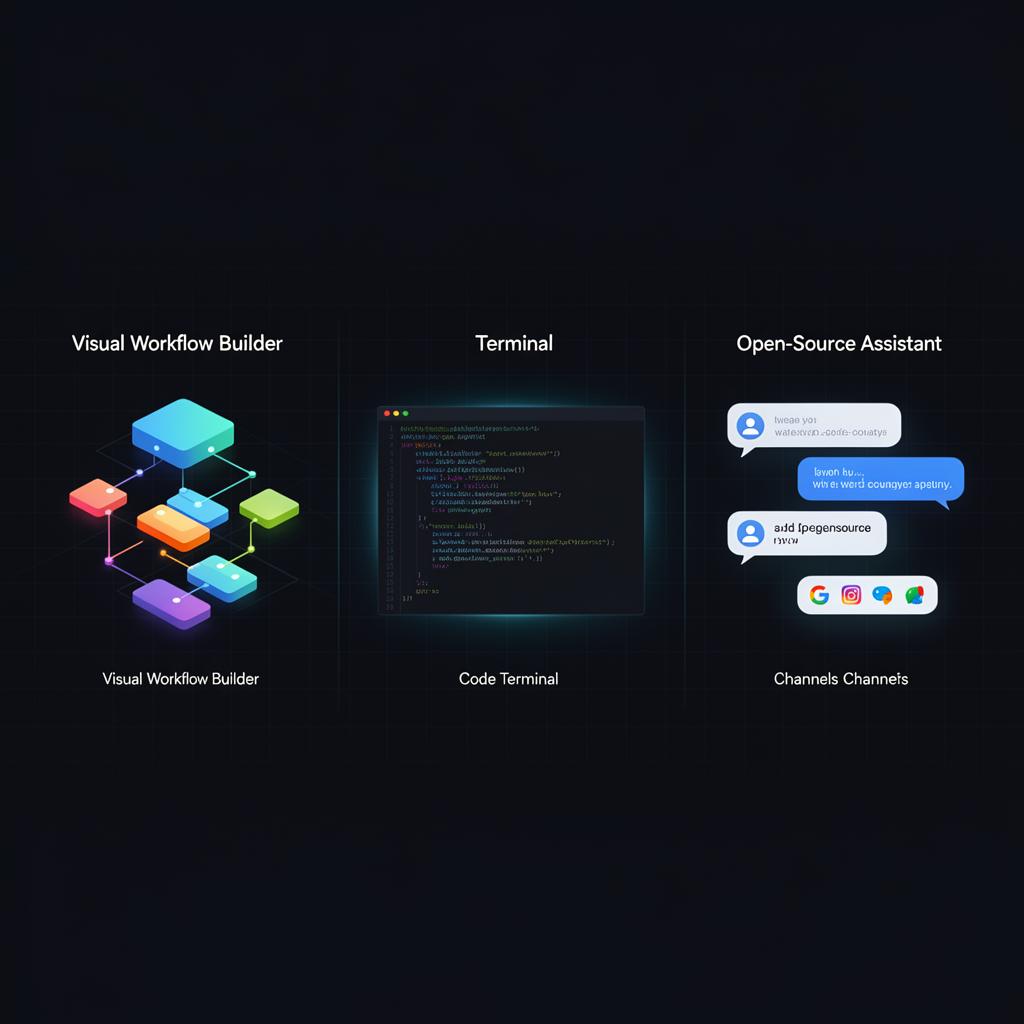
Make vs. Claude Code vs. OpenClaw – Picking the Right Orchestration Layer (2026)
Make.com, Claude Code, or OpenClaw? Three tools, three layers of the stack. Here's when to pick which orchestration tool…
Weiterlesen Deep Dive
Open-Source LLMs Compared 2026 – 25+ Models You Should Know
From Llama to Qwen to Gemma 4: all major open-source LLMs at a glance – with GitHub stars, parameters, licenses, and cle…
WeiterlesenDeep DiveOpen-Source LLMs Compared 2026 – 25+ Models You Should Know
From Llama to Qwen to Gemma 4: Every major open-source LLM at a glance – with GitHub stars, parameters, licenses, and cl…
Weiterlesen Deep Dive
Time Tracking in monday.com: The Ultimate Guide 2026
Every option for time tracking in monday.com – from the native column to Marketplace apps and monday Vibe. With pricing …
Weiterlesen Deep Dive
The Best OpenClaw Alternatives 2026 – from NanoClaw to NullClaw
OpenClaw has 160,000+ GitHub stars – but not everyone needs 430,000 lines of code. We compare the best alternatives in 2…
Weiterlesen