
The History of AI, Part 2: The Language Revolution (2018–2020)

TL;DR: „BERT and GPT showed two paths – but both proved: machines can understand and generate language."
— Till FreitagThe Transformer Architecture Unleashed
After the Transformer architecture was introduced in 2017, a race began. Two approaches emerged – and both fundamentally changed the AI world.
2018: BERT – Google Understands Context
In October 2018, Google released BERT (Bidirectional Encoder Representations from Transformers). The trick: BERT reads text in both directions simultaneously and thereby understands context better than anything before it.
An Example
The sentence: "I went to the bank to deposit my check."
- Before: Models struggled with whether "bank" meant a financial institution or a river bank
- BERT: Understands through context ("deposit," "check") that it's about a financial institution
Google integrated BERT directly into Search – the biggest algorithm leap in years. Suddenly Google understood what you mean, not just what you type.
2019: GPT-2 – "Too Dangerous to Release"
OpenAI released GPT-2 in February 2019 – but only partially. They initially held back the full model, reasoning: too dangerous for the public. The fear: mass-generated fake content.
GPT-2 could write astonishingly coherent texts. Entire news articles, stories, even simple programming tasks. 1.5 billion parameters – unimaginably large at the time.
The Debate Begins
The GPT-2 controversy marked the beginning of a discussion that continues to this day:
- Safety vs. Openness – Who decides what's "too dangerous"?
- Dual Use – Every AI capability can be useful or harmful
- Developer Responsibility – OpenAI became the center of this debate
2020: GPT-3 – The Paradigm Shift
In June 2020, GPT-3 appeared with 175 billion parameters – over 100x larger than GPT-2. And suddenly it became clear: scaling alone produces emergent capabilities.
GPT-3 could do things that nobody had explicitly trained it to do:
- Write programming code
- Translate between languages
- Solve mathematical problems
- Compose creative texts in various styles
- Learn from just a few examples (few-shot learning)
The Scaling Hypothesis
| Model | Parameters | Year | Capabilities |
|---|---|---|---|
| GPT-1 | 117M | 2018 | Simple text completion |
| GPT-2 | 1.5B | 2019 | Coherent paragraphs |
| GPT-3 | 175B | 2020 | Code, translation, reasoning |
The message was clear: More parameters = more capabilities. The so-called scaling hypothesis became the driving force of the entire industry.
GitHub Copilot – AI Becomes a Tool
At the end of 2020, development of GitHub Copilot began, based on GPT-3 (later Codex). For the first time, a large language model was directly integrated into a product that millions of people use daily.
Copilot showed: AI is no longer a future concept. It sits in your editor and writes code with you.
What We Learn from This Era
The years 2018–2020 brought three fundamental insights:
- Language is the key – Whoever masters language can master almost anything
- Scaling works – Larger models can do qualitatively new things
- AI becomes product – From research to everyday work
But the truly big things were still to come.
Continue with Part 3: The ChatGPT Moment – AI Reaches the World (2022–2023)
Related Articles
The History of AI, Part 5: Outlook 2026 – What Comes Next?
AGI, autonomous agents, AI-native companies: A pragmatic outlook on the AI year 2026.…
Read moreThe History of AI, Part 4: AI Becomes Infrastructure (2024–2025)
From chatbots to agents, from text to multimodal: How AI became the infrastructure of the working world in 2024 and 2025…
Read moreThe History of AI, Part 3: The ChatGPT Moment (2022–2023)
100 million users in two months: How ChatGPT, DALL-E, and GPT-4 turned the world upside down.…
Read moreThe History of AI, Part 1: When Machines Learned to See and Play (2012–2017)
From AlexNet to AlphaGo to the Transformer paper: How the foundations were laid that are changing everything today.…
Read more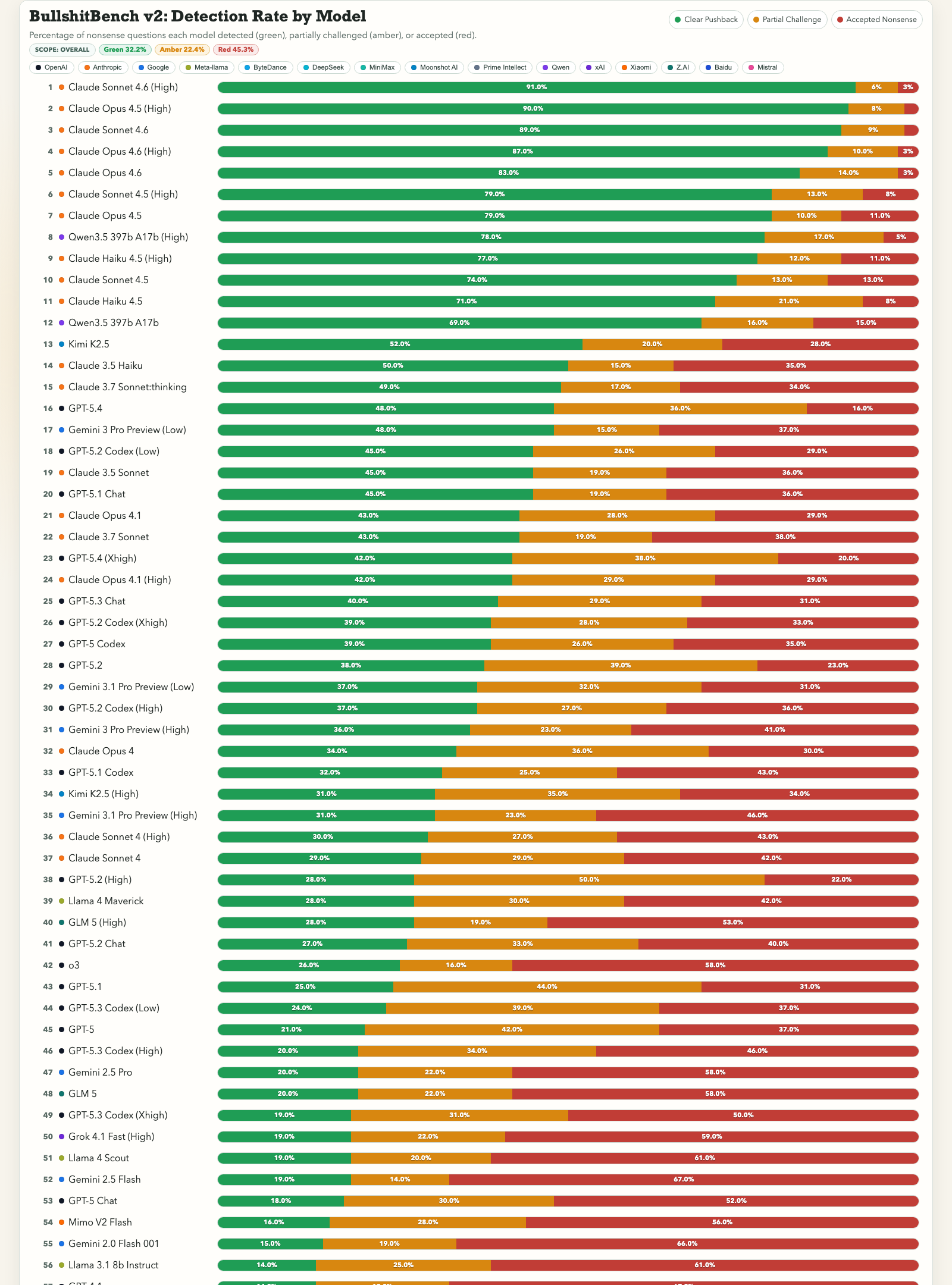
BullshitBench – Which AI Detects Nonsense?
BullshitBench tests whether AI models detect plausible-sounding nonsense – or just go along with it. The results are sur…
Read more
Hermes: TillClawn 🤡 Got a Brother – and It's Not a Parcel Service
Next to TillClawn 🤡, there's a second building block in our stack as of today: Hermes. Not a parcel service, not anothe…
Read more Deep Dive
Claude Sonnet 5: Agentic AI Goes Mainstream
Anthropic ships Claude Sonnet 5 – a Sonnet model that gets close to Opus 4.8 performance at a fraction of the price. Aug…
Read more
Europe's Compute Crunch: Why There's Barely Any Capacity Left in 2026
B200 clusters with months of lead time, sold-out EU regions, hyperscalers openly talking 'capacity constraints': Europe …
Read more
Sakana Fugu: Orchestrator, Not Monolith
Sakana AI ships Fugu – not another foundation model, but an orchestrator that routes prompts across specialised LLMs. Th…
Read more