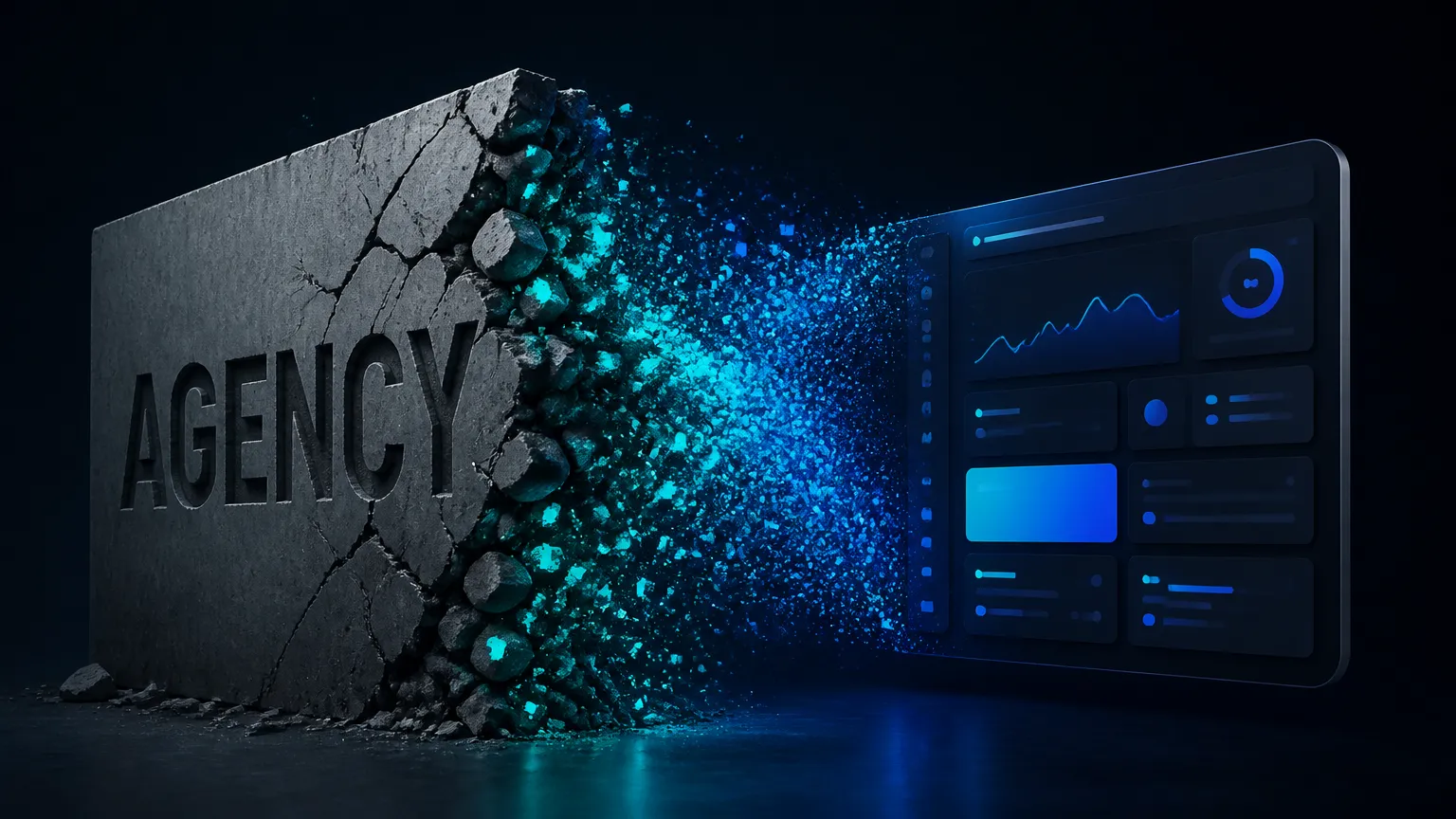


TL;DR: „Traditional web agencies sell websites. We solve business problems – and a website is sometimes part of the solution. That's the difference."
— Till Freitag"You're Not Really a Web Agency, Are You?"
We get this question a lot. And our answer: Correct. And that's exactly our advantage.
When someone says "We need a website," we hear: "We have a problem we think a website will solve." Sometimes that's true. Often, though, it takes something different – or at least something in addition.
A traditional web agency would now write a brief, build wireframes, go through three design rounds, set up a CMS, and hand you a WordPress site after 8 weeks. Plus a maintenance contract, of course.
We do things differently.
What a Traditional Web Agency Sells – And Why It's No Longer Enough
The traditional web agency business model rests on three pillars:
- Design services: Wireframes → Mockups → Pixel-perfect implementation
- CMS setup: Install and configure WordPress, Webflow, or similar
- Maintenance contract: Updates, backups, "Can you quickly change this text?"
That was a solid model in 2015. In 2026, it has three fundamental problems:
Problem 1: Speed
A web agency needs 6–12 weeks for a website. In that time, your market may have already shifted. With AI-native development, an MVP is ready in days, not months. We've had clients whose complete web app was live after two weeks – including backend, auth, and CRM integration.
Problem 2: The Website Is Never the Real Problem
Behind "We need a new website" there's almost always a business problem: leads aren't converting, internal processes are chaotic, data lives in 15 different tools. A pretty website solves none of these problems. A web agency delivers a website. We deliver the solution.
Problem 3: Lock-in and Ongoing Costs
WordPress needs plugins, hosting, updates. Webflow locks you into a proprietary platform. Both models create dependency – and the web agency profits from it. With us, you own your code. Completely. Period.
What We Do Instead
We're an AI-First Consultancy. Here's what that means:
Consulting First, Code Second
Before a single line of code is written, we understand your business. What are your goals? Where are the bottlenecks? What systems do you already use? Only when it's clear what needs to be built do we start.
AI-Native Instead of CMS Legacy
We don't build with WordPress. We don't build with Webflow. We use modern AI-powered development (Lovable, Vibe Coding) and deliver real, clean code – React, TypeScript, Tailwind CSS. No plugin hell, no bloated CMS.
The result: websites and web apps that load faster, are easier to maintain, and belong to you.
End-to-End, Not Just Frontend
A web agency stops at the website. We often start there:
- CRM integration: Your contact form feeds directly into monday CRM
- Automation: Inquiries are automatically qualified and routed
- Dashboards: You see in real time what your website delivers
- Processes: The website is part of a larger system, not an isolated artifact
Cost Efficiency Through AI
Where a web agency needs a 4-person team for 8 weeks, we work with AI-powered tools that multiply output. This doesn't mean we're cheaper because we do worse work – but because AI handles repetitive tasks, letting us focus on what machines (still) can't do: strategy, architecture, and your specific business understanding.
The Real Difference: Project vs. Partnership
A web agency has a clear interest in you needing a website relaunch every 2–3 years. That's their business model.
Our interest is different: We build systems that grow. A website that evolves with your business. CRM processes that scale with your team. Automations that adapt to new requirements.
The Cofounder Mindset
What our clients value most: we don't act like external vendors. We work like cofounders – with the same urgency, the same ownership, the same drive to solve the actual problem. We don't deliver a project and disappear. We stay until it works – and then we help it scale.
This isn't a marketing claim. It's how we're wired. Our team comes from management roles on the client side. We've been you. We know what it feels like when an agency delivers a beautiful website that doesn't solve the underlying business problem.
| Traditional Web Agency | Till Freitag | |
|---|---|---|
| Focus | Website as product | Digital solution for your problem |
| Timeline | 6–12 weeks | MVP in days, iteration in weeks |
| Tech stack | WordPress/Webflow/Typo3 | React, TypeScript, AI-native |
| Ownership | You rent (CMS dependency) | You own the code |
| Scope | Frontend + CMS | Consulting + Build + Automation |
| Maintenance | Ongoing contract | Self-maintainable |
| Running costs | Hosting + CMS + plugins | Minimal (edge deployment) |
| Mindset | Vendor / contractor | Cofounder on demand |
What a Typical Project Looks Like
Instead of the classic agency waterfall – brief → wireframe → design → development → launch → maintenance contract – we work in short, iterative cycles:
Week 1: Discovery & Strategy We understand your business, your goals, and your existing system landscape. The output isn't a 40-page concept document, but a clear plan with concrete deliverables.
Week 2–3: Build & Iterate The first functional prototype is often ready after 2–3 days. Not as a clickable mockup, but as a real, deployable application. You give feedback directly in the product – not on static screenshots.
Week 4+: Launch & Integration Go-live isn't a month-long event, it's a Tuesday. In parallel, we integrate CRM, automation, and everything that makes the system truly useful.
Our Stack: What "AI-Native" Actually Means
When we say "AI-native development," we don't mean ChatGPT-generated text on a WordPress page. We mean a fundamentally different development process:
- Claude (Anthropic) as reasoning engine: Architecture decisions, code reviews, and complex problem-solving – with the model that leads in agentic work
- Lovable for rapid prototyping: From idea to deployed web app in hours, not weeks
- Vibe Coding as methodology: Human and AI work collaboratively – AI writes code, humans steer strategy and architecture
- React + TypeScript + Tailwind: Production-grade, type-safe code – no template compromises
- Vercel + Supabase: Edge deployment and backend infrastructure without server management
This isn't marketing speak. This is the stack this website was built with. And the stack we ship client projects with every week.
What Our Clients Say
"We used to wait 12 weeks for a relaunch. With Till Freitag, we had a better solution in 10 days than anything the old agency delivered in two years." — Head of Digital, Berlin Mittelstand
"The best part: we can make changes ourselves without opening a ticket with an agency every time." — CEO, SaaS Startup
Who We're Not the Right Fit For
Transparency is one of our values, so we'll say it straight:
- You only need a static business card on the web? → A builder like Squarespace is enough
- You have a content team of 20 editors publishing daily? → A headless CMS might make more sense
- You need an online shop with 10,000 products? → Shopify or similar e-commerce platforms are more specialized
- You want a "vendor" who executes exactly what you specify? → We challenge before we build. That's our job.
For everything else – from company websites to customer portals to internal web apps – we're the logical evolution of the traditional web agency.
The Future Doesn't Belong to Agencies – It Belongs to Partners Who Think Ahead
The web agency landscape will change radically in the next 2–3 years. AI will drive the production cost of standard websites toward zero. What matters then isn't who builds a website – but who understands what needs to be built and why.
Agencies that define themselves through pixel work and CMS expertise will struggle. Those that see technology as a tool to solve business problems will thrive.
We've chosen which side we're on.
Conclusion: The Web Agency Is Dead. Long Live the Solution.
The question is no longer: "Which web agency should build our website?" But rather: "Who understands our problem and solves it – with the right mix of consulting, technology, and implementation?"
We're not a web agency. We're craftsmen, declutterers, and architects for all things digital. And yes – sometimes a website is part of the solution. But it's never the goal. The goal is making your business run better.
Related Articles

What Is Vibe Coding? Building Software with AI – Simply Explained
Vibe Coding is revolutionizing software development: describe what you want – AI writes the code. Everything about the t…
Read more
Website Builders vs. AI-Native Stack: Which Path Wins in 2026?
Wix, Squarespace, Jimdo & co. vs. an AI-native stack with Lovable, Cloud and edge hosting – when does each really pay of…
Read more
Cloudflare vs. Vercel – Which One Should You Use When?
Vercel or Cloudflare? Both host your modern web app at the edge – but they pursue fundamentally different strategies. We…
Read more
Vibe Coding & SEO: Why AI-Generated Apps Stay Invisible – And How We Fix It
Lovable, Bolt, v0 – Vibe Coding tools produce SPAs that Google can't see. Our playbook makes them SEO-ready: SSG, Schema…
Read more
Google Search Console for Vibe Coding Projects: Setup, Debugging & Indexing
Your Lovable app is live on Vercel – but Google isn't indexing anything? How to set up Search Console, debug crawling is…
Read more
OG-Image Best Practices for SPAs: Making Your Vibe Coding Projects Shareable
When you share a link from your Lovable app, LinkedIn shows an empty box. Why SPAs don't deliver social previews – and h…
Read more
Lovable Now Does More Than Build Apps – Documents, Data Analysis, Videos & More
Lovable is no longer just an app builder. The platform now analyzes data, creates pitch decks, generates videos and proc…
Read more
Why Nobody Will Use WordPress and Webflow in the Future
WordPress dominated for 20 years, Webflow was the designer's darling – but AI-native tools like Lovable are making both …
Read more
No-Code vs. Custom Development – When Is Each the Right Choice? (2026)
No-code, vibe coding, or custom development? We break down when each approach makes sense – with real examples and a dec…
Read more