
What Is a Knowledge Graph – and Why Is Everyone Talking About It?

TL;DR: „A knowledge graph stores knowledge not as documents but as a web of entities and relationships. For LLMs, it's the missing piece between 'sounds plausible' and 'is verifiably correct' – which is why it's becoming standard infrastructure for AI agents."
— Till FreitagWhat this is about
Since GraphRAG, Palantir ontologies, and the latest agent platforms, the term knowledge graph shows up in nearly every AI pitch. At the same time, almost no one can clearly explain how it differs from a database, a vector store, or a data warehouse – or why you'd want one in the first place.
This article cuts through the noise: what a knowledge graph technically is, why LLMs love it, and when you should build one yourself.
The short definition
A knowledge graph stores knowledge as a network:
- Entities (nodes): people, companies, products, contracts, tickets
- Relationships (edges): "works at", "is part of", "references", "causes"
- Attributes: properties on nodes and edges (date, status, source)
Instead of "data in tables" or "text in documents," you get a searchable, traversable model of reality – with explicit meaning instead of implicit columns.
Rule of thumb: If you're thinking "JOIN across five tables plus three PDFs," that's a single traversal hop in a graph.
Why now? Three drivers
1. LLMs need reliable context
Vector RAG is great for "find me similar text passages." But the moment a question becomes multi-step ("Which customers of account manager X opened tickets about feature Y in the last 12 months?"), naive retrieval falls apart. A graph delivers exactly those multi-hop answers deterministically.
2. Agents need a world model
An AI agent that takes actions needs to understand what relates to what. Without a graph it bounces from tool to tool and loses context. With a graph it has a persistent map of the domain – including permissions, sources, and freshness.
3. Compliance & traceability
Every edge can carry source, timestamp, and confidence. That's what makes auditable AI possible in the first place – a hard requirement in enterprise contexts (EU AI Act, SOC 2, ISO 42001).
Knowledge graph vs. the usual suspects
| Vector Store | Data Warehouse | Knowledge Graph | |
|---|---|---|---|
| Data model | embeddings | tables / star schemas | nodes + edges |
| Strength | semantic similarity | aggregation, BI | relationships, multi-hop |
| Weakness | multi-hop, logic | unstructured data | initial setup |
| AI fit | RAG | reporting | agents, reasoning |
Spoiler: in practice you combine all three. The graph becomes the connecting layer.
Typical architecture
Sources (CRM, tickets, docs, code, email)
        ↓
   Entity extraction (LLM)
        ↓
   Knowledge graph (Neo4j, Memgraph, Kuzu)
        ↓
   Hybrid retrieval (graph + vector)
        ↓
   LLM / agent
The interesting layer is entity extraction: modern LLMs are good enough to pull entities and relationships out of emails, Slack threads, and PDFs automatically – two years ago that was a dedicated ML project.
When building your own graph pays off
Worth it:
- You have data in many silos that keeps getting joined via IDs
- Your users ask multi-hop questions ("show me all deals involving person A that also have a ticket in area B")
- You're building AI agents that operate across multiple systems
- You have compliance requirements around provenance and traceability
Not (yet) worth it:
- Your use cases are pure text search → stick with vector RAG
- You have < 5 structured sources that live cleanly in one database → SQL is fine
- No one on the team is excited about data modeling → the graph will turn into a landfill
Our take
Knowledge graphs aren't new – Google has used one since 2012, Palantir even longer. What's new is that LLMs have made building them dramatically cheaper and that agents simply don't scale without them.
We see the knowledge graph as the backbone of serious enterprise AI: unglamorous, but without it every agent stays a demo. Anyone shipping an AI product in 2026 that does more than "chat with your PDFs" won't get around a graph.
Tools we currently recommend: Neo4j (the classic, big ecosystem), Kuzu (embedded, fast), Memgraph (real-time), and for the extraction pipeline LLM-native frameworks like LlamaIndex or custom pipelines using structured outputs.
Conclusion
A knowledge graph isn't a hype term. It's the answer to a very concrete question: how do you get an LLM to answer not just plausibly but verifiably correctly – across system boundaries?
If you don't have that problem, you don't need a graph. If you do, you won't get far without one.
Go deeper:
- GraphRAG vs. vector RAG – when does semantic similarity stop being enough?
- Entity extraction with LLMs – how documents turn into a graph
- Neo4j vs. Kuzu vs. Memgraph – which graph DB for which setup
- Obsidian as a personal knowledge graph – the same principle on a small scale
Need this in your company? We build knowledge graphs as a service – from discovery to prototype to production.
Mini knowledge graph – click to explore
Pick an entity to see its relationships and attributes. This is exactly how an agent "thinks" when it answers multi-hop questions.
Tip: click a node.
- Branche
- Manufacturing
- MRR
- €12.400
- ←betreutAnna Becker
- →nutztmonday.com CRM
- →unterzeichnetMSA #4471
- →meldetTicket #8821
„What does Acme use, what did they sign, what's broken?"
Verwandte Artikel

GraphRAG vs. Vector RAG – when similarity stops being enough
Vector RAG is the default — but the moment questions go multi-hop, it falls apart. GraphRAG combines knowledge graphs wi…
Weiterlesen
Entity extraction with LLMs – from document to knowledge graph
How does a knowledge graph actually get its entities? With LLMs in four steps: chunking, extraction, deduplication, reso…
Weiterlesen
„Claude Code Killed OpenClaw" – Why That Comparison Makes No Sense
People on LinkedIn keep saying „Claude Code killed OpenClaw." That's like comparing apples with interstellar spaceships.…
Weiterlesen
Autonomous AI Agents in Business: Opportunities, Risks & Governance
Gartner says 40% of agentic AI projects will be cancelled by 2027. Not because of the tech – because of missing governan…
Weiterlesen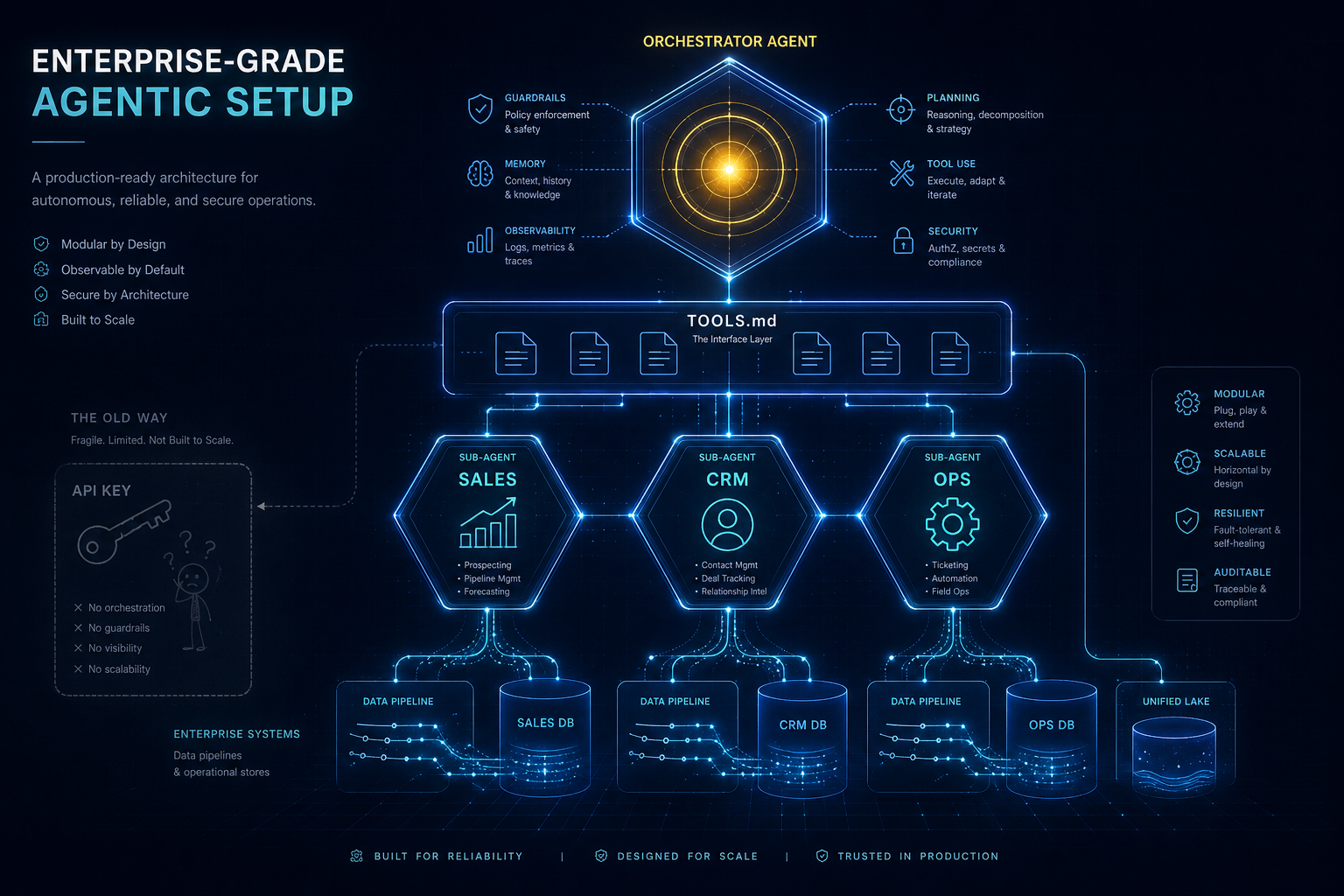
Enterprise-Grade Agentic Setup: Why an API Key Is Not an AI Strategy
An API key on your website is child's play. An agentic setup with specialised sub-agents, TOOLS.md, clean system prompts…
Weiterlesen
Claude Managed Agents vs. LangGraph vs. CrewAI: Agent Runtimes for Production Compared
Three paths to production agents: Anthropic's hosted runtime, LangGraph's graph orchestration, or CrewAI's role-based te…
Weiterlesen
superglue.ai – The AI-Native Integration Platform That Finally Connects Enterprise Systems
superglue.ai replaces brittle SQL scripts and cron jobs with AI-powered enterprise integrations. Open source, Y Combinat…
Weiterlesen
Claude Managed Agents: Anthropic's Play to Own the Agent Runtime
Anthropic launches Managed Agents in public beta – a hosted runtime that decouples the 'brain' from the 'hands.' No more…
Weiterlesen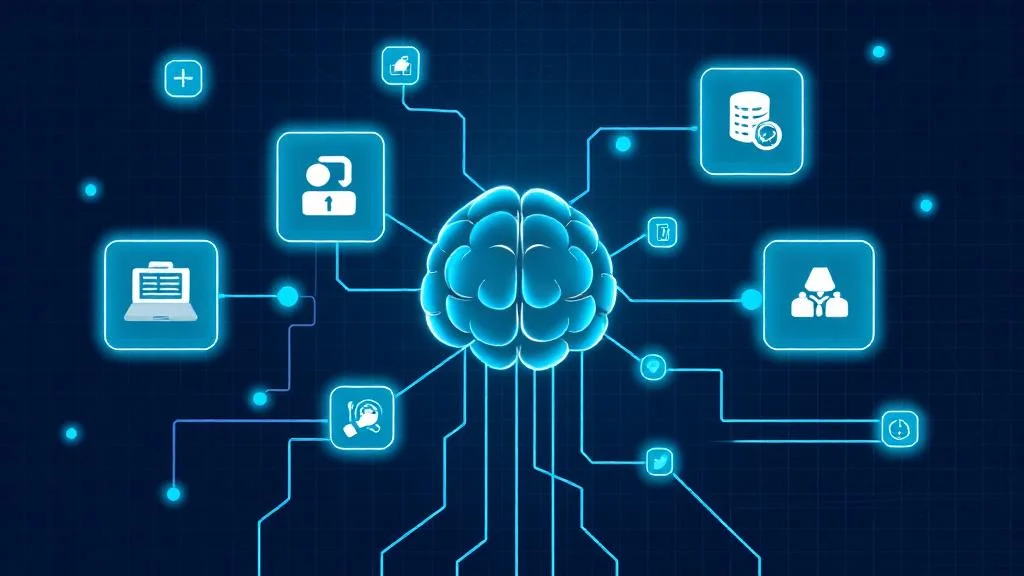
Agent Skills Are Becoming an Industry Standard: What Teams Need to Know
Agent Skills are reusable capabilities for AI agents – and they're becoming the new standard. What sets them apart from …
Weiterlesen