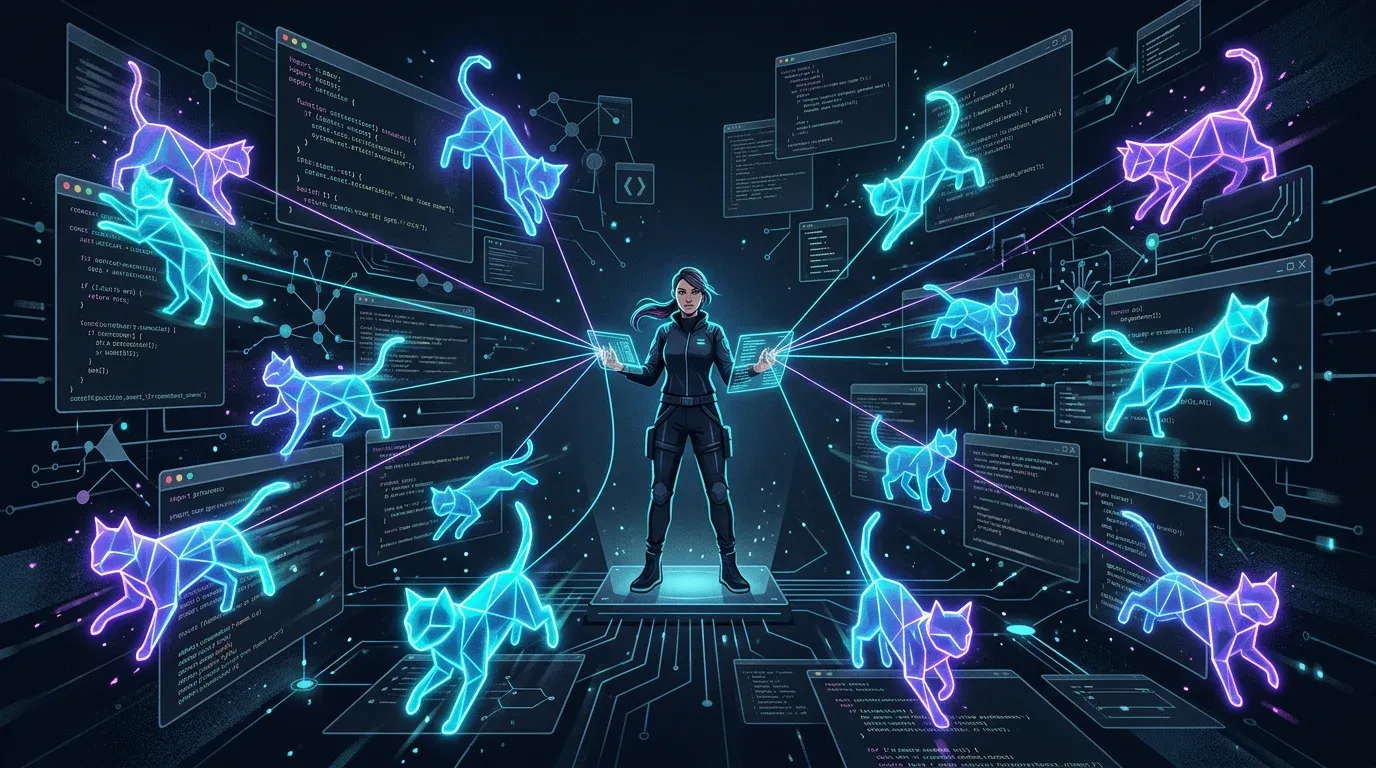
Herding Cats: The Agentic Coding Tools Landscape (March 2026)


TL;DR: „A new tooling layer is wrapping headless CLI agents like Claude Code and Codex. Five categories – from terminal multiplexers to autonomous agent teams – each removing the human from one more loop."
— Till FreitagKeeping Up With Agentic Coding Tools Is Like Herding Cats
You wrangle three into a category, turn around, and five more just appeared on Product Hunt.
Not Cursor. Not Windsurf. Not VS Code Copilot. Those are IDEs with agents bolted on – they've been around. What's new is a parallel tooling layer wrapping headless CLI agents like Claude Code and Codex. Terminal multiplexers, session managers, full development environments, orchestrators. New tools every week. Hard to keep track.
I surveyed the landscape. Five categories, each removing the human from one more loop.
The Five Layers of Agentic Dev Tooling
1. Agent Terminals → Attention Management
Watch 5 agents at once. Notification rings when one needs input.
You're not writing code here – you're managing attention. The terminal becomes a control surface for parallel agent sessions. Think tmux, but purpose-built for AI agents that occasionally need a human nudge.
2. Session Managers → Workflow Plumbing
Isolate each agent in its own worktree and branch, merge back when done. Human decides what to build. Tool handles git.
This is where most power users land first. You dispatch tasks, each gets a sandboxed environment, and the tool handles the git gymnastics – branching, diffing, merging. The cognitive load drops dramatically.
3. ADEs (Agentic Dev Environments) → Workflow Ownership
Human dispatches from a board. Tool owns the workflow from ticket to merge, including task boards, code review, and PR lifecycle.
The jump from session managers to ADEs is significant. You stop thinking about branches and start thinking about tickets. The tool doesn't just isolate work – it manages the entire lifecycle. Some even let you approve diffs from your phone.
4. ADPs (Agentic Dev Platforms) → Agent Coordination
Auto-dispatch from Jira/Linear, best-of-N competitive runs, agents collaborating with each other. Human supervises.
Here's where it gets interesting. Multiple agents work on the same problem – sometimes competitively, sometimes collaboratively. The platform picks the best output. You're no longer directing individual agents; you're overseeing a process.
5. Autonomous Agent Teams → Goal-to-Output Autonomy
AI manages AI. Headless. Decomposes goals, assigns agents, fixes CI failures, addresses review comments. Human sets direction.
The end state – at least for now. You describe what you want at a high level, and a hierarchy of agents figures out the rest. Decomposition, assignment, execution, debugging, review. The human's role shrinks to strategic direction and final approval.
Where I Am Right Now
I'm currently somewhere between session managers and ADEs. Still figuring out how much control I'm willing to hand over.
The honest answer: more than I expected six months ago, less than the marketing pages promise. Session managers feel like a genuine productivity multiplier. ADEs feel promising but still need guardrails. Everything above that? Impressive demos, unclear production readiness.
The Tool Landscape (March 2026 Snapshot)
⚠️ This moves weekly. Star counts are approximate.
Agent Terminals
| Tool | Stars | What It Does |
|---|---|---|
| cmux | 10k ⭐ | GPU-accelerated, scriptable terminal multiplexer |
| Solo | — | Agent process dashboard |
Session Managers
| Tool | Stars | What It Does |
|---|---|---|
| Superset | 7.8k ⭐ | Diff viewer, IDE linking |
| Agent of Empires | 1.3k ⭐ | Docker sandboxing per agent |
| dmux | 1.2k ⭐ | One keypress spawn, auto-merge |
| ccmanager, agtx, Parallel Code, Amux, Kagan, Piebald | — | The long tail – growing weekly |
ADEs (Agentic Dev Environments)
| Tool | Stars | What It Does |
|---|---|---|
| Vibe Kanban | 23.7k ⭐ | Kanban board as agent control surface |
| Conductor | — | GitHub PR workflow, used at Linear/Stripe |
| Nimbalyst | — | Approve agent diffs from your phone |
ADPs (Agentic Dev Platforms)
| Tool | Stars | What It Does |
|---|---|---|
| Emdash | 2.8k ⭐ | Competing agents on same task |
| Maestro | 2.5k ⭐ | Agents in group chat |
| Dorothy, Capy | — | Emerging entrants |
Autonomous Agent Teams
| Tool | Stars | What It Does |
|---|---|---|
| Agent Orchestrator | 5.4k ⭐ | Decomposes features, fixes CI |
| Squad | 1.3k ⭐ | Learns your conventions |
| Overstory | 1.1k ⭐ | Hierarchical agent teams |
The Big Question
This space barely existed three months ago. The question is whether it survives the next three.
Here's what I think: The categories are real, even if the tools aren't permanent. The progression from "watch an agent" to "tell agents what to build" to "let agents figure it out" – that trajectory isn't going away. The specific tools will churn. The layers will consolidate. But the abstraction ladder is being built, rung by rung.
For teams evaluating this space, my advice:
- Start with session managers. The ROI is immediate and the risk is low.
- Watch the ADE space. Vibe Kanban's star count isn't an accident – kanban as control surface is an intuition that clicks.
- Be skeptical of autonomous teams. Not because they won't work, but because they're not ready for production codebases with real consequences.
- Don't optimize for any single tool. The underlying agents (Claude Code, Codex) matter more than the wrappers.
- Evaluate the agent runtime question separately. The tooling layer (this article) is independent from the runtime decision. Whether you use Claude Managed Agents, LangGraph, or CrewAI – that determines how your agents run in production, not how you steer them.
- Watch the platform conflict. Foundation model providers are moving into the application layer. Anthropic is reportedly building its own app builder – directly competing with tools like Lovable. The wrappers in this article face the same squeeze: when the underlying model provider ships native tooling, differentiation becomes existential.
The best wrapper is the one that makes the agent more useful without making you more dependent.
Building with agentic tools and need help navigating the landscape? Let's talk →
Related Articles
 Deep Dive
Vibe Coding Tools Compared: Cursor vs. Lovable vs. Kiro vs. Claude Code vs. Trae (2026)
Which vibe coding tool is right for you? We compare 15+ tools across 7 categories – from AI IDEs to agentic coding tools…
Read more
What Is Agentic Engineering? The Next Step Beyond Vibe Coding
Agentic Engineering goes beyond Vibe Coding: AI agents plan, decide, and implement autonomously. What this means for tea…
Read more
What Is Vibe Coding? Building Software with AI – Simply Explained
Vibe Coding is revolutionizing software development: describe what you want – AI writes the code. Everything about the t…
Read moreClaude Code Hidden Features – 15 Power Tips from Boris Cherny (Anthropic)
Boris Cherny from Anthropic shared 15 hidden Claude Code features that transform the tool from a chat interface into a D…
Read more
Claude Code Out of Pro: The End of the All-You-Can-Eat Era for Coding Agents
Anthropic is removing Claude Code from the Pro plan. Cursor already moved to token-based pricing. Codex is likely next. …
Read more
Claude Opus 4.7 Is Here: What Premium Teams Need to Know About the Tokenizer, xhigh, and Spend Controls
Anthropic just released Claude Opus 4.7. Same price as 4.6, but noticeably better at coding, agents, and visual output. …
Read more
Why We're Hiring Germany's First Vibe Coder
We're looking for Germany's First Vibe Coder. Not a marketing gag – the logical consequence of how we build software in …
Read more
Gemma 4 12B Coder: Local Code Generation Becomes the Default
Google ships the Gemma 4 12B Coder — the specialized coding variant of the Gemma 4 stack. 12B parameters in GGUF format,…
Read more
Ponytail: The Best Code Is the Code You Never Wrote
A dev built Ponytail because his AI agents wrote 500 lines for a 5-line problem. The result: 80-94% less code, 47-77% ch…
Read more