
Technology Isn't the Problem Anymore. Adoption Is.


TL;DR: „You don't have a technology problem. You have an adoption problem. And that's a people problem."
— Till FreitagThe uncomfortable truth about digital transformation
Here's a number that should make every CEO pause: 70% of digital transformation initiatives fail. Not because the technology was wrong. Not because the budget was too small. But because the people who were supposed to use it – didn't.
We've seen it firsthand. Hundreds of times. A company buys monday.com, HubSpot, Make, or any other best-in-class tool. The IT team sets it up. The rollout email goes out. And three months later? Half the team is back to spreadsheets and email chains.
The tool isn't the problem. The rollout is.
Why adoption is the new bottleneck
In 2020, the bottleneck was access to technology. In 2023, it was choosing the right tools. In 2026? The technology is mature, affordable, and abundant. The bottleneck has shifted entirely:
- AI tools are powerful but intimidating
- Automation platforms are flexible but require new thinking
- Work management systems are comprehensive but demand behavioral change
Every new tool you introduce asks your team to change how they work. And humans don't change because you send them a Confluence page. They change when they understand why, when they feel supported, and when the new way is easier than the old way.
The three layers of adoption failure
Layer 1: No clear "Why"
When leadership introduces a new tool without connecting it to a problem the team actually feels, adoption dies on arrival. "We're implementing monday.com for better visibility" means nothing to someone who's drowning in tasks. "You'll never lose track of a client request again" – that lands.
Layer 2: No safe space to learn
Most companies train once, then expect mastery. But learning a new tool while doing your actual job is hard. Without dedicated time, peer support, and permission to be slow at first, people default to what they know.
Layer 3: No feedback loop
If nobody asks "Is this working for you?" after week two, the answer is already no. Adoption requires continuous listening, adjusting, and iterating – just like product development.
What actual change management looks like
Change management isn't a PowerPoint deck or a one-day workshop. It's a structured approach to making sure technology sticks. Here's what we do differently:
1. Start with the pain, not the tool
Before we touch any software, we map the team's actual pain points. What's slow? What's frustrating? What falls through the cracks? The tool is the answer – but only if we understand the question first.
2. Design workflows with the team, not for them
Top-down implementations fail. We run collaborative workshops where the people who'll use the system daily help design it. This creates ownership, not resistance.
3. Roll out in waves, not tsunamis
We start with a pilot team – ideally 5-8 people who are curious, not skeptical. They become internal champions. Their success stories become the best marketing for the rest of the organization.
4. Build AI fluency, not just tool skills
In 2026, adopting a new platform also means adopting AI capabilities within it. We don't just teach "how to create a board" – we teach "how to let AI draft your status updates, generate reports, and flag risks before you see them."
5. Measure adoption, not just deployment
Deployment is binary – the tool is live or it's not. Adoption is a spectrum. We track:
- Active usage rates per team and feature
- Time-to-value – how quickly users see personal benefit
- Workaround frequency – are people still using shadow systems?
- Satisfaction scores – do people actually like working this way?
The AI amplifier effect
AI makes the adoption challenge both harder and easier:
Harder because AI features introduce a new layer of trust issues. "Can I rely on this AI summary?" "Will it make mistakes?" "Is it using my data?" These aren't technical questions – they're emotional ones.
Easier because AI can dramatically reduce the friction of learning. monday.com's AI assistant can explain features, suggest automations, and even build workflows from natural language descriptions. The barrier to entry has never been lower – if people are willing to try.
The cost of poor adoption
Let's do the math. A company with 50 employees buys monday.com Enterprise at roughly €25/user/month. That's €15,000/year. If only 60% of the team actually uses it meaningfully, you're burning €6,000 annually on unused licenses.
But the real cost is invisible:
- Duplicated work because half the team uses the tool and half doesn't
- Lost insights because data is fragmented across systems
- Frustration that erodes trust in future digital initiatives
- Opportunity cost of automation and AI features that never get activated
How we help
At Till Freitag, change management isn't an add-on. It's the core of what we do.
| Phase | What we do | Outcome |
|---|---|---|
| Discovery | Pain point mapping, stakeholder interviews | Clear picture of where technology can help |
| Design | Collaborative workflow workshops | Systems built by the people who use them |
| Pilot | Small-team rollout with daily support | Proven workflows and internal champions |
| Scale | Phased rollout with training & documentation | Organization-wide adoption |
| Optimize | Ongoing reviews, AI feature activation | Continuous improvement and ROI |
We don't just set up your monday.com, HubSpot, or Make instance. We make sure your team actually uses it. Every day. With confidence.
The mindset shift
The companies that win in 2026 aren't the ones with the most tools. They're the ones where every team member feels empowered to use the tools they have.
That requires:
- Leadership that models new behavior – if the CEO still asks for Excel reports, nobody will use dashboards
- A culture of experimentation – trying new features without fear of "doing it wrong"
- Continuous learning – not one training, but ongoing AI sprechstunden, peer sharing, and skill building
- Patience – real adoption takes 3-6 months, not 3 weeks
Your next step
If you're about to roll out a new tool – or if you already did and it's not sticking – let's talk. We'll help you figure out where adoption broke down and how to fix it.
Because the technology was never the problem. The question was always: will your people use it?
Related Articles

AI Transformation: Roadmap, Change Management & Implementation Phases for Companies
AI Transformation is more than handing out ChatGPT licenses. An honest roadmap with five phases, change management princ…
Read more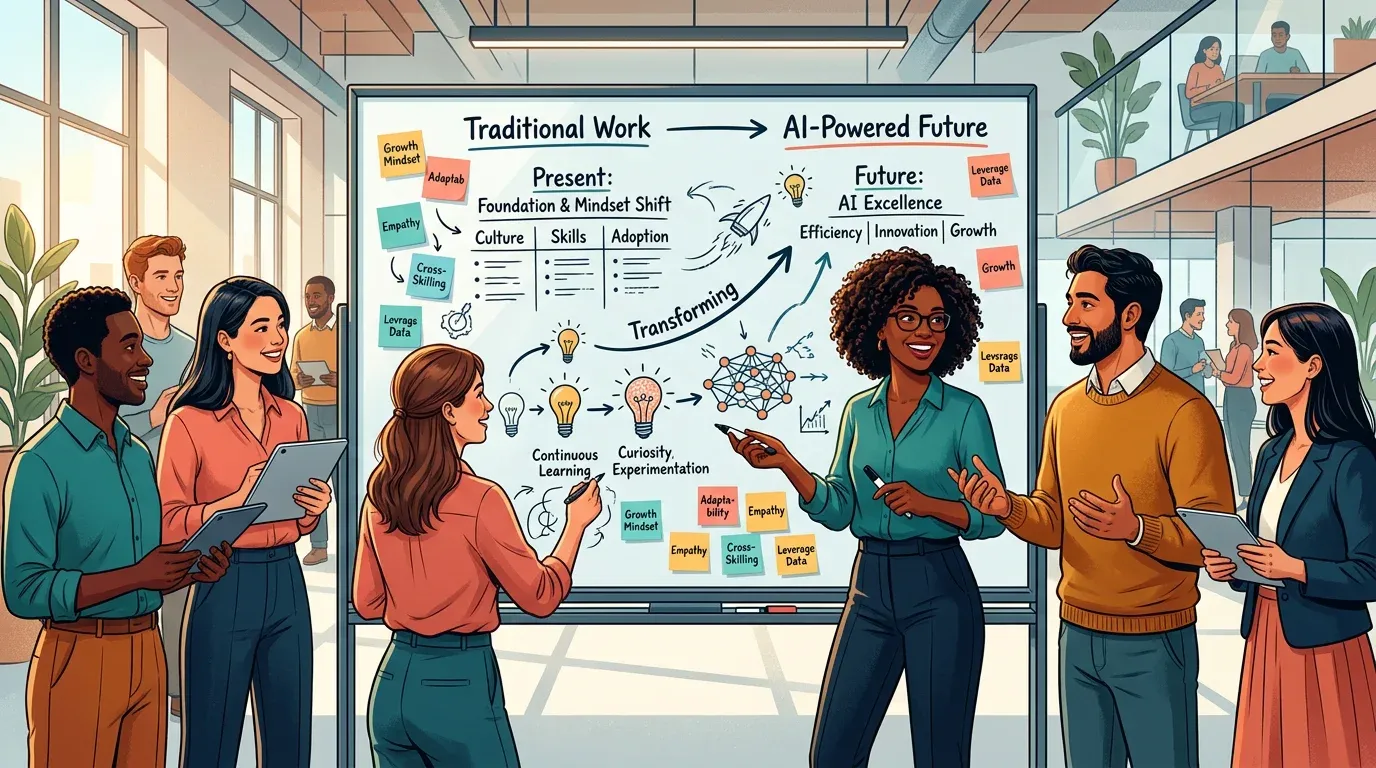
Culture & Mindset – How to Get Your Team Ready for the AI Era
Introducing AI tools is easy. Creating the culture for it is the real challenge. How to get your team ready for Working …
Read more
Collaboration in monday.com: How Teams Actually Work Together
Updates, WorkDocs, guest access, dashboards, and AI – how monday.com turns asynchronous teamwork into real collaboration…
Read more
Marketing is Dead. Creativity is Back.
The marketing playbook that ran the last decade is over. AI killed the template. What's left? The only thing machines ca…
Read more
Remote Teamwork with monday.com – How Distributed Teams Stay Productive (2026)
Remote work needs the right tools and processes. Here's how to set up monday.com for distributed teams – with AI assista…
Read moreDigital Transformation: The Complete Guide for Businesses 2026
Digital transformation step by step: 5 pillars, common pitfalls, and a proven roadmap for implementation.…
Read more
OpenClaw Audit 2026: What's Left of All Those Promises?
OpenClaw was the hot new thing in 2024, a LinkedIn religion in 2025, and supposedly dead in 2026. A sober audit: what he…
Read more
monday Dev: Why It's the Most Underrated Dev Tool of 2026
Agile out of the box, MCP-ready, and the cheapest enterprise pricing on the market: why monday Dev is becoming a serious…
Read more
Token Maxxing: When AI Stops Being a Search Engine and Becomes Infrastructure
Most teams use AI like Google. The winners treat it like electricity. Token maxxing means pushing every doc, every call,…
Read more