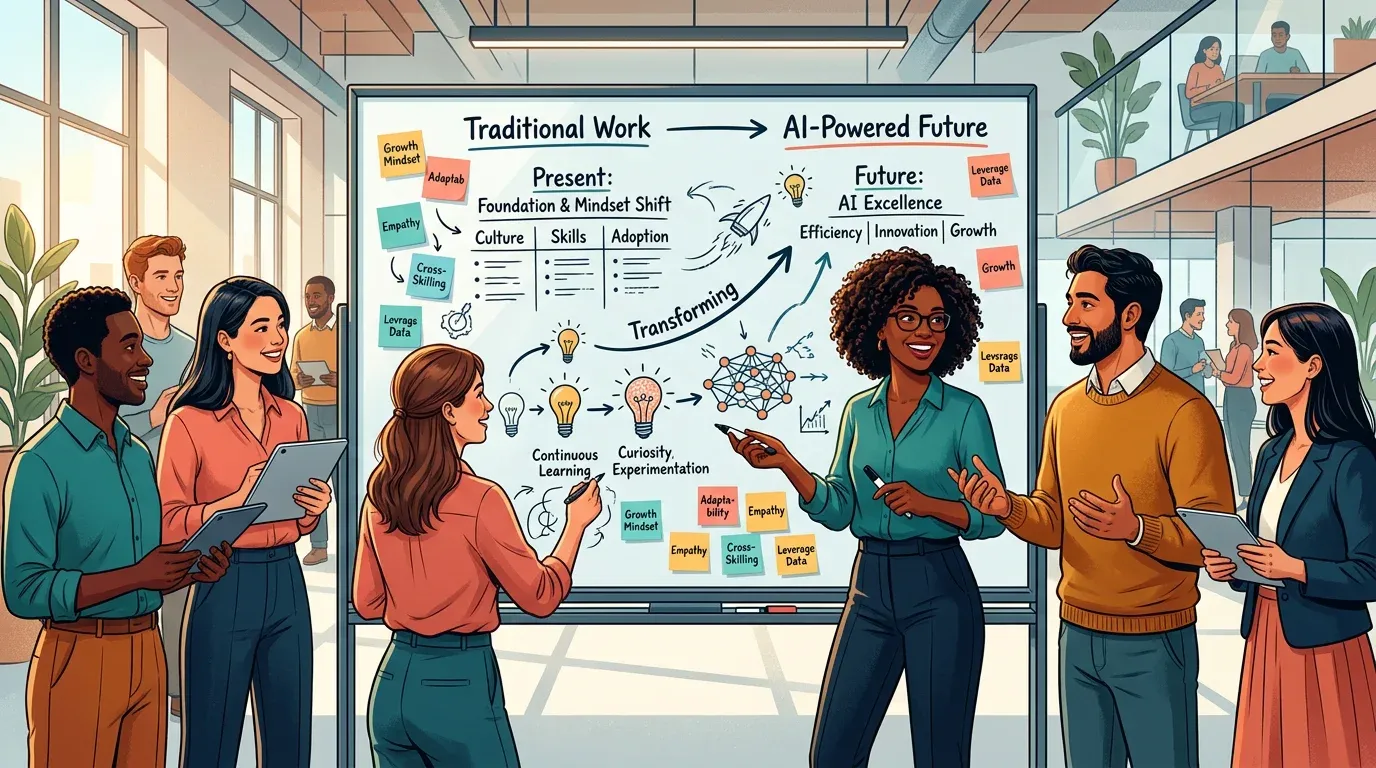
Culture & Mindset – How to Get Your Team Ready for the AI Era

TL;DR: „The best tool is useless if the culture doesn't follow – change management is the real challenge."
— Till FreitagThe Tool Problem Is Actually a Culture Problem
We see it in every other consulting project: The tool is there, the licenses are paid, the boards are set up – but the team keeps working like before. In Excel. Via email. With Post-its.
The problem is rarely the tool. The problem is the mindset.
And with AI, this compounds. Because AI isn't just a new tool – it changes how we think about work.
The Three Mindset Shifts for Working 2.0
1. From "I'll Do It Myself" to "I Orchestrate"
The most valuable skill in the AI era is no longer being able to do everything yourself – but knowing when to use AI and when not to. This requires:
- Letting go – not every draft needs to be written from scratch
- Quality checking – critically evaluating AI output instead of blindly accepting it
- Prompting as a skill – asking the right questions is more important than having the right answers
2. From "Perfection" to "Iteration"
AI enables faster cycles. A first draft in 5 minutes instead of 2 hours. This changes the rhythm:
- 80% solution → Feedback → Refinement instead of a 100% solution in isolation
- Prototyping mentality – test fast, learn fast, adapt fast
- Mistakes as a feature – those who don't experiment don't learn
3. From "My Knowledge" to "Our Knowledge"
AI democratizes expertise. Junior employees with AI support can tackle tasks that previously required senior-level skills. This shifts hierarchies:
- Sharing knowledge becomes more important than hoarding knowledge
- "How did you do that?" becomes the standard question
- Willingness to learn becomes the most important competency
Concrete Measures for Your Team
Introduce AI Office Hours
Once a week, 30 minutes: Someone shows an AI use case from daily work. No training, no lecture – peer learning. For us, the most effective way to drive AI adoption.
"AI Budget" for Experiments
Give your team time and permission to experiment. 2 hours per week to test new tools. No justification required, no immediate ROI expected.
Make Successes Visible
When someone saves 3 hours on a report with AI – share it. In Slack, in standup, in the newsletter. Success stories are the best engine for change.
Define AI Guidelines
Not everything AI can do, AI should do. Define clear guidelines:
- Where may AI be used?
- Where must a human review?
- What data may flow into AI tools?
- How do we label AI-assisted content?
The Skillsets of the Future
What your team needs in 2–3 years isn't Python or prompt engineering. It's:
- Critical thinking – questioning and contextualizing AI output
- Creative problem-solving – asking the questions AI doesn't ask
- Empathy & communication – the human side that AI can't do
- Willingness to learn – constantly adapting to new tools and workflows
- Data literacy – understanding how AI works with data (without being a data scientist)
The Elephant in the Room: Fear of Job Loss
Let's be honest: Many people are afraid of being replaced by AI. This fear is understandable, and ignoring it is a mistake.
Our approach:
- Transparency – openly communicate where AI is used and why
- Participation – involve the team in AI decisions
- Upskilling – actively invest in continuing education
- Guarantees – clear statements that AI serves to support, not to replace
Conclusion: Culture Eats Technology for Breakfast
You can have the best AI tools – without the right culture, they stay unused. Working 2.0 isn't a technology project. It's a culture project that uses technology.
The future doesn't belong to teams with the most tools. It belongs to teams with the most open mindset.
Part 4 and conclusion of the Working 2.0 series. Back to the campaign overview.
Related Articles

Why We Stopped Calling Ourselves Consultants – Behind the Scenes
We changed every job title from 'Consultant' to 'Builder'. Not a rebrand – an honest look at a decision that wasn't obvi…
Read more
Cofounder Mindset – How Builders Actually Work
Cofounder Mindset sounds like startup jargon. It's not. It's the attitude that makes the difference – every single day.…
Read more
Scale Impact, Not Headcount: Why We Don't Want to Grow Endlessly
Growth isn't a goal in itself. We scale impact, not headcount – and here's why that's the better strategy.…
Read more
AI First = People First: Why AI-Native Doesn't Mean Anti-Human
AI First sounds like a technology fetish. For us, it means the opposite: we use AI so people can do better work – not so…
Read more
Senior-Only: Why We Don't Put Juniors on Client Projects
The classic consulting model sells senior partners and delivers junior analysts. At Till Freitag, everyone on your proje…
Read more
Technology Isn't the Problem Anymore. Adoption Is.
Most digital transformations fail not because of bad tools – but because nobody uses them. Why change management matters…
Read more
AI Transformation: Roadmap, Change Management & Implementation Phases for Companies
AI Transformation is more than handing out ChatGPT licenses. An honest roadmap with five phases, change management princ…
Read more
We Believe in Europe and the Power of Balance
We believe in Europe. In cultural diversity. In the power of balance. And against the extremes – no matter which directi…
Read moreWe Care: Why Attitude Matters More Than Skills
We care. For our customers, partners, employees, society, nature and ourselves. Sounds soft. Is hard. And it decides who…
Read more