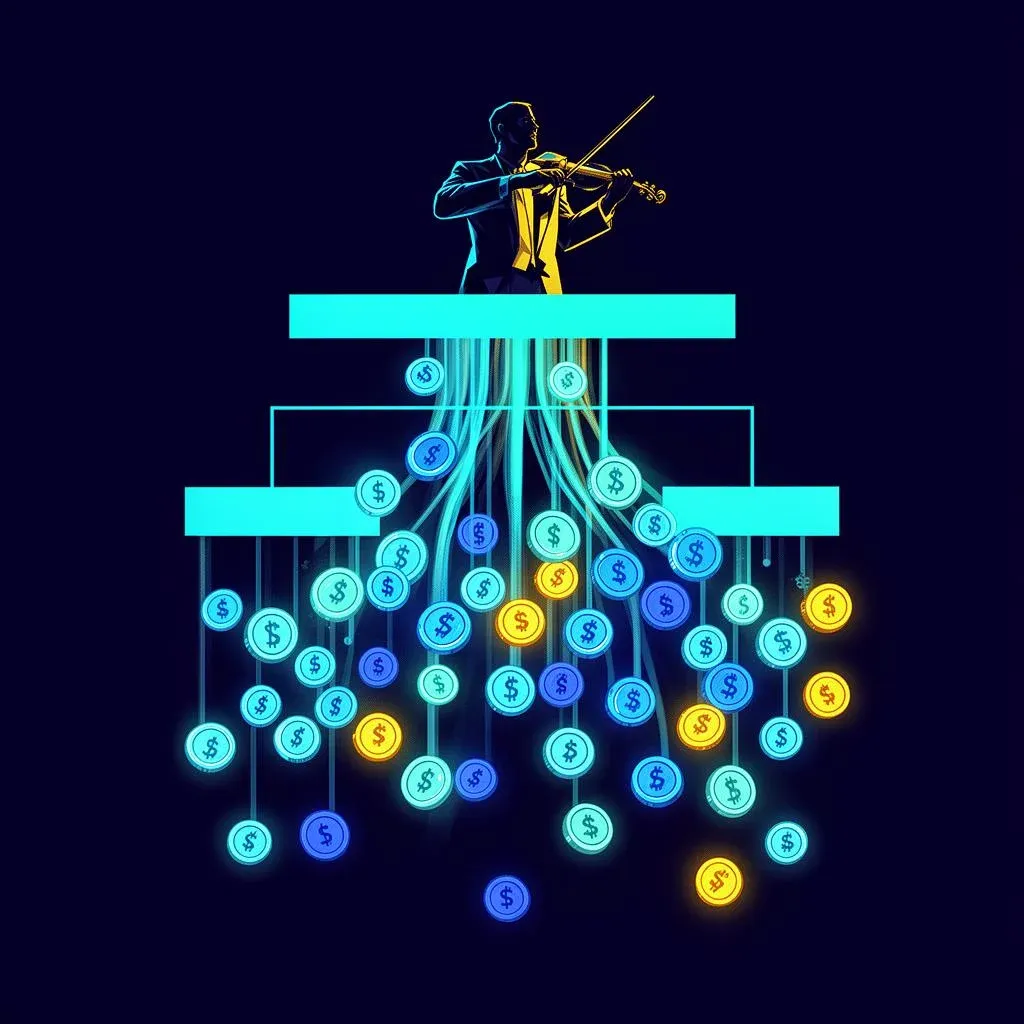
Token Maxxing: When AI Stops Being a Search Engine and Becomes Infrastructure

TL;DR: „Top-quartile AI spenders doubled revenue since 2023; bottom-quartile is flat. The difference: they push everything through the context window – contracts, calls, proposals – and shift humans from executing tasks to orchestrating agents."
— Till FreitagMost Teams Are Using AI Wrong
They open ChatGPT, ask a question, copy the answer, close the tab. Repeat tomorrow. AI as a better search engine.
The teams pulling away right now are doing something different. They don't treat AI as a tool – they treat it as infrastructure. Like electricity, like the internet, like their database. Everything that happens inside the org runs through the context window: meeting notes, contracts, proposals, customer calls, tickets, job docs.
The term for this is token maxxing. And the data on who's doing it isn't subtle.
The Ramp Data: The Delta Is Brutal
Ramp tracks AI spend across 50,000+ businesses. Since 2023, top-quartile AI spenders have doubled their revenue. Bottom quartile: flat.
Two concrete examples from US mid-market:
- A Florida construction firm doing ~$20M, systematically running LLMs on contracts and paperwork: +65 %.
- A Utah window installer using AI tools every month for over a year on proposals: +59 %.
These aren't YC startups with GPU clusters. These are classic mid-market operators who made one simple move: stop using AI for one-offs. Start routing the entire workflow through it.
The Pattern Inside High-AI Orgs
When you look at companies that have made this transition, the pattern is always the same:
| Anti-pattern | Token Maxxing |
|---|---|
| AI reserved for engineers | Every role has AI access – Sales, Ops, HR, Finance |
| One-off prompts, manual copy-paste | Token-max everything that flows through the org |
| One-off scripts | Agentify any process with a repeatable pattern |
| Humans execute tasks | Humans orchestrate, review, direct agents |
The last point is the actual unlock. When your team stops executing tasks and starts orchestrating agents, the org becomes structurally something different. Every employee is effectively a manager. Faster decisions, tighter feedback loops, compounding output.
What "Push Everything Through the Context Window" Actually Means
"Token maxxing" sounds abstract. Concretely it means every artifact in the company is a potential AI input – not just the things that obviously look like "text".
| Artifact | Who's already maxxing it | Output |
|---|---|---|
| Sales calls (Granola, Fathom, Otter) | RevOps, founder-led sales teams | Auto-CRM updates, coaching notes, forecast signals |
| Contracts & SOWs | Legal Ops, Procurement | Risk flags, clause diffs, negotiation prep |
| Proposals & RFPs | Solution Engineering | First drafts in minutes instead of days, win-pattern analysis |
| Support tickets | Customer Success | Categorization, escalation prediction, KB updates |
| Job docs & SOPs | Ops, People | Onboarding material, skill-gap analysis |
| Slack/Teams channels | Leadership | Weekly org pulse, decision logs |
| Meeting recordings | Everyone | Action items, automatic tickets into monday/Linear |
Rule of thumb: if a human reads it, a model can read, classify, enrich, or summarize it first.
Architecture: What You Actually Need
Token maxxing isn't "buy more ChatGPT seats". It's a small but consistent architecture:
1. Ingestion Layer
Anything that comes in needs a path to becoming tokens. That means: meeting recorders, email forwarding addresses, webhook endpoints, file drops to storage buckets, monday webhooks, CRM events. Every artifact gets a path into the system.
2. Routing Layer
Not every token belongs in GPT-4o. A classifier sorts by complexity (trivial → frontier reasoning) and data sensitivity (public → sensitive). We've broken this down cleanly here: Model Routing Guide and Privacy Router.
3. Agent Layer
Repeatable patterns become agents. Not "an automation in Make" – an agent with a clear role, tools, guardrails, and eval. If you're getting serious about this, read our take on Agent Skills as the new industry standard.
4. Orchestration Layer (the Human)
This is where the team sits now. Their job: review agents, correct them, identify new patterns, decide on escalations. This is the work that remains in high-AI orgs – and it's significantly more valuable than "working tickets".
5. Observability
Token spend, latency, error rates per agent. Without this you're flying blind. If you're scaling here, look at AI Agent Ops & Monitoring.
Token Economics: Why This Works Now
The reason token maxxing would have been economic insanity in 2024 and works today is trivial:
- Gemini 2.0 Flash at $0.40 / 1M output tokens
- Claude Haiku at $4.00 / 1M output tokens
- DeepSeek R1 reasoning at $2.19 / 1M output tokens
Today you can classify a 100-page PDF for less than a cent. You can fully analyze a sales transcript for ~3 cents. At these prices the question is no longer "is this worth it?" but "why aren't we doing this for everything?".
Want to do the math: AI Token Calculator shows you what your volume costs at each provider.
The Real Move: From Executing to Orchestrating
The hard part of token maxxing isn't the tech. It's the org change behind it.
As long as your team is measured on tasks – "X tickets per day", "Y contracts reviewed", "Z proposals written" – AI reads as a threat. The moment the team is measured on outcomes and agents do the tasks, AI becomes leverage.
That's the shift we describe in our Agentic Engineering piece: humans no longer type code, they direct agents that type code. Apply that to Sales, Ops, HR, Finance – that's token maxxing at org level.
In the orgs that have made this move, we consistently see:
- 2–4× output per person in agent-covered processes
- Significantly shorter decision cycles, because data is real-time prepared
- Better junior onboarding, because agents act as pair partners
- Stronger talent magnets, because the work is finally interesting for senior people
Where to Start (If You're at Zero)
You don't have to build all of it at once. But you should start in this order:
- Take inventory. Which five artifacts get read most often in your org? (Calls, tickets, contracts, proposals, reports)
- Tokenize one of them. Build a single path: artifact → model → structured output → system (CRM, monday, Slack).
- Measure eval. What was quality without AI, what is it with? Where does it break?
- Agentify. Once the path is stable, turn it into an agent with escalation rules to a human.
- Repeat. Next artifact. Next process. Next role.
This isn't a 24-month transformation project. It's a 4-week loop you keep running.
The Bottom Line
Eric Glyman from Ramp puts it well: the ice has cracked. The question isn't whether to jump. It's whether you're already too far from the edge.
We see it in every engagement right now: the speed gap between orgs that have agentified their work and those still processing manually is widening every quarter. Not linearly. Exponentially.
Token maxxing isn't the next AI methodology. It's the prerequisite for being operationally competitive at all over the next 24 months.
🧮 What would token maxxing actually cost you? Run it through our AI Token Calculator – free, no signup.
🛡️ Which model is allowed to see what data? The Privacy Router Guide walks through the three-zone model for sensitive data.
🤖 Want to build agents, not just prompts? Agent Skills as Industry Standard explains where the market is heading.
🏗️ Why token maxxing is the value-chain lever: Jensen Huang's Five-Layer Cake & the Application Layer – where economic value actually lands.
Want to roll out token maxxing in your org without starting from zero? Talk to us – we build the first agent loops with you. In weeks, not quarters.
Related Articles
Perplexity Computer: 19 AI Models, One System – The End of Single-Model Thinking
Perplexity just launched Computer – a multi-model agent that orchestrates 19 AI models to complete complex workflows aut…
Read more
What Is Agentic Engineering? The Next Step Beyond Vibe Coding
Agentic Engineering goes beyond Vibe Coding: AI agents plan, decide, and implement autonomously. What this means for tea…
Read more
What Is Vibe Coding? Building Software with AI – Simply Explained
Vibe Coding is revolutionizing software development: describe what you want – AI writes the code. Everything about the t…
Read more
Model Routing Guide – Which AI Model for Which Task?
Using GPT-4o for everything is like taking a Porsche to the bakery. Model routing saves 80% of AI costs – without qualit…
Read more
Antigravity in Practice: Multi-Agent Pipelines for Mid-Market Clients
Antigravity moves multi-agent pipelines from lab toy to production tool. A hands-on architecture walkthrough from active…
Read more
Ponytail: The Best Code Is the Code You Never Wrote
A dev built Ponytail because his AI agents wrote 500 lines for a 5-line problem. The result: 80-94% less code, 47-77% ch…
Read more
Google's Agent Marketplace Goes Live – And monday.com Is Already Inside
Google just opened Gemini Enterprise to partner-built AI agents – and monday.com is one of the first in. What that means…
Read more Deep Dive
From GPT Engineer to Today: The Complete Lovable Journey in 6 Theses
From the GPT Engineer repo in June 2023, through the Lovable launch in late 2024, to Beyond Apps, Skills, Mobile, Vent T…
Read more
Lovable Subagents: Parallel Research, One Orchestrating Head Agent
Lovable introduces subagents: read-only helpers that explore your codebase and the web in parallel, each with its own co…
Read more