
Domain Authority & Domain Rank: What the Number Really Means – and What to Watch For

TL;DR: „Domain Authority isn't a Google metric – it's a tool estimate of your backlink strength on a 0–100 scale. Useful as a benchmark against competitors, not as an absolute target. Growth comes from topical relevance and quality links, not from chasing the number itself."
— Till FreitagWhat This Is Really About
You google your own company, land on page three, and think: "Why is the competitor with clearly worse content ranking above me?"
One of the most common answers: Domain Authority. Or Domain Rank. Or Authority Score. The name changes depending on the tool – the idea is the same: a value between 0 and 100 indicating how strong your domain is overall from an SEO perspective.
Important upfront: Google itself does not publish such a number. What you see is a third-party estimate (Moz, Ahrefs, Semrush, Majestic) – calculated from what they've crawled across the web.
The Main Scores at a Glance
| Tool | Metric | Scale | Based On |
|---|---|---|---|
| Semrush | Authority Score | 0–100 | Backlinks + organic traffic + spam signals |
| Ahrefs | Domain Rating (DR) | 0–100 | Strength and number of referring domains |
| Moz | Domain Authority (DA) | 0–100 | Link profile, ML model trained on Google rankings |
| Majestic | Trust Flow / Citation Flow | 0–100 | Trustworthiness and link volume, separated |
All scales are logarithmic: getting from 20 to 30 is manageable. 60 to 70 takes years.
Why the Number Matters
Three reasons to know your score:
- Benchmark against competitors. If your score is 18 and a direct competitor sits at 52, you know instantly: you won't outrank them on contested keywords any time soon. Find more specific niches.
- Reality check for keyword difficulty. KDI tells you how hard a keyword is to rank for. An Authority Score of 60+ can target KDIs 20–30 points higher than a new site at AS below 30.
- Link-building impact signal. If your score climbs over months without active link building, that's a good sign – your content is being shared organically.
What to Watch For
It's a Tool Number, Not a Google Ranking Factor
John Mueller from Google has said it many times: "There is no domain authority metric used by Google." Yet the number correlates well with what ranks in practice. Why? Because it's calculated from the same raw data (backlinks) that Google also uses.
Low Numbers Are Normal
A new domain starts at 1. After 6 months of good work you'll be at 10–15. After two years of content and PR, 25–35. That's normal. Don't waste energy chasing the number directly. Build content, earn mentions, the score follows.
Quality Beats Quantity – Brutally
500 backlinks from spam blogs hurt you more than they help. A single link from a tier-1 publication (Reuters, The Verge, TechCrunch) moves the needle more than 100 link-farm entries. If your backlink profile is full of anonymous .blogspot domains, that's a warning sign, not a win.
Watch Anchor-Text Distribution
If 80% of your backlinks share the same anchor ("Best monday.com Partner"), it looks unnatural. Healthy profiles have a mix of brand name, URL, generic phrases ("click here", "read more"), and keywords.
Topical Relevance Beats Authority
A DR-30 link from your exact niche is more valuable than a DR-70 link from an off-topic site. Google weights contextual relevance more and more.
How to Find Out Where You Stand in 5 Minutes
Free Options
- Ahrefs Website Authority Checker (ahrefs.com/website-authority-checker) – shows DR without login
- Moz Link Explorer (free account) – shows DA, Spam Score, top backlinks
- Semrush (free account, daily lookup limit) – shows Authority Score
What to Look At
- Your own score – starting point
- Top 3 organic competitors – score gap as benchmark
- Number of referring domains (not backlinks!) – more important indicator
- Anchor-text distribution – natural or suspiciously concentrated?
- Top referring domains – legitimate or link farm?
Example: What We See on Our Own Domain
Being honest about our own: till.agency currently sits at Authority Score 4/100, 171 referring domains, most of them from dubious blogspot sources. What we take from that:
- Real PR work is missing → that's our 2026 focus
- Ignore negative SEO from spam links as long as Google flags them as "nofollow"
- The next lever isn't "more links" but a few high-quality mentions from our niche
What Actually Helps (Instead of Score Chasing)
- Write content others want to cite. Original data, clear opinion, good visualizations.
- Digital PR over link building. Build press contacts, become visible in industry media.
- Sort out internal linking. Your strong pages pass authority to new content.
- Technical hygiene. Fast load times, clean prerendering for React SPAs, structured data.
- Patience. Authority grows in months and years, not weeks.
Conclusion
Domain Authority is a thermometer, not a thermostat. It shows you the status, but you can't directly "turn" it. Treating the score as a competitor benchmark while working in parallel on content, PR, and technical foundation – that's the right mindset.
Spending €500/month on "link-building packages" to push the number, on the other hand, buys you a penalty risk on the medium term. Burn that budget on one good guest article in a tier-1 outlet instead.
👉 Want an honest take on where you stand and what the next three steps should be? Drop us a line – we'll do a 30-minute audit with real numbers.
Related Articles

Lovable SEO/AEO: Every App Discoverable by Google and ChatGPT From Day 1
Lovable ships server-side rendering, pre-rendering for existing apps, Semrush directly in the builder chat, and an on-de…
Read more
Prerendering: How to Turn a React SPA Into a Google-Friendly Site
React SPAs are invisible to crawlers. Prerendering fixes that – without Next.js, without an SSR server. How our Playwrig…
Read more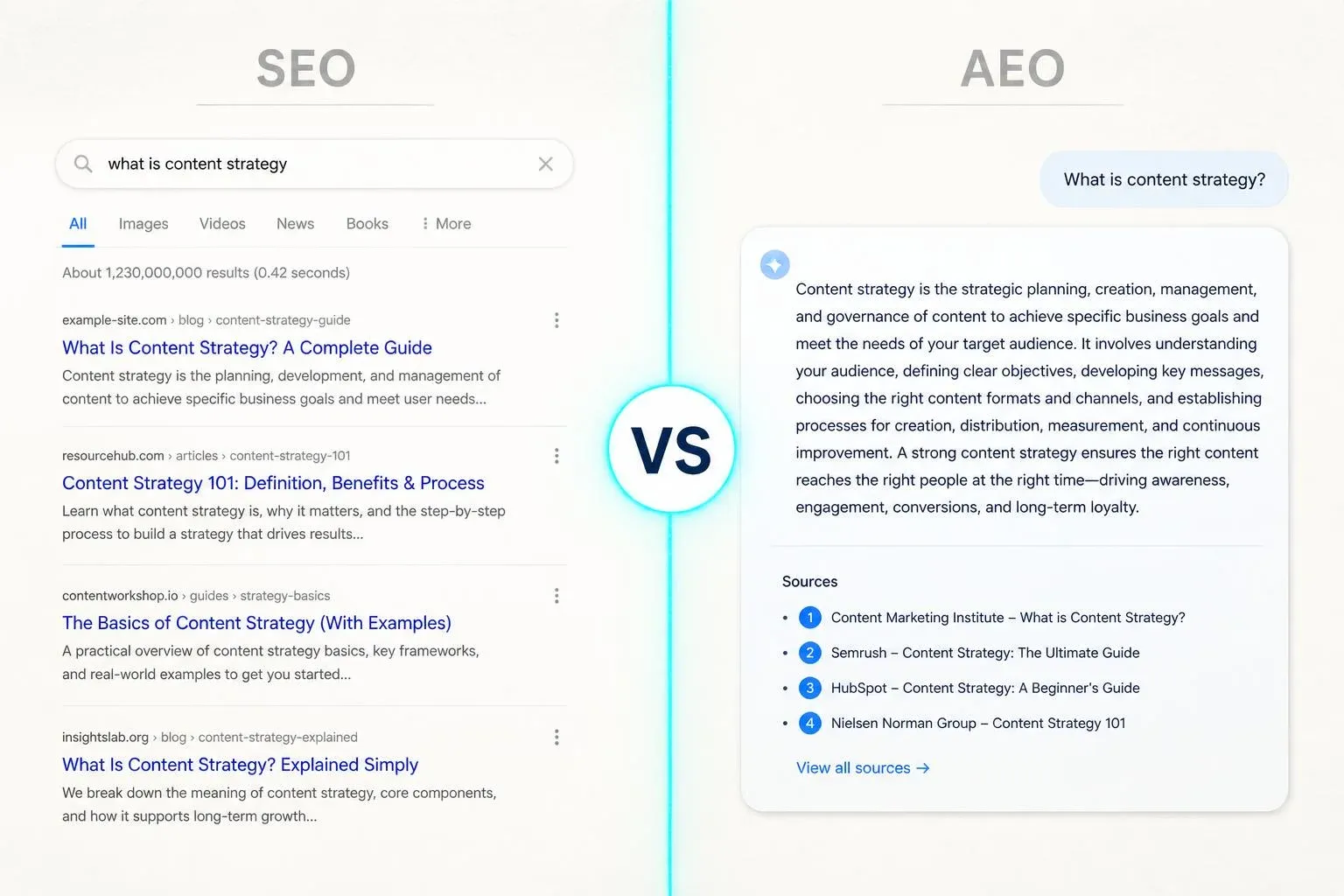 Deep Dive
SEO vs. AEO – aren't they the same thing?
SEO and AEO sound like the same game with a different acronym. They're not. Where the two disciplines overlap, where the…
Read more
Automate JSON-LD Schema for SPAs: Structured Data Without a Backend
SPAs have no structured data – and Google shows no rich snippets. This tutorial shows how to automatically generate JSON…
Read more
Lovable → GitHub → Vercel: The Complete Deployment Flow for SEO-Ready Apps
Lovable generates the app, GitHub versions the code, Vercel delivers with < 50ms TTFB. This guide shows the complete flo…
Read morePlaywright SSG Tutorial: How to Make Lovable Apps Visible to Google
SPAs are invisible to search engines. With Playwright, you can render any Lovable app into static HTML – automated, on e…
Read more
Vibe Coding & SEO: Why AI-Generated Apps Stay Invisible – And How We Fix It
Lovable, Bolt, v0 – Vibe Coding tools produce SPAs that Google can't see. Our playbook makes them SEO-ready: SSG, Schema…
Read more
Google Search Console for Vibe Coding Projects: Setup, Debugging & Indexing
Your Lovable app is live on Vercel – but Google isn't indexing anything? How to set up Search Console, debug crawling is…
Read more
OG-Image Best Practices for SPAs: Making Your Vibe Coding Projects Shareable
When you share a link from your Lovable app, LinkedIn shows an empty box. Why SPAs don't deliver social previews – and h…
Read more