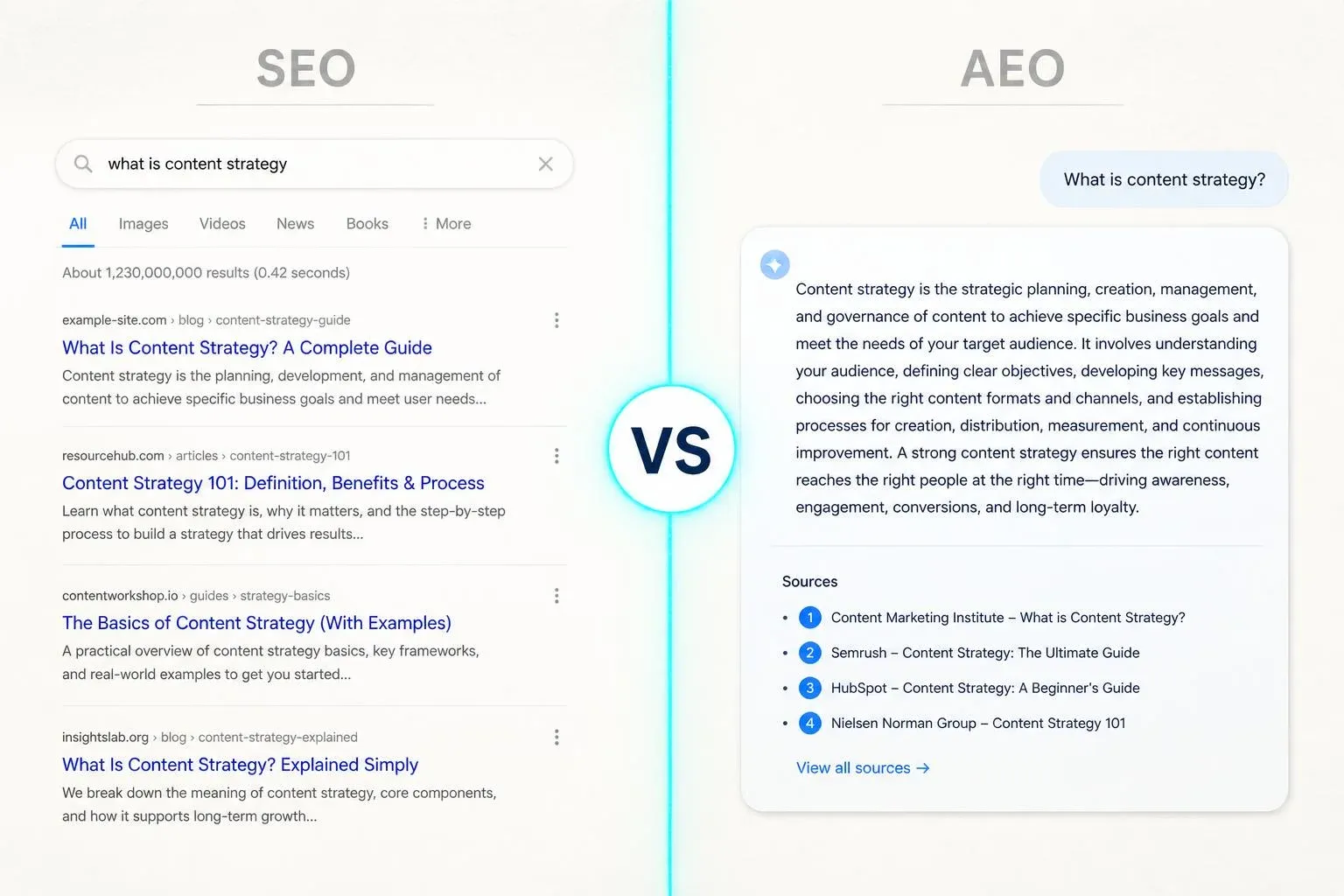

TL;DR: „SEO gets you into Google rankings; AEO makes you a cited source in AI answers from ChatGPT, Perplexity & co. They share a technical foundation (semantic HTML, schema, crawlability) but not content strategy: SEO wants clicks, AEO wants citations. To win real reach in 2026, optimize for both — with different levers."
— Till FreitagShort answer: No, SEO and AEO are not the same thing. They share a technical foundation, but they have different goals, different winners, and different levers. If you only do SEO, you'll lose reach over the next 24 months. If you only do AEO, you have no conversion path.
What the acronyms actually mean
SEO – Search Engine Optimization. The classic game for ~25 years: rank in Google's top 10 so users click your link and land on your site.
AEO – Answer Engine Optimization. The new game: get cited as a source in the answer of an AI search — ChatGPT, Perplexity, Google AI Overviews, Claude, Gemini, Bing Copilot. The user gets the answer inside the AI, not on your site.
Some call it GEO (Generative Engine Optimization) or LLMO (LLM Optimization). All variants of the same thing. We stick with AEO here because it's become the most common term.
Why the question "isn't it the same thing?" makes sense
On the surface, it looks the same:
- Both need crawlable content (no empty JavaScript)
- Both benefit from structured data (Schema.org, JSON-LD)
- Both reward clear information architecture (H1/H2, lists, semantic HTML)
- Both live on authority (who links to / cites you?)
If you already do good SEO, you have a head start on AEO. But "head start" doesn't mean "done."
Where SEO and AEO diverge
| Dimension | SEO | AEO |
|---|---|---|
| Success metric | Ranking, clicks, CTR | Mentions, citations, source listings in AI answers |
| User behavior | User clicks link, lands on page | User stays in chat, gets answer directly |
| Winning format | Listicles, how-tos, pillar pages, long-tail | Clear definitions, comparison tables, step-by-step, FAQ blocks |
| Optimization goal | "Be the best result for keyword X" | "Be the most reliable source for statement Y" |
| Measurability | Search Console, Sistrix, Semrush | Manual, prompt testing — no standard tool yet |
| Backlinks | Anchor texts, domain authority | Mentions often suffice — no link required |
| Update frequency | Algorithm updates every few months | Model updates weekly, training-data cutoffs |
In other words: SEO is a distribution game (get users to your site). AEO is a representation game (be inside the answer).
The decisive difference: zero-click
In SEO, the winner gets the click. In AEO, the click is usually irrelevant — or doesn't happen at all. Perplexity shows you the answer with source bubbles on the side. ChatGPT sometimes cites sources, sometimes doesn't. Google AI Overviews places a compact summary above the organic results.
The hard consequence: if your strategy is "more clicks from Google," you'll lose traffic in the next 24 months. Not because your SEO got worse — but because more and more queries end inside an AI that may cite your page but no one has to click it anymore.
In our own Serponado contest sprint we track both in parallel: classic ranking and whether the pillar page shows up as a source in Perplexity/ChatGPT answers. These are two different battles.
What AEO does differently (four levers)
1. Direct answers in the first 100 words
SEO tolerates long intros and storytelling. AEO wants the answer to be in the text immediately. If someone asks "What is AEO?", the first two sentences of your article should contain a clean definition that an LLM can extract 1:1. Just like further up in this article.
In practice: TLDR block on top, clear definition right under the first heading, FAQ blocks with short answers.
2. Fact structure instead of prose only
LLMs love lists, tables, comparisons, step-by-step instructions. What humans find tedious to write is exactly what builds well into a generated answer. Rule of thumb: every 200–300 words, drop a list, table, or code block.
3. Clear authorship & freshness
ChatGPT and Perplexity weigh sources partly by reputation and freshness. That means:
- Author box with name, photo, bio, links to LinkedIn / personal site
datePublishedanddateModifiedin JSON-LD schema- Real updates — don't just bump the date, actually change the content
4. Schema markup that AIs read
Classic SEO schema (Article, BreadcrumbList, Organization) helps AEO too. But two schemas are AEO gold:
- FAQPage – LLMs extract Q&A blocks directly
- HowTo – step-by-step guides get reused as structured answers
We use this in every pillar article — including this one (see FAQ below).
What SEO and AEO have in common (and why you don't have to throw anything out)
The good news: clean SEO covers ~70% of your AEO homework:
- Crawlability — without it, neither Googlebot nor GPTBot gets to your page
- Server-side rendering / SSG — see our Playwright SSG tutorial
- Semantic HTML —
<article>,<section>,<h1>to<h6>,<table> - Clean internal linking — pillar + cluster works for both
- JSON-LD schemas — Article, BreadcrumbList, FAQPage
That's the shared foundation. Without it, you lose both games.
Practical: how to start today
If you're doing SEO and want to layer AEO on top, the three smallest concrete steps:
1. Add a TLDR block on top of every important article. One paragraph, three to four sentences, answers the main question. That's exactly what an LLM picks up.
2. Build a FAQ section at the bottom with 4–8 Q&A pairs — and render it as FAQPage JSON-LD. Helps Google rich snippets and makes you an extractable source for AI answers.
3. Check that GPTBot and PerplexityBot are allowed to crawl. In robots.txt:
User-agent: GPTBot
Allow: /

User-agent: PerplexityBot
Allow: /

User-agent: ClaudeBot
Allow: /
Blocking these out of an "AI is stealing my content" reflex actively excludes you from the next 5 years of discoverability. That's a strategic decision, not a technical one — but it has consequences.
What we see on our own site
Since spring 2026, we track how our content gets cited in ChatGPT and Perplexity. Three patterns:
- Comparison tables (e.g., "X vs. Y") get pulled as a source disproportionately often
- Definition articles with clear etymology (like our Serponado pillar) often surface as "according to source X, this means…"
- How-tos with concrete code examples get reused in step-by-step form
Classic long-tail content ("The 27 best tips for…") performs noticeably weaker in AEO than in SEO. Anyone who played the listicle game for the last 10 years has to rethink.
What we do for clients in practice
In our SEO sprints, every pillar article is now built AEO-first: TLDR on top, FAQ at the bottom, FAQPage schema, comparison tables wherever possible. Classic SEO (keyword targeting, internal linking, backlinks) runs around it.
Result: the same page ranks in Google and surfaces as a Perplexity source. With marginally more effort than pure SEO.
Common misconceptions
"AEO replaces SEO." No. They run in parallel. Google itself is integrating AI answers into the regular SERPs — AI Overviews are both at the same time.
"AEO is just a marketing buzzword." Half true. The term is new, optimizing for structured extractable answers is not. But the discipline has shifted enough that it deserves its own name.
"If I optimize for ChatGPT, my SEO bleeds." No. Technical levers overlap 70%. The additional 30% (TLDR, FAQ, clear definitions) doesn't hurt classic rankings — quite the opposite.
"I can't measure AEO success." Limited. You can manually prompt-test whether your page surfaces as a source. Tools like Otterly.ai, Profound, or Peec.ai are working on AEO rank tracking but aren't as reliable yet as Sistrix is for SEO.
What you do differently starting today
- Every new article gets a TLDR block on top.
- Every pillar article gets a FAQ section with FAQPage schema.
robots.txtallows GPTBot, PerplexityBot, ClaudeBot.- Comparison tables, lists, how-tos instead of pure prose.
- Author box with clear identity on every article.
This isn't a big bang. It's a shift in how you write — and an add-on in your schema. Do it consistently and you'll build a lead in both disciplines over the next 12 months.
FAQ — short version
Is AEO just SEO under a new name? No. SEO wants clicks to your site, AEO wants citations in AI answers. The technical foundation (crawlability, schema, semantic HTML) is shared, the content strategy isn't.
Which AI tools should I track? ChatGPT (incl. Search), Perplexity, Google AI Overviews, Claude, Gemini, Bing Copilot. Perplexity and AI Overviews are most citation-driven right now and therefore most important for AEO measurement.
Do I need new tools for AEO? Not yet, strictly. Sistrix, Semrush, Search Console cover the SEO half. For AEO you prompt-test manually or try early tools like Otterly.ai or Peec.ai — no standard has emerged yet.
Do I lose traffic when AIs cite my content? Some click traffic, yes. In return you gain brand awareness and trust signals that feed back into SEO and direct traffic. Being cited regularly in ChatGPT answers gets you Googled more.
How is AEO different from GEO and LLMO? Practically not at all — three names for the same concept. AEO dominates the DACH region, GEO is more common in the US, LLMO is rarer.
Which schema matters most for AEO? FAQPage and HowTo. Both deliver AIs directly extractable Q&A or step structures. Article and BreadcrumbList are standard and should be in place anyway.
Want to set up SEO and AEO in parallel — as an ongoing process, not a one-off audit? We offer sprint-based SEO services that bake AEO in from day 1. → See Serponado SEO as a service
Related Articles

Lovable SEO/AEO: Every App Discoverable by Google and ChatGPT From Day 1
Lovable ships server-side rendering, pre-rendering for existing apps, Semrush directly in the builder chat, and an on-de…
Read more
GPTBot, ClaudeBot, PerplexityBot: What AI Crawlers Really See With Prerendering
We analyzed three months of edge logs: who actually crawls, who executes JavaScript, and who relies entirely on the HTML…
Read more
Why We Switched from ChatGPT to Claude – and What We Learned About LLMs Along the Way
We worked with ChatGPT for 18 months – then switched to Claude. Here's our honest comparison of all major LLMs and why C…
Read more
Domain Authority & Domain Rank: What the Number Really Means – and What to Watch For
Authority Score, Domain Rank, DR, DA – every SEO suite has its own number. What it actually measures, why it matters, an…
Read more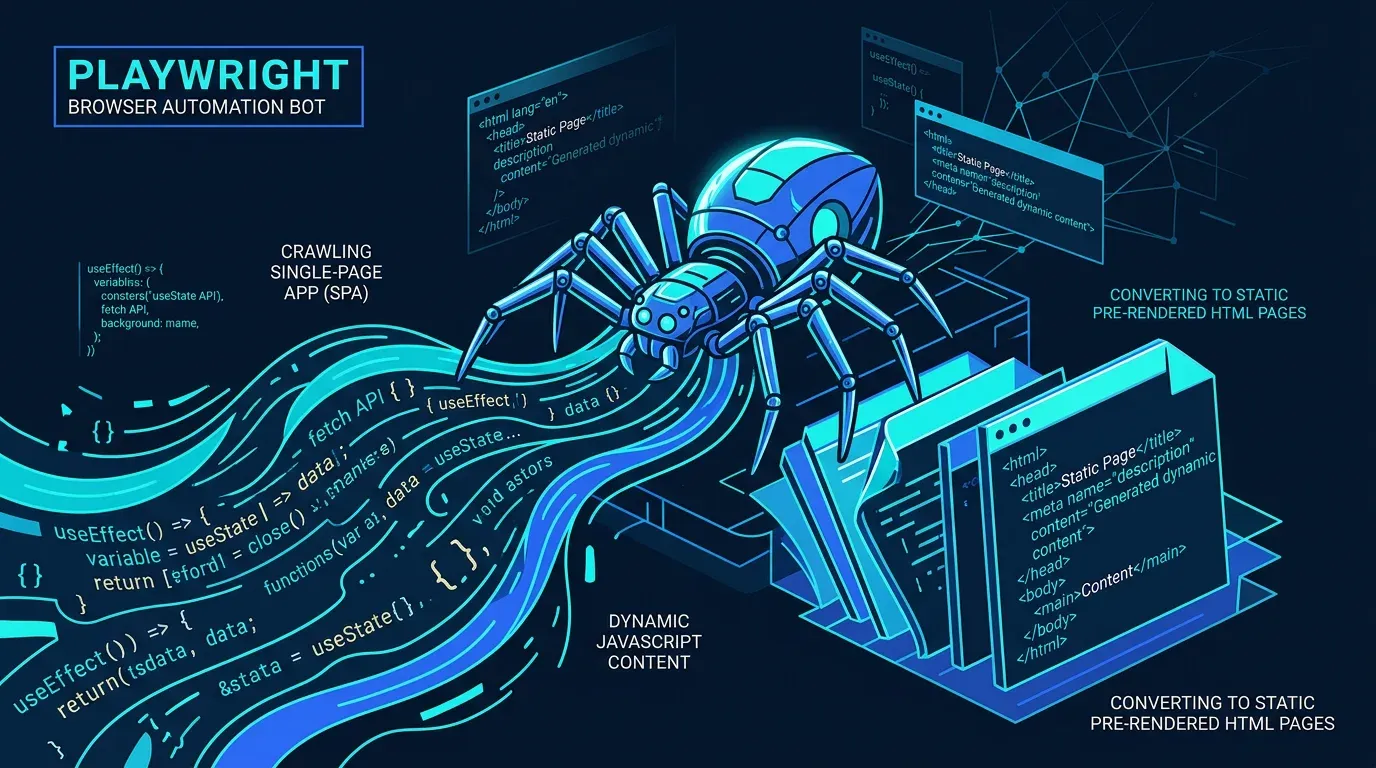
Prerendering: How to Turn a React SPA Into a Google-Friendly Site
React SPAs are invisible to crawlers. Prerendering fixes that – without Next.js, without an SSR server. How our Playwrig…
Read more Deep Dive
Claude Sonnet 5: Agentic AI Goes Mainstream
Anthropic ships Claude Sonnet 5 – a Sonnet model that gets close to Opus 4.8 performance at a fraction of the price. Aug…
Read more
AI Benchmarks Explained: Arena, SWE-Bench, AutomationBench & Co.
How do AI benchmarks actually work – from LMArena to SWE-Bench to Zapier's AutomationBench? A tour of Elo rankings, stat…
Read more
GLM-5.2 vs. Kimi K2.7 Code: Two Open-Weight Releases in One Week – Two Very Different Bets
Within four days in June 2026, Z.ai (GLM-5.2) and Moonshot AI (Kimi K2.7 Code) shipped their next-generation open-weight…
Read more
Gemma 4 12B Coder: Local Code Generation Becomes the Default
Google ships the Gemma 4 12B Coder — the specialized coding variant of the Gemma 4 stack. 12B parameters in GGUF format,…
Read more