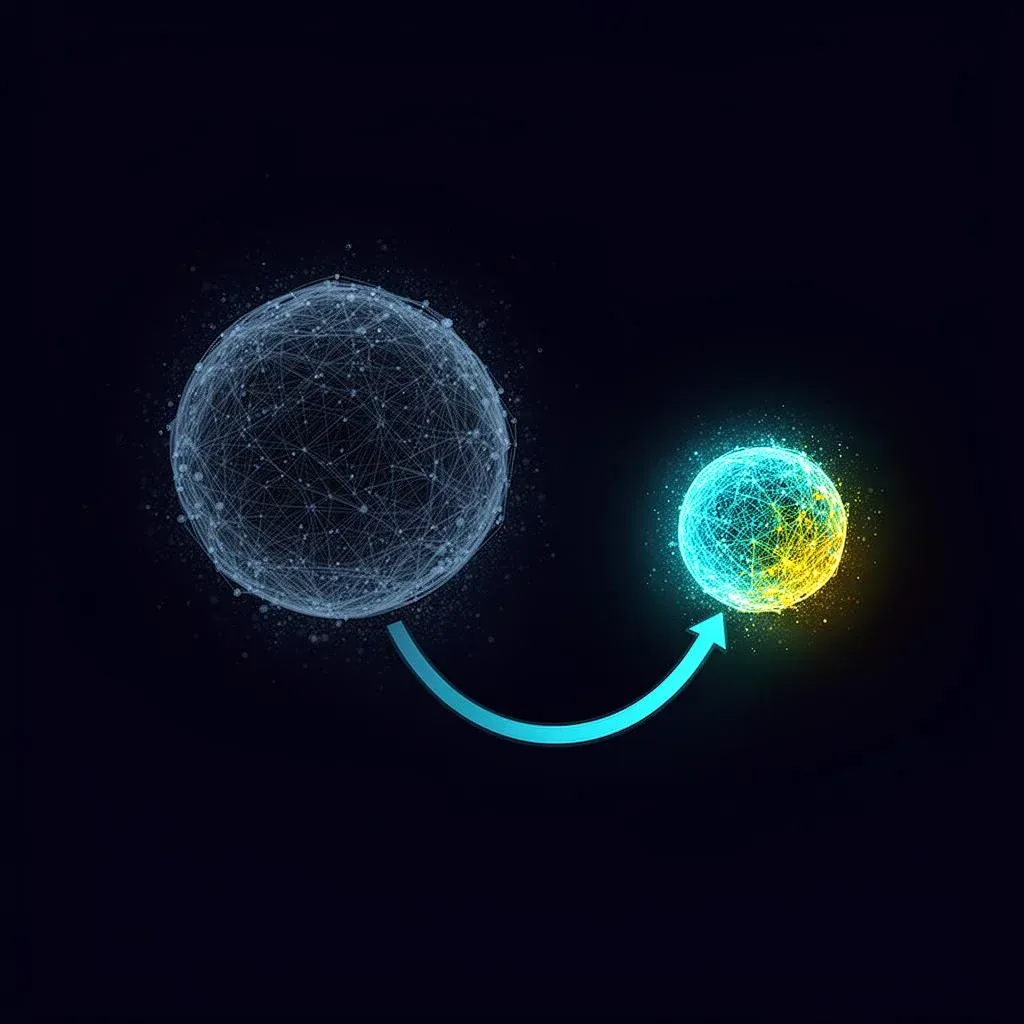
Nex-N2-Pro: How the Open-Model Frontier Shrunk 75 % in Six Weeks

TL;DR: „DeepSeek-V4-Pro (April 2026): 1.6T parameters, 49B active. Nex-N2-Pro (June 2026): 397B parameters, 17B active – beats V4-Pro on Terminal-Bench 2.1, edged GPT-5.5 on SWE-Bench Pro. The open frontier quarters itself on a weekly cadence. Those who want to build sovereign win – hyperscalers less so."
— Till FreitagSix weeks, two orders of magnitude
On April 22, 2026, DeepSeek launched DeepSeek-V4-Pro – the largest open-weight model ever released: 1.6 trillion parameters, 49B active, MoE, 1M-token context. A technical statement – and for many, proof that the open frontier had finally caught up with the closed one.
On June 5, 2026, nex-agi released Nex-N2-Pro: 397 billion parameters, 17B active, Apache 2.0, post-trained on Qwen3.5-397B-A17B. One quarter the total parameters. About one third the active ones. And on the benchmarks that matter for agentic work, on par with or ahead of V4-Pro.
| Model | Total | Active (MoE) | Release | License |
|---|---|---|---|---|
| DeepSeek-V4-Pro | 1.6 T | 49 B | Apr 22 2026 | MIT |
| Nex-N2-Pro | 397 B | 17 B | Jun 5 2026 | Apache 2.0 |
| Factor | 0.25× | 0.35× | +44 days | both open |
The benchmarks that actually matter
Nex-N2 is explicitly an agentic model – not "just another chat." The official numbers on the benchmarks that stand for tool use, coding and long-horizon execution:
| Benchmark | Nex-N2-Pro | Comparison |
|---|---|---|
| Terminal-Bench 2.1 | 75.3 | ahead of Claude Opus 4.7 and DeepSeek-V4-Pro |
| SWE-Bench Pro | 58.8 | edged GPT-5.5 |
| BrowseComp | 83.7 | on par with top-tier frontier |
This is not "pretty good for an open model." This is frontier level at one quarter the size – with a license no one will drag you to court over.
What explains this curve technically
Three levers are running in parallel, reinforcing each other:
- Better MoE architectures. 17B active instead of 49B means: less VRAM per token, higher throughput, lower latency. The choice of which expert fires is significantly smarter today than it was in 2024.
- Post-training on strong bases. Nex-N2-Pro is post-trained on Qwen3.5-397B-A17B. The community no longer builds from scratch; it stacks specialization on top of proven pretrained cores.
- Agentic thinking as a first-class capability. Instead of reactively attaching chain-of-thought, reasoning is part of the architecture and training. The model decides when and how deeply to think – similar to Mistral Medium 3.5 and GPT-5.4.
Translated: We do not get slightly more performance per parameter each year – we get it in leaps.
What used to need a cluster, runs locally tomorrow
A very rough but honest curve of the "largest open frontier models":
2024 Q4   Llama-3.1-405B Dense           405 B
2025 Q2   DeepSeek-V3                    671 B  (37B active)
2025 Q4   Kimi K2 / Qwen3.5             ~1,000 B
2026 Q2   DeepSeek-V4-Pro                1,600 B (49B active)
2026 Q2   Nex-N2-Pro                       397 B (17B active)
The point is not "small beats large." The point is: the efficient frontier shifts downward while the maximum frontier keeps moving upward. The tension between "what can maximally be done" and "what do you actually need" keeps growing – in favor of builders.
Concretely: What ran on a multi-node H100 cluster a year ago now runs on a single 8×H100 node with the right quantizations – and with aggressive GGUF/AWQ increasingly on workstations or edge boxes. Frontier level is migrating from the hyperscaler data center to the desktop.
Who wins – and who does not?
The winners
- Builders with sovereignty requirements. Healthcare, public sector, banking, pharma, industry. Those who cannot push data through US APIs get a model that delivers instead of merely "suffices."
- EU companies under GDPR pressure. Self-hosted, Apache 2.0, clear supply chain. No more "we have the DPA, trust us" layer needed.
- AI-first builders. Anyone running agents in production can switch the default model without rebuilding the architecture stack. Tool-calling quality becomes a swappable component.
- Edge and on-device scenarios. 17B active is the threshold where "runs on a workstation" becomes realistic – with genuine reasoning depth, not just as a toy.
The losers (at least at the margin)
- Hyperscaler pricing for pure inference. When a 397B model with an Apache 2.0 license can do frontier coding, willingness to pay $ for GPT-class inference drops – except for the exact workloads where closed models still truly lead.
- Closed "open-but-not-really" licenses. Modified MIT with MAU thresholds or acceptable-use clauses suddenly look expensive when real Apache 2.0 sits right next to them.
- Pure model-license business models. Value creation is finally shifting to the tool layer – Cursor, Vibe, Claude Code, IDE integrations, agentic runtime, eval stack. Anyone just selling weights is selling a commodity.
What we are doing concretely
At Till Freitag, we are rotating Nex-N2-Pro into our internal eval suite this week – alongside Medium 3.5, Claude Sonnet 4.5 and Kimi K2.5. Three questions we want answered:
- Tool-calling accuracy on real monday.com and RevOps workflows.
- Long-horizon stability over 50+ steps – Terminal-Bench reads well, but the real question is drift in multi-step agents.
- Inference economics self-hosted on 8×H100 NVL vs. managed via SiliconFlow – at what point does self-operation pay off?
First impressions will land in a follow-up within the next two weeks. Want to compare along? Model card is on Hugging Face, playground at SiliconFlow.
What to do now
- If you are running DeepSeek-V4-Pro or Llama 4 Maverick today: Evaluate Nex-N2-Pro on your own tasks. Not on marketing benchmarks – on your workflows.
- If you do not have an open-weights strategy yet: Get in now. The curve of the next twelve months will renegotiate the pricing of your closed-source contracts.
- If you are building in regulated industries: Self-hosting is shifting from premium path to default path. Plan your infra accordingly.
- If you only need chat: Stay with your managed provider. This wave is built for agents, coding and long-horizon tasks.
Bottom line
Six weeks ago, "largest open model" meant "1.6 trillion parameters." Today, the largest open model leading the agentic benchmarks is one quarter that size. This half-life is not an anomaly – it is the new pace.
The honest answer to "who wins" is: everyone who wants to own their AI. Frontier level is no longer exclusive hyperscaler territory. It is a release you can download this week, operate in license compliance, and embed in your product tomorrow.
The exciting question is no longer whether open models win. It is what you build when frontier AI sits on your desktop.
→ Mistral 3, Large 3 & Vibe: Europe's AI hope back in the game → Open-source LLM comparison: 20+ models at a glance → GGUF, GGML, Safetensors – formats for local AI → Our AI services at Till Freitag
Related Articles

Mistral 3, Large 3 & Vibe: Why the Latest Update Puts Europe's AI Hope Back in the Game
Mistral flipped the script in six months: Mistral 3 with Large 3 (675B MoE) as open weights, Medium 3.5 as the new defau…
Read more Deep Dive
Kimi K2.6: The Most Interesting AI Optimization in 2026 Isn't Intelligence – It's Duration
Moonshot AI open-sourced Kimi K2.6 yesterday. 1 trillion parameters, 300 sub-agents, 13 hours of autonomous code refacto…
Read more
Gemma 4: Frontier Intelligence Goes Laptop-Sized – The Hype Is Real
Google's Gemma 4 delivers GPT-4 level intelligence in 14 GB. 85 tokens per second on consumer hardware, 256K context, na…
Read more Deep Dive
Open-Source LLMs Compared 2026 – 25+ Models You Should Know
From Llama to Qwen to Gemma 4: all major open-source LLMs at a glance – with GitHub stars, parameters, licenses, and cle…
Read more Deep Dive
Claude Sonnet 5: Agentic AI Goes Mainstream
Anthropic ships Claude Sonnet 5 – a Sonnet model that gets close to Opus 4.8 performance at a fraction of the price. Aug…
Read more
GLM-5.2 vs. Kimi K2.7 Code: Two Open-Weight Releases in One Week – Two Very Different Bets
Within four days in June 2026, Z.ai (GLM-5.2) and Moonshot AI (Kimi K2.7 Code) shipped their next-generation open-weight…
Read more
Gemma 4 12B Coder: Local Code Generation Becomes the Default
Google ships the Gemma 4 12B Coder — the specialized coding variant of the Gemma 4 stack. 12B parameters in GGUF format,…
Read more
SearXNG: The Underrated Search Infrastructure for Agents
31.8k stars, AGPL-3.0, one self-hosted endpoint instead of the next commercial search API. Why SearXNG keeps showing up …
Read more
Claude Fable 5 & Mythos 5: When AI Shifts from Tasks to Responsibilities
Anthropic launches Claude Fable 5 and Mythos 5 – SOTA on almost all benchmarks. More interesting than the numbers: The s…
Read more