Privacy Router – How to Implement AI Data Protection Without Compromise

The Problem Nobody Talks About
Every company using AI has a data protection question – and most ignore it.
The standard situation: a team uses ChatGPT or Claude. Everything goes through the same API. Customer emails, salary data, strategic documents, support tickets – all into the same tunnel, to the same US cloud provider.
This isn't just a GDPR problem. It's a trust problem.
The good news: you don't have to choose between AI usage and data protection. The Privacy Router makes both possible.
What Is a Privacy Router?
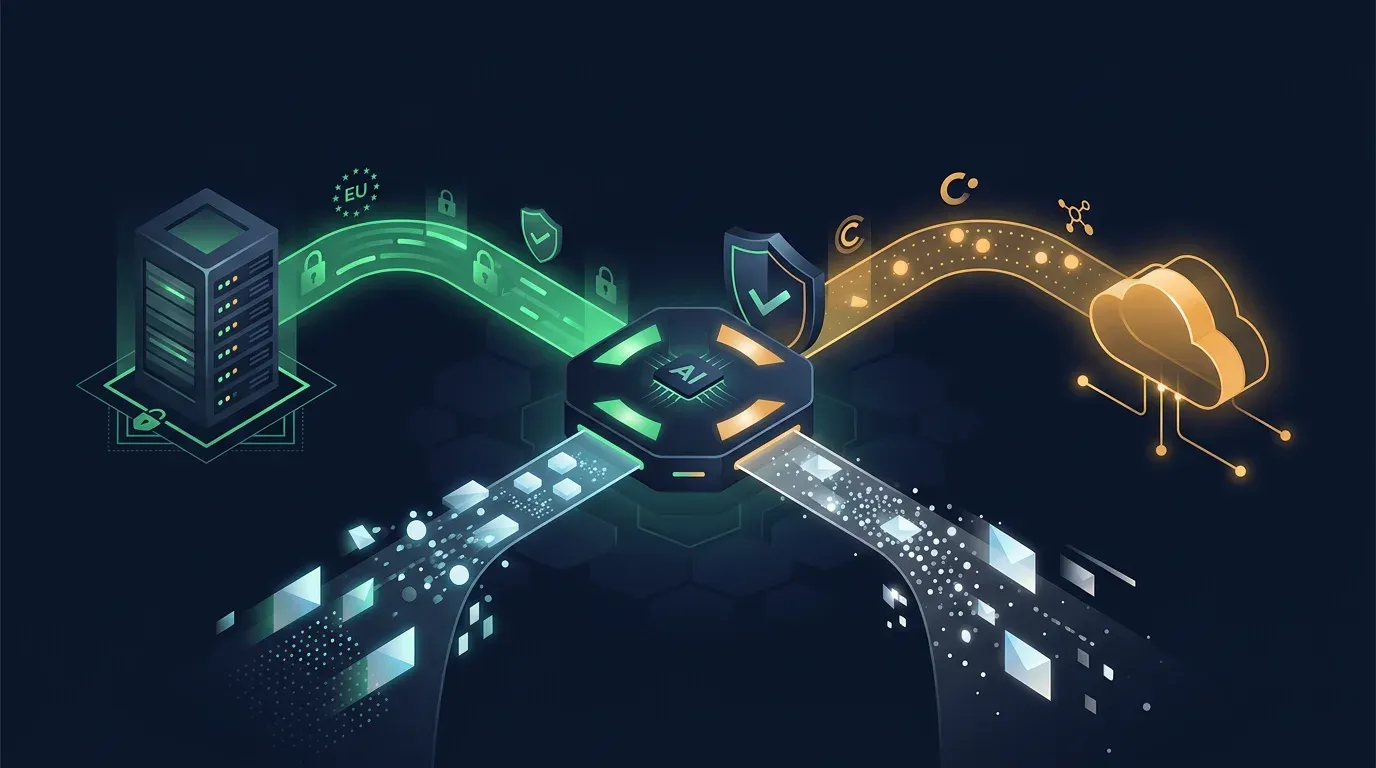
A Privacy Router is a system that classifies every AI request before processing and automatically routes it to the right model – based on data sensitivity.
The principle: The data determines the model. Not the other way around.
Three zones, three rules:
| Zone | Data Type | Routing | Example Models |
|---|---|---|---|
| 🟢 Green | Public data | US/Global Cloud | GPT-4o, Claude, Gemini |
| 🟡 Yellow | Internal data | EU-hosted APIs | Mistral (EU), AWS Bedrock (Frankfurt), Azure (EU) |
| 🔴 Red | Sensitive/personal data | Local / On-Premise | Llama 4, Nemotron Nano, Qwen local |
Green Zone: Everything That's Public Anyway
Rule: Public data can go to any model.
Examples:
- Creating marketing copy
- Summarizing public research
- Generating social media posts
- General code generation (open-source projects)
- Translating published content
Here, price plays the main role. Use the Model Routing Guide and our AI Token Calculator to find the cheapest model.
Recommendation: Gemini 2.0 Flash for commodity tasks ($0.40/1M tokens), Claude Sonnet for creative tasks.
Yellow Zone: Internal Data, EU Sovereignty
Rule: Internal data only to EU-hosted models with a Data Processing Agreement (DPA).
Examples:
- Summarizing internal documents
- Analyzing project plans
- Processing meeting notes
- Preparing CRM data for reporting
- Code reviews for proprietary code
This data isn't secret, but it doesn't belong in US cloud APIs without a DPA. The GDPR is clear here: personal data requires a legal basis for transfer to third countries.
Recommended providers:
- Mistral AI (Paris) – Mistral Large, natively in the EU
- AWS Bedrock Frankfurt – Claude, Llama, Mistral with EU data residency
- Azure West Europe – GPT-4o with EU data processing
- OVHcloud AI Endpoints – European cloud provider with LLM APIs
Important: A DPA alone isn't enough. Verify that the provider technically ensures data doesn't leave the EU – not just contractually.
Red Zone: Sensitive Data Stays Local
Rule: Sensitive and personal data never leaves your own infrastructure.
Examples:
- HR data and salary information
- Customer data (CRM with contact details)
- Health data
- Financial reports before publication
- Contracts and legal documents
- Passwords, API keys, credentials
For this zone, you need local models. This sounds like a lot of effort, but in 2026 it's surprisingly easy:
Hardware requirements:
- Llama 4 Scout (17B active): 32 GB RAM, runs on a Mac Studio
- Nemotron Nano (8B): 16 GB RAM, runs on any modern laptop
- DeepSeek R1 Distill (14B): 32 GB RAM, strong local reasoning
- Qwen 3.5 (7B): 16 GB RAM, excellent for classification
Tools for local models:
Local model quality is sufficient for 90% of red-zone tasks: classification, extraction, summarization. For complex analysis, fall back to the yellow zone – with anonymized data.
Implementation: The 3-Step Plan
Step 1: Data Classification (Day 1)
Create a simple matrix for your company:
Public (🟢): Marketing, public docs, general code
Internal (🟡): Projects, meetings, CRM aggregate data, proprietary code
Sensitive (🔴): HR, customer PII, finance, contracts, credentials
Tip: When in doubt, classify one level higher. Better too cautious than too careless.
Step 2: Build Routing Logic (Day 2–3)
Option A: Rule-based (simple)
IF data_source IN [HR system, CRM contacts, financial accounting]
  → Route to local model
IF data_source IN [project management, intranet, internal code]
  → Route to EU API
ELSE
  → Route to cloud API
Option B: Classifier-based (intelligent)
Use a local mini-model (Nemotron Nano, <1ms latency) as a classifier:
- Every request goes through the classifier first
- Classifier detects PII, financial data, HR context
- Routing happens automatically based on classification
- Fail-safe: When uncertain → always local model (never cloud fallback for sensitive data)
Option C: Workflow automation (make.com / n8n)
Build the Privacy Router as an automation workflow:
- Incoming request → PII detection module
- Routing decision → Switch node
- API call to the right model
- Audit log for every routing decision
Step 3: Audit Trail (Day 4–5)
Every routing decision must be traceable – for the data protection officer, for audits, for the EU AI Act.
What you should log:
- Request timestamp
- Classification result (🟢/🟡/🔴)
- Selected model + provider
- Hash of the request (not the plaintext!)
- Response time and token consumption
What you should NOT log:
- The full prompt (may contain sensitive data)
- Model outputs with PII
- API keys or credentials
EU AI Act: Why the Privacy Router Becomes Mandatory
Starting August 2026, the EU AI Act's transparency obligations take effect. For high-risk AI systems (HR decisions, credit scoring, etc.), strict requirements apply:
| Requirement | Privacy Router Solves This |
|---|---|
| Data quality & governance | ✅ Data classification before processing |
| Transparency | ✅ Audit trail for every routing decision |
| Human oversight | ✅ Approval gates for sensitive actions |
| Technical robustness | ✅ Fail-safe: sensitive data never to cloud |
| Risk management | ✅ Three-tier zone model |
The Privacy Router isn't a nice-to-have – it's becoming the compliance backbone for every company using AI productively.
Kill-Switch Hierarchy: When Things Go Wrong
Autonomous AI agents need guardrails. Our governance framework defines three escalation levels:
- Soft Stop – Agent pauses and asks for approval (e.g., before sending an email)
- Immediate Stop – Immediate cancellation of the current task (e.g., PII detected in output)
- Emergency Kill – Complete shutdown of all AI processes (e.g., suspected data leak)
Rule: Every write-action by an agent to sensitive systems requires an approval gate. No agent writes unsupervised to HR, finance, or customer systems.
The Cost Question
"Sounds expensive" is the most common reaction. The reality:
| Component | Cost |
|---|---|
| Local model (Ollama on Mac Studio) | ~$0 (hardware already available) |
| EU API (Mistral Large) | $6/1M tokens (only 2× more than budget models) |
| Classifier (Nemotron Nano local) | $0 |
| make.com workflow | From $9/month |
| Audit log (own DB) | ~$0 |
Total Privacy Router cost: $10–50/month premium over an "everything to the cloud" setup. That's less than one hour of legal fees for a GDPR violation.
The Bottom Line
AI data protection isn't a binary problem. You don't have to choose between "everything to the cloud" and "don't use AI."
The Privacy Router gives you the best of both worlds:
- Maximum AI power for public and internal tasks
- Maximum data protection for sensitive data
- EU AI Act compliance out-of-the-box
- Traceability through audit trails
Setup takes one week. The alternative – a GDPR fine – takes significantly longer.
Data protection isn't a roadblock. It's a routing problem.
🧮 What does your AI setup cost? Run the numbers with our AI Token Calculator – including EU-hosted models.
📋 Which model for which task? Read the Model Routing Guide for the complete decision matrix.
🛡️ Which zone does your data fall into? Take the Privacy Router Self-Check – interactive questionnaire with specific model recommendations.
Want to set up a Privacy Router for your company? Talk to us – we'll build it with you. GDPR-compliant, in one week. No PowerPoint required.
Related Articles
Model Routing Guide – Which AI Model for Which Task?
Using GPT-4o for everything is like taking a Porsche to the bakery. Model routing saves 80% of AI costs – without qualit…
Read more
Autonomous AI Agents in Business: Opportunities, Risks & Governance
Gartner says 40% of agentic AI projects will be cancelled by 2027. Not because of the tech – because of missing governan…
Read more
OpenClaw Self-Hosting Guide: GDPR-Compliant in 30 Minutes
Self-host OpenClaw with Docker, persistent storage, and local LLMs via Ollama – fully GDPR-compliant because no data eve…
Read more
make.com Security & Secrets Management: Connections, Webhooks, IP Whitelisting (2026)
Make.com scenarios handle API keys, customer data, and production webhooks. Here's how to secure connections, webhook en…
Read more
Sakana Fugu: Orchestrator, Not Monolith
Sakana AI ships Fugu – not another foundation model, but an orchestrator that routes prompts across specialised LLMs. Th…
Read more
Z.ai GLM-5.2 – why the next frontier leap comes from China
Z.ai ships GLM-5.2 – more than doubling GLM-5.1, close to Claude Fable 5, cheaper, deployable on-prem. While US frontier…
Read more
Is Local AI Killing the AI-SaaS Startups? An Honest View From the Engine Room
Meetily takes meeting notes fully locally. Qwen runs on a laptop. RTX Spark hits notebooks in 2026. Are all the AI-wrapp…
Read more
SearXNG: The Underrated Search Infrastructure for Agents
31.8k stars, AGPL-3.0, one self-hosted endpoint instead of the next commercial search API. Why SearXNG keeps showing up …
Read more
Lovable Model Routing: Why Output Quality Has Slipped for Builders
Lovable now routes chat requests across different models depending on the task. From a builder's perspective, output qua…
Read more