

The Problem: One Model for Everything
Most teams make the same mistake: they use GPT-4o or Claude Sonnet for everything. Every email, every summary, every data extraction, every code review.
That's like taking a Porsche to the bakery. It works, but you're burning money.
The reality: 70% of all AI tasks don't need a frontier model. They need a fast, cheap model that gets the job done. The remaining 30% might even need more than a frontier model – they need a reasoning model.
Model routing solves exactly this: The right model for the right task. Automatically.
The Routing Matrix: 4 Tiers
We split tasks into four tiers – each with an optimal model type:
Tier 1: Commodity Tasks (Budget Models)
Cost: $0.40–0.60 / 1M Output Tokens
| Task | Why Budget Is Enough |
|---|---|
| Text classification | Sentiment, categorization – trivial for any LLM |
| Data extraction | Pulling structured fields from documents |
| Simple summaries | Meeting notes, email digests |
| Translations | Standard content without nuance |
| Template generation | Standardized emails, responses |
Recommended models:
- Gemini 2.0 Flash – $0.40/1M output, unbeatable price
- GPT-4o mini – $0.60/1M output, solid all-round performance
- DeepSeek V3 – $1.10/1M output, strong price-performance ratio
- Llama 4 Maverick (via Groq) – $0.60/1M output, open-source
Tier 2: Professional Tasks (Mid-Tier Models)
Cost: $4.00–6.00 / 1M Output Tokens
| Task | Why Mid-Tier |
|---|---|
| Content creation | Blog articles, marketing copy with brand voice |
| Code generation | Standard features, boilerplate, refactoring |
| Customer support | Nuanced, empathetic responses |
| Data analysis | Recognizing correlations, describing patterns |
Recommended models:
- Claude 3.5 Haiku – $4.00/1M output, Anthropic quality at mid-tier price
- Mistral Large – $6.00/1M output, strong European model
Tier 3: Frontier Tasks (Premium Models)
Cost: $10.00–15.00 / 1M Output Tokens
| Task | Why Frontier |
|---|---|
| Strategic analysis | Complex business decisions with context |
| Agentic coding | Multi-file refactoring, architecture decisions |
| Creative writing | Thought leadership, differentiated content |
| Complex research | Multi-source synthesis with critical evaluation |
Recommended models:
- GPT-4o – $10.00/1M output, the all-rounder
- Claude 3.5 Sonnet – $15.00/1M output, best for code + creative writing
- Gemini 2.5 Pro – $10.00/1M output, massive context window
Tier 4: Reasoning Tasks (Specialized Models)
Cost: $2.19–40.00 / 1M Output Tokens
| Task | Why Reasoning |
|---|---|
| Mathematical proofs | Step-by-step logical thinking |
| Architecture design | Weighing complex trade-offs |
| Debugging hard bugs | Hypothesis formation and systematic analysis |
| Compliance checking | Validating documents against rule sets |
Recommended models:
- DeepSeek R1 – $2.19/1M output, open-source reasoning at budget price
- OpenAI o3 – $40.00/1M output, strongest reasoning, but expensive
Routing in Practice: An Example
Imagine a support team processing 1,000 tickets per month with AI:
| Without Routing | With Routing |
|---|---|
| Everything via Claude Sonnet | Tier 1 for 700 standard tickets |
| 1M output tokens × $15 = $15.00 | Tier 2 for 250 complex tickets |
| Tier 3 for 50 escalations | |
| $3.85 (74% cheaper) |
The quality of responses? Identical. A "where's my package?" ticket doesn't need a frontier model.
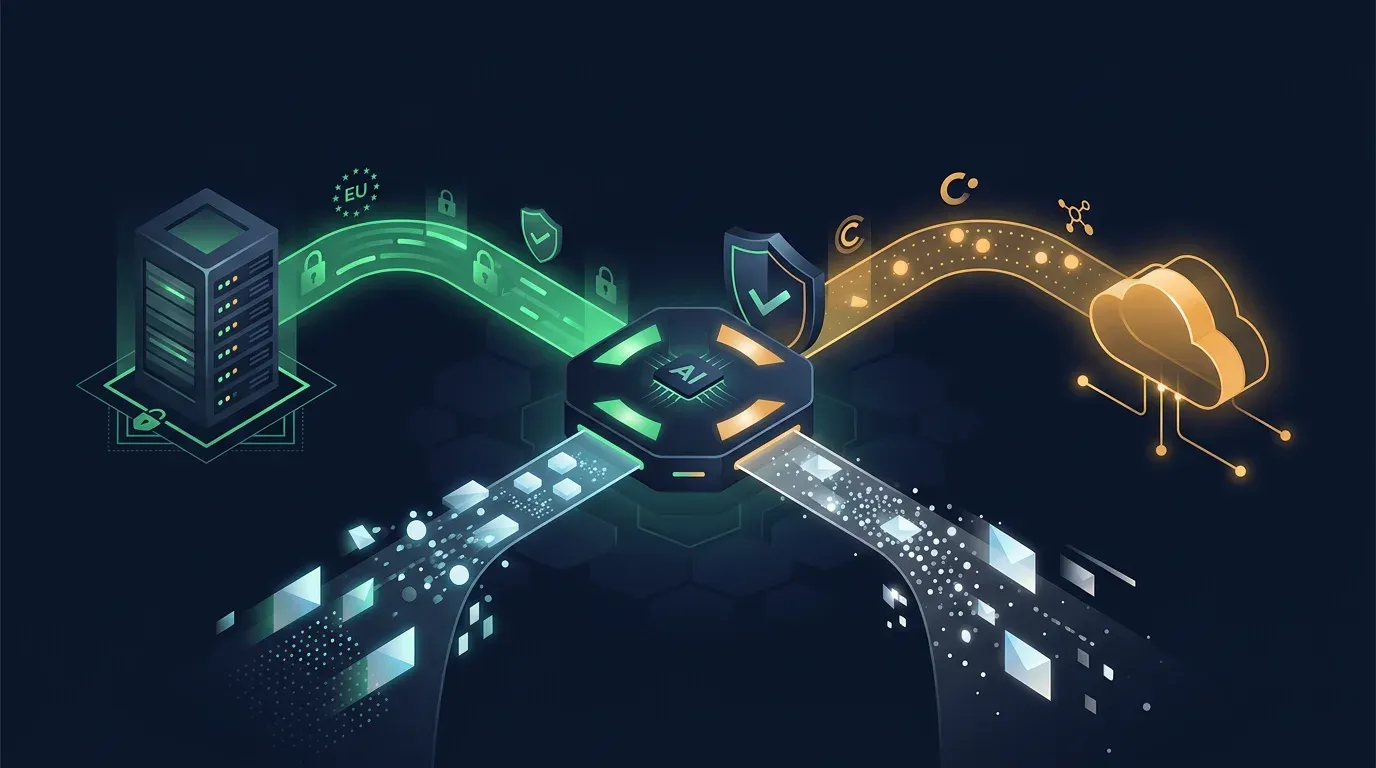
The Privacy Layer: Data Sensitivity as a Routing Criterion
Model routing isn't just a cost question – it's also a data protection question.
Our recommendation: a three-tier privacy routing:
- 🟢 Public data → Cloud models (GPT-4o, Claude, Gemini)
- 🟡 Internal data → EU-hosted models (Mistral, EU Bedrock)
- 🔴 Sensitive data → Local models (Llama local, Nemotron Nano)
The principle: The data determines the model, not the other way around.
Sensitive HR data, salary information, or customer data should never go to US cloud APIs – regardless of how good the model is. A local Llama model is perfectly sufficient for classifying personnel files.
🔐 Deep Dive: Our Privacy Router Guide shows step-by-step how to implement the three-zone model – including EU AI Act compliance and kill-switch hierarchy.
How to Implement Model Routing
Option 1: Manual Routing (Immediately actionable)
Create a simple decision table for your team:
IF task = classification/extraction → Gemini Flash
IF task = content/code → Claude Haiku
IF task = strategy/creative → Claude Sonnet
IF task = reasoning/debugging → DeepSeek R1
IF data = sensitive → Local model
Option 2: Automated Routing (with make.com or n8n)
Build a workflow that analyzes incoming requests and automatically routes to the right model:
- Classifier (Gemini Flash, costs almost nothing): Evaluates complexity + data sensitivity
- Router: Forwards to the appropriate model
- Fallback: If the budget model fails, upgrade to next tier
Option 3: OpenRouter as a Meta-Layer
OpenRouter aggregates 200+ models under one API. You can:
- Switch models per request
- Define fallback chains
- Track costs per model
The Cost Calculation
Run the numbers for your own setup: Our AI Token Calculator shows you what you get for your budget with every provider.
A typical company that introduces model routing saves 60–80% of AI costs – with equal or better output quality. Why better? Because reasoning models at reasoning tasks are actually better than frontier models.
The Bottom Line
Model routing isn't a nice-to-have. It's the first optimization every company should make before talking about AI strategy.
The logic is simple:
- 70% of your tasks need the cheapest model
- 25% of your tasks need a good model
- 5% of your tasks need the best model
- 0% of your tasks need the same model for everything
Whoever understands this doesn't just save money – they build better AI systems.
🧮 What does your AI setup really cost? Run the numbers with our AI Token Calculator – free, no signup required.
Want to introduce model routing for your team? Talk to us – we'll build the routing logic with you. In days, not months.
Related Articles
Privacy Router – How to Implement AI Data Protection Without Compromise
Most AI setups have a data protection problem nobody talks about: everything goes to the same cloud API. The Privacy Rou…
Read more
Token Maxxing: When AI Stops Being a Search Engine and Becomes Infrastructure
Most teams use AI like Google. The winners treat it like electricity. Token maxxing means pushing every doc, every call,…
Read more Deep Dive
Claude Sonnet 5: Agentic AI Goes Mainstream
Anthropic ships Claude Sonnet 5 – a Sonnet model that gets close to Opus 4.8 performance at a fraction of the price. Aug…
Read more
Europe's Compute Crunch: Why There's Barely Any Capacity Left in 2026
B200 clusters with months of lead time, sold-out EU regions, hyperscalers openly talking 'capacity constraints': Europe …
Read more
Sakana Fugu: Orchestrator, Not Monolith
Sakana AI ships Fugu – not another foundation model, but an orchestrator that routes prompts across specialised LLMs. Th…
Read more
AI Benchmarks Explained: Arena, SWE-Bench, AutomationBench & Co.
How do AI benchmarks actually work – from LMArena to SWE-Bench to Zapier's AutomationBench? A tour of Elo rankings, stat…
Read more
Z.ai GLM-5.2 – why the next frontier leap comes from China
Z.ai ships GLM-5.2 – more than doubling GLM-5.1, close to Claude Fable 5, cheaper, deployable on-prem. While US frontier…
Read more
GLM-5.2 vs. Kimi K2.7 Code: Two Open-Weight Releases in One Week – Two Very Different Bets
Within four days in June 2026, Z.ai (GLM-5.2) and Moonshot AI (Kimi K2.7 Code) shipped their next-generation open-weight…
Read more
Gemma 4 12B Coder: Local Code Generation Becomes the Default
Google ships the Gemma 4 12B Coder — the specialized coding variant of the Gemma 4 stack. 12B parameters in GGUF format,…
Read more