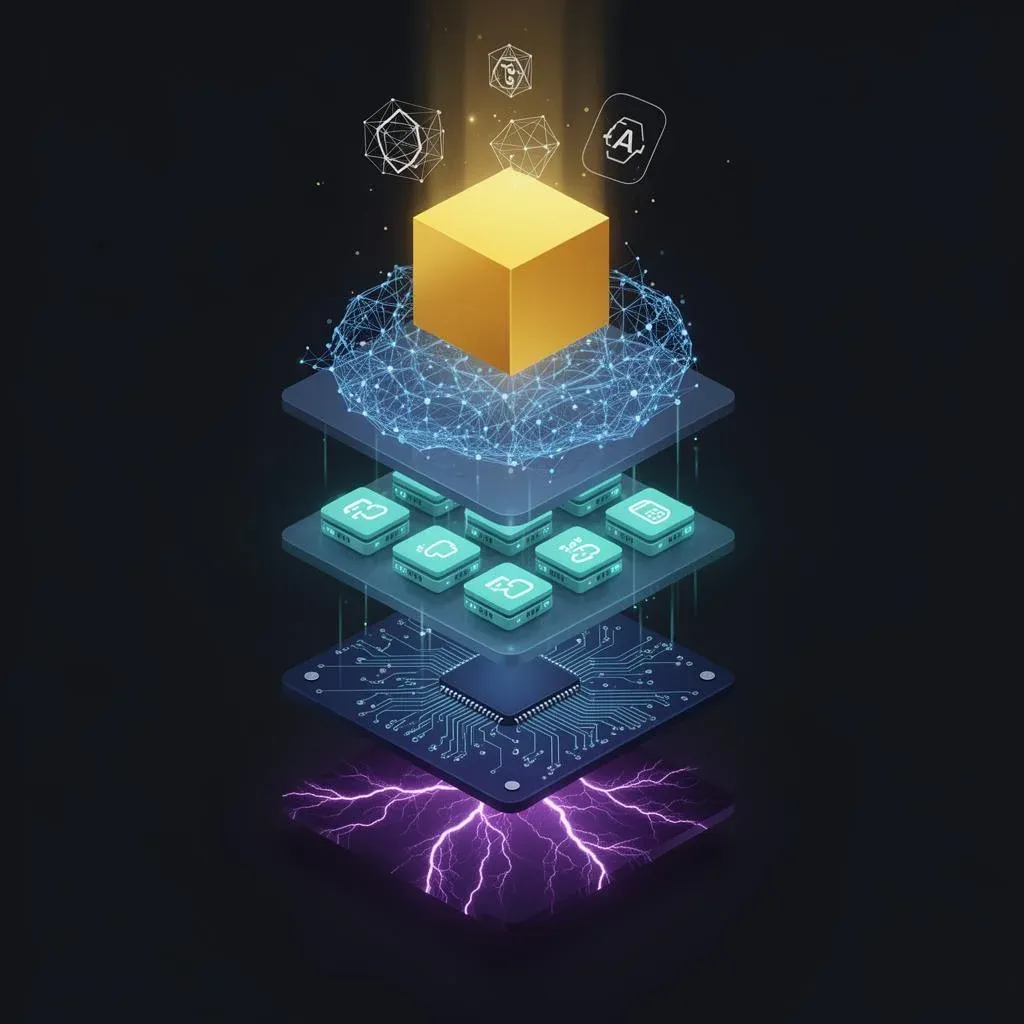
Jensen Huang's Five-Layer Cake: Why the Application Layer Now Decides the Real Economy

TL;DR: „Energy, chips, cloud and models are expensive prerequisites. Economic upside lands with whoever builds in the application layer. Mid-market and enterprises don't need their own model research – they need AI-native business models on top of the existing stack."
— Till FreitagIn 30 Seconds
At the World Economic Forum in Davos, NVIDIA CEO Jensen Huang sat down with BlackRock's Larry Fink and broke the AI value chain into five layers: Energy → Chips → Cloud → Models → Applications. His punch line: "This layer on top, ultimately, is where economic benefit will happen." Models, he says, are now good enough that AI-native companies can build on top of them – and that's the real game of the next ten years.
For the real economy that means: the race for models isn't your race. The race for AI-native products and business models absolutely is.
The Five Layers – and Where Value Lands
| Layer | What happens | Who wins | Investment |
|---|---|---|---|
| 5 · Applications | AI-native products, workflows, agents | Builders, mid-market, founders | low–medium |
| 4 · Models | Frontier LLMs (Claude, Gemini, GPT, Qwen) | OpenAI, Anthropic, Google, DeepSeek | billions |
| 3 · Cloud | Hyperscalers, AI clouds | AWS, Azure, GCP, CoreWeave | tens of billions |
| 2 · Chips | GPUs, accelerators | NVIDIA, AMD, TSMC | hundreds of billions |
| 1 · Energy | Power, grid, cooling | Utilities, nuclear renaissance | trillions |
Huang's point: the bottom four layers are capital-intensive prerequisites. They are necessary, but they are not where a mid-market manufacturer in Ohio, an insurer in Munich or an industrial holding in Düsseldorf will make money. The lever for 99 % of all companies sits in the application layer.
Why This Statement Is Landing Right Now
Three things collide in 2026:
- Models are "good enough". Claude 4.5, Gemini 3, GPT-5 and open-source models like DeepSeek V4 (Hunter Alpha) deliver reasoning quality that's sufficient for 90 % of business use cases.
- Token costs are collapsing. What cost $30 per million output tokens in 2024 is often <$1 today. We unpacked that in AI Token Economics.
- Agent frameworks are mature. OpenClaw, agent SDKs, Skills, sandboxing runtimes – the building blocks for application-layer products are freely available.
The consequence: there is no technical excuse left for not building in the application layer.
What "Application Layer" Means in the Real Economy
Application layer doesn't mean "a ChatGPT seat for everyone". It means: products, workflows and business models that couldn't exist without AI.
Three categories will define the next 24 months:
1. AI-Native Workflow Products
Existing processes get re-thought so that AI is architecture, not an add-on. A classic sales process with AI assist remains a classic sales process. A sales process driven by an agent swarm where humans only see escalated deals is a different product. Examples: Globster on monday.com, Account360 as a Zero-Update CRM.
2. Vertical AI Companies
Industry-specific applications that combine deep domain knowledge with AI. Legal-tech agents that check contracts against internal policies. Insurance agents that triage claims in minutes. Manufacturing agents that validate SOPs against reality data.
3. Agent-First Operations
Internal operations get rebuilt around agents – not as an efficiency project, but as org architecture. We showed in Token Maxxing what happens when a mid-market firm systematically pushes every workflow through the context window: 60 % revenue growth in two years. That's application-layer leverage.
What This Means for Mid-Market and Enterprises
Most companies in 2026 are asking the wrong question. They ask: "Which model should we use?" or "Should we build our own AI infrastructure?" Both are Layer 2–4 questions. The right question is:
"Which of our products or processes would be a standalone business model as an AI-native version?"
You don't find answers in an IT steering committee. You find them in three places:
- In sales, by asking which customers you currently don't serve because the process is too expensive.
- In operations, by asking which workflow is 80 % manual routine today.
- In pricing, by asking which service you "throw in for free" because you can't sell it at scale.
Every one of those answers is a potential application-layer product.
Where We Come In: Building AI-Native Business Models
We've been building exactly on this layer for two years. Not as consultants delivering strategy PDFs – as AI First Builders who develop and ship the product with you. Three typical entry paths:
→ AI Product Studio (4–8 weeks)
From hypothesis workshop to a production AI-native MVP that customers or internal users actually use. Architecture, UX, agent logic, eval, deployment. Details: AI Product Studio.
→ Agentic Workflow Engineering
Rebuild existing processes as agent loops. Classic fields: sales, customer success, operations, recruiting. Including sandboxing, privacy router and agent ops for production operation.
→ AI-Native Web Development
If the new business model is a digital product: from concept to production platform in four weeks. Details: AI-Native Web Development.
Either way we work from a Cofounder Mindset: we take the bet with you instead of describing it.
What Layers 1–4 Mean for You (and What They Don't)
A short grounding, because many companies are overreacting right now:
- Energy & chips: Operationally none of your business. Watching is enough.
- Cloud: Pick your hyperscaler based on compliance, region, skill set – not on AI specialty features. Those will be identical everywhere in 18 months.
- Models: Do not go all-in on one provider. Architect via model routing so you can switch tomorrow when the price/performance ratio flips.
- Applications: This is where you go all-in. This is where your competitive edge for the next decade lives.
The Honest Part
The application layer isn't "easier" than the layers below. It's just differently hard. Instead of capital, it needs:
- a clear understanding of your own business
- the courage to think a product differently from the competition
- a team that ships in weeks, not quarters
- eval discipline, because AI products fail differently in production than classical software
That's exactly the gap we walk into. And it's the gap where the next mid-market champions will emerge.
Bottom Line
Huang's picture is clean: the bottom four layers are a hardware, energy and capital game between a handful of global players. The application layer is open – and it's where the bulk of economic value of the next ten years will be created.
Whoever spends 2026 still debating "the right AI strategy" instead of building in the application layer will be reacting to margin pressure in 2028 instead of generating it. The tools are open. The models are good enough. Token cost is no longer the barrier. What's usually missing is one thing: someone who builds with you.
🚀 Get concrete: AI Product Studio – we build your first AI-native product in 4–8 weeks.
🧮 Run the math first: Token Calculator shows what your use case actually costs in operation.
🤖 Go deeper: Token Maxxing shows how top-quartile mid-market firms run AI as infrastructure – +59 % to +65 % revenue growth.
You see an application-layer product in your business that nobody is building? Talk to us – we'll come along.
Related Articles
NVIDIA RTX Spark: When the Laptop Becomes the AI Cloud – Local AI First Gets Real
DGX Spark was the prelude, RTX Spark is the rollout. Why NVIDIA's RTX Spark platform flips the cloud-default assumption …
Read more
Vibeland Kickoff Munich: Why We're Putting Our Own Builder Event on a Rooftop
On May 20, we're building apps live on the WERK3 rooftop terrace in Munich's Werksviertel – with Lovable, p0, Claude and…
Read more
\"Claude Code Killed OpenClaw\" – Why This Comparison Is Complete Nonsense
On LinkedIn you increasingly read: \"Claude Code killed OpenClaw.\" That's like comparing apples with interstellar space…
Read more
Globster: monday.com Enters the Personal AI Agent Game – on NVIDIA's NemoClaw
monday agent labs just launched Globster: personal AI agents built on OpenClaw, secured by NVIDIA's NemoClaw runtime. Wh…
Read more
Token Maxxing: When AI Stops Being a Search Engine and Becomes Infrastructure
Most teams use AI like Google. The winners treat it like electricity. Token maxxing means pushing every doc, every call,…
Read more
AI Is Not the Bottleneck. Context Is.
The models are good enough. The problem isn't AI – it's the knowledge trapped inside process owners' heads that never re…
Read more
NemoClaw: NVIDIA's Privacy Router and What It Means for Agent Architecture
NVIDIA enters the Claw ecosystem with NemoClaw – and brings a concept that could reshape agent architecture: Privacy Rou…
Read more
AI Readiness Check: Why 90% of Companies Aren't Ready for AI – And How You Fix That in One Day
Most companies talk about AI – but almost none know where they actually stand. An AI Readiness Check reveals in one day …
Read more
We Are the Anti-McKinsey for AI.
McKinsey sells you an AI strategy on 200 slides. We build it – in half the time, at a fraction of the cost. Why the futu…
Read more