AI Agentic First at Groupon: What Ales Drabek's Dark Software Factory Teaches Us

TL;DR: „Groupon shows what AI Agentic First looks like in production: JIRA ticket → PR in 20 minutes via Claude Code, plus 'Speedboats' of 1 PM + 1 Engineer. Both rely on context infrastructure — not more tools."
— Till FreitagWhen a CTIO Uses LinkedIn to Show Real Architecture
LinkedIn is mostly noise. Sometimes it isn't. Ales Drabek, Resilient Chief Technology & Information Officer at Groupon, published a post that describes what enterprise engineering actually looks like in 2026 more precisely than most McKinsey decks on "AI Transformation".
Two patterns, both live in production:
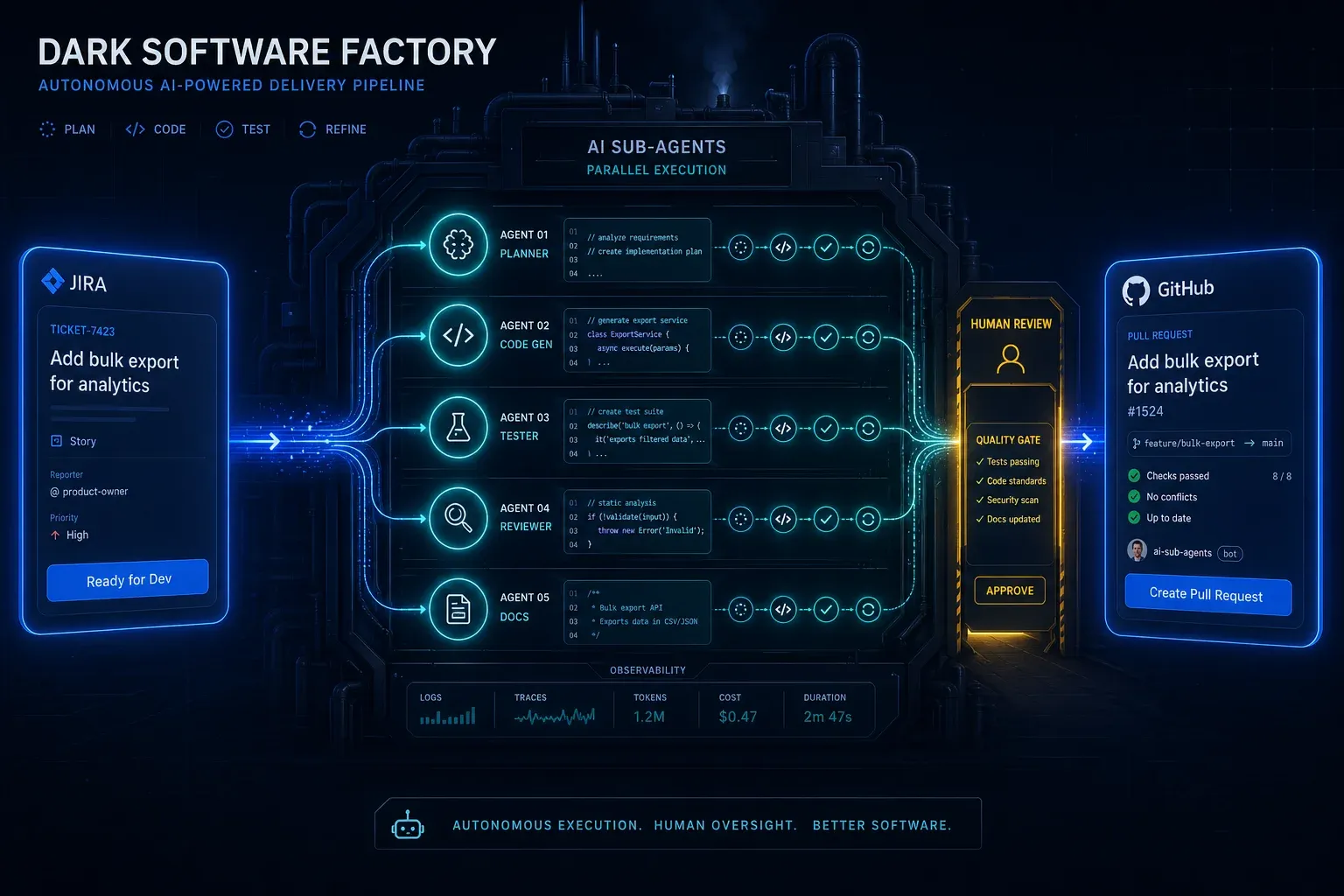
- Dark Software Factory — JIRA ticket to draft PR in ~20 minutes
- Speedboats — 1 Product Manager + 1 Engineer, one outcome, no sprint cadence
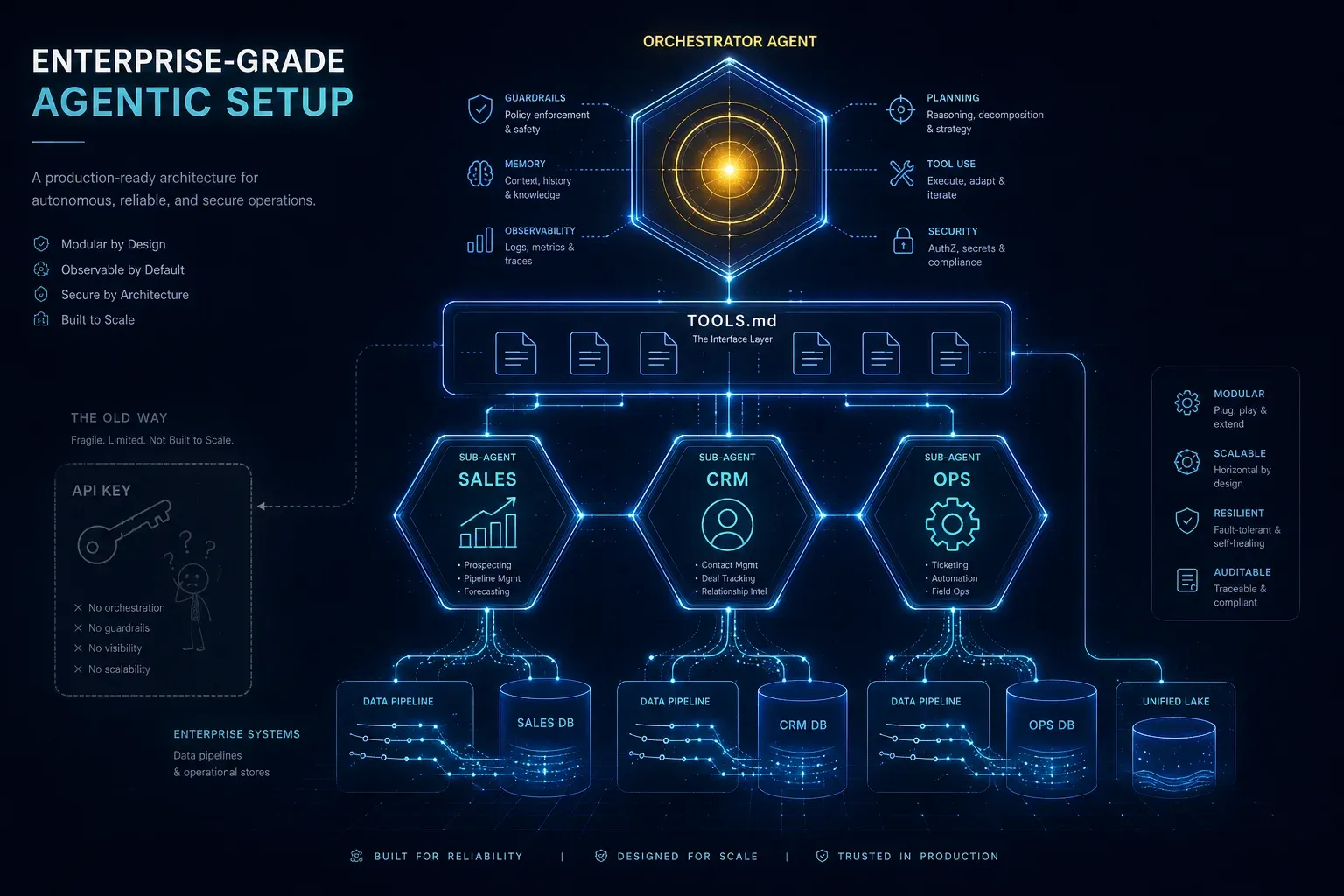
Both go beyond hype. They're the operationalized version of what we described in our piece on Enterprise-Grade Agentic Setup as "the gap between vibe coding and production-grade agentic architecture".
Pattern 1: Dark Software Factory
What happens technically
Drabek's description — condensed:
A ticket moves to "Ready for Dev" → the pipeline fires. The runner provisions itself, Claude Code writes the code, posts the PR back to JIRA, and shuts down. Every PR is still reviewed by a human before merge. That's why we don't call it "dark" yet.
Live since April 1, 9 orgs, 16 repositories. This isn't a sandbox.
Why this is becoming a standard pattern
The architecture follows a principle we see in every serious agentic setup:
| Component | Function | Why it matters |
|---|---|---|
| Trigger via status change | "Ready for Dev" as event bus | No custom API — uses existing workflows |
| Self-provisioning runner | GitHub Actions runner spins up on demand | No new infra, just agents on top |
| Claude Code as builder agent | Reads ticket context, writes code, opens PR | Coding agent with file access, not chat |
| Human review gate | PR reviewed by human before merge | Ownership stays with the engineer |
| Auto-shutdown | Runner terminates after posting PR | Cost control is an architectural default |
Stage 2 (in review): the same ticket fans out across multiple prompt and model variants in parallel, a Claude QA agent emits PASS/FAIL. That's head-to-head measurement of agent performance — not gut feel.
Stage 3 (in design): six agent stages from raw story to auto-merge — on the same infrastructure. The work is in the agents, not the platform underneath.
What changes for the people
Drabek's framing — and this is the honest part most posts skip:
Product managers and engineers stop spending hours translating tickets into code, and put that time into the parts only humans should own — the requirement, the review, the judgment call.
That's the right framing. Not "agents replace engineers", but "agents replace the boring 60% of the engineering workflow so humans can focus on the 40% that produce signal".
Pattern 2: Speedboats
The second pattern is organizational, not technical — but just as interesting.
A speedboat is exactly what it sounds like: one product manager and one engineer, paired on a single outcome, shipping outside the quarterly planning machine.
What a speedboat is:
- Prototype first: prove → review → release → learn
- Protected from backlog overhead
- Connected to the same platform standards as everyone else
What a speedboat is not:
- A standalone AI side-project
- A way around engineering review
- A permanent shadow team
This sounds like common sense. In large orgs, it's revolutionary. Quarterly planning is the defensive line where most innovative ideas die — not because they're bad, but because they don't fit into the next sprint.
The Connection: Both Patterns Require the Same Foundation
Drabek's last sentence is the most important:
Both rely on the same prerequisite: context infrastructure. AI does not fix weak systems — it amplifies what is already there.
That's exactly the point we make in every client engagement. You cannot throw a coding agent at a chaotic JIRA backlog with unclear tickets, missing acceptance criteria, and 200 open bugs and expect it to save the world. If you're cleaning up the backlog anyway, migrate from Jira to monday Dev — machine-readable tickets are a default there, not a discipline exercise.
What context infrastructure means in practice:
- Tickets machines can read — acceptance criteria, reproduction steps, linked spec, clear definition of done (see sprint planning with monday Dev)
- Repos that are navigable —
TOOLS.md,ARCHITECTURE.md, clear module boundaries (details in Enterprise-Grade Agentic Setup) - System prompts that don't weigh 12k tokens — disciplined sub-agent briefings instead of monolith prompts
- CI/CD pipelines that run deterministically — agents break on flakiness, humans tolerate it
That's the homework. Skip it and you'll buy a Claude Code account and produce expensive half-results. Do it and you'll build the Dark Software Factory.
Why This Is More Than a Groupon Case
Drabek isn't the first CTIO running agentic engineering in production — but one of the first to publicly describe the architecture instead of just celebrating outcomes. That matters because it sets a template:
- Trigger via existing tools (JIRA, monday Dev, Linear) — not new platforms
- Self-provisioning compute on existing CI/CD infra — not new "AI platforms"
- Coding agents with file access (Claude Code, Cursor) — not just chat wrappers
- Human gates at decisive points — not "full autonomy" as a marketing lie
- Parallel agent variants with QA verdict — performance measurement instead of vibes
If you're running an engineering org in 2026 and don't have this stack in pilot, you're already accruing debt.
What You Should Do Now
Three concrete moves, derived from Drabek's setup:
1. Audit your context infrastructure
Before you build the first agent: how many of your tickets could a human convert into a PR without follow-up questions? If the answer is below 50%, you have a ticket hygiene problem, not an AI problem.
2. Pilot on a clearly scoped repo
Pick a repo with high test coverage, clean architecture, and disciplined tickets. Not the messiest one — the cleanest. The agent needs wins, you need data.
3. Speedboat model as an organizational lever
Even without coding agents, you can test the speedboat pattern tomorrow: 1 PM + 1 engineer, one outcome, four weeks, out of the sprint cadence. You'll be surprised what happens.
Conclusion: This Is What Engineering Looks Like in 2026
Drabek's post matters because it demonstrably runs in production — not because it sounds impressive. Dark Software Factory + Speedboats aren't buzzwords, they're operational patterns with clear mechanics.
The gap between "we use ChatGPT for code snippets" and "JIRA ticket → PR in 20 minutes across 9 orgs" isn't gradual. It's an architectural leap. And it doesn't start with the agent — it starts with the context infrastructure underneath.
Source & credit: Original LinkedIn post by Ales Drabek — worth reading in full.
Read more:
- Enterprise-Grade Agentic Setup: Why an API key isn't an AI strategy — the architecture behind the software factory
- monday Dev: the most underrated dev tool of 2026 — the better frontend for agentic tickets
- monday Dev vs. Jira and monday Dev vs. Linear — tool comparison for agentic workflows
- Sprint planning with monday Dev — machine-readable sprints agents can work in
- Jira to monday Dev migration guide — backlog hygiene as an agent prerequisite
- Lovable Beyond Apps — when builders become platforms
Frequently Asked Questions
Dark Software Factory, speedboats and context infrastructure – Drabek's patterns explained.
Related Articles
Enterprise-Grade Agentic Setup: Why an API Key Is Not an AI Strategy
An API key on your website is child's play. An agentic setup with specialised sub-agents, TOOLS.md, clean system prompts…
Read more
Agent Skills Are Becoming an Industry Standard: What Teams Need to Know
Agent Skills are reusable capabilities for AI agents – and they're becoming the new standard. What sets them apart from …
Read more
Perplexity Computer: 19 AI Models, One System – The End of Single-Model Thinking
Perplexity just launched Computer – a multi-model agent that orchestrates 19 AI models to complete complex workflows aut…
Read more
Ponytail: The Best Code Is the Code You Never Wrote
A dev built Ponytail because his AI agents wrote 500 lines for a 5-line problem. The result: 80-94% less code, 47-77% ch…
Read more
Google's Agent Marketplace Goes Live – And monday.com Is Already Inside
Google just opened Gemini Enterprise to partner-built AI agents – and monday.com is one of the first in. What that means…
Read more
Globster: monday.com Enters the Personal AI Agent Game – on NVIDIA's NemoClaw
monday agent labs just launched Globster: personal AI agents built on OpenClaw, secured by NVIDIA's NemoClaw runtime. Wh…
Read more Deep Dive
Copilot vs. OpenClaw vs. Claude: Enterprise AI Agents Compared 2026
Three philosophies, one goal: AI agents in the enterprise. Microsoft Copilot (platform), OpenClaw (open source), Claude …
Read more
Agentalent.ai: monday.com Launches the First Marketplace for Hiring AI Agents
monday.com launches Agentalent.ai – a marketplace where companies can 'hire' AI agents for real business roles. Here's w…
Read more
AI Agent Ops: How to Monitor, Audit, and Control Agents in Production
Governance is the strategy – Agent Ops is the execution. How to monitor autonomous AI agents in production, audit every …
Read more