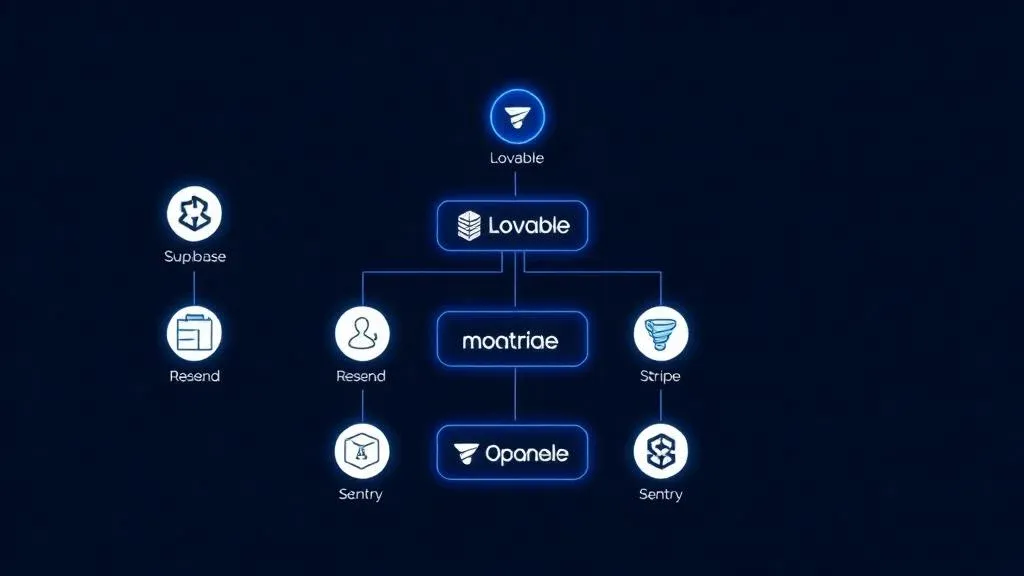
The Vibe Coding Stack 2026: Lovable, Supabase, Resend – And What's Still Missing

TL;DR: „Lovable + Supabase + Resend = the core stack for Vibe Coding projects. monday.com for operations, Stripe for payments, Sentry for monitoring. No compromise – production-ready."
— Till FreitagThis Is the Stack We Use to Build Apps in 2026
No 15-person dev team. No months of planning. No architecture debates lost in Confluence.
Instead: Three core tools, two for operations, and a handful of extensions that complete the stack depending on the use case. Everything you need to take a full-stack app from idea to launch.
This isn't a theoretical framework. It's the stack we use at Till Freitag in real projects – for SaaS apps, internal tools, customer portals, and automations.
The Core Stack: Three Tools, One App
Lovable – Frontend & UI
Lovable is the foundation. You describe what you want to build – Lovable generates React components, routing, styling, and deployment.
What Lovable covers:
- React + Vite + Tailwind CSS as the technical base
- Responsive UI components with shadcn/ui
- Routing, lazy loading, code splitting
- Lovable Cloud for integrated backend (Supabase under the hood)
- Git integration for version control
Lovable isn't a prototyping tool. It generates production code. Anyone claiming otherwise hasn't tested it since Q1 2026. More in our hands-on review.
Supabase – Backend & Database
Supabase delivers everything that happens behind the UI:
- PostgreSQL database – relational, scalable, with Row Level Security
- Auth – email, social login, magic links
- Edge Functions – serverless logic in TypeScript (Deno)
- Storage – files, images, documents
- Realtime – live updates via WebSockets
Why Supabase over Firebase? Open source. SQL over NoSQL. And a developer experience that's hard to beat in 2026. We've written the detailed comparison here.
Resend – Transactional Emails
Resend is the third building block. Not a newsletter tool – but the infrastructure for emails your app sends:
- Welcome emails after registration
- Password reset links
- Notifications and status updates
- Invoices and confirmations
Resend uses React components as email templates. If you use Lovable for your UI, you'll feel right at home. The Supabase Edge Function integration takes about 20 minutes.
Why This Exact Combination?
| Requirement | Tool | Alternative |
|---|---|---|
| Frontend & UI | Lovable | Cursor + manual setup |
| Database | Supabase (PostgreSQL) | PlanetScale, Neon |
| Auth | Supabase Auth | Clerk, Auth0 |
| Serverless Functions | Supabase Edge Functions | Vercel Functions, AWS Lambda |
| File Storage | Supabase Storage | S3, Cloudflare R2 |
| Transactional Email | Resend | SendGrid, Postmark |
The key point: Everything speaks the same language. React in the frontend, TypeScript in Edge Functions, React templates in Resend. One stack, one ecosystem, one learning curve.
Optional: monday.com for Operations
Not every app needs its own ticketing system or CRM. But when it does, we integrate monday.com – not as a workaround, but as a strategic extension.
monday.com Service – Ticketing & Support
When your app generates customer inquiries, you need a system for that. monday.com Service provides:
- Ticket creation via email, form, or API
- SLA tracking and automatic escalation
- Knowledge base for self-service
- Integration with CRM for complete customer context
The trick: Supabase Edge Functions can create tickets directly in monday.com – via API, trigger-based, without manual effort.
monday.com CRM – Sales Pipeline
For B2B apps with a sales process, monday.com CRM is the natural extension:
- Lead capture directly from the app (form → Supabase → monday.com)
- Pipeline management with automatic stage transitions
- Email tracking and activity logs
- Dashboards for sales teams
What's Still Missing: The Extensions
The core stack covers 80%. For the remaining 20%, depending on the project:
Stripe – Payments
If your app needs to make money, there's no way around Stripe. Subscriptions, one-time payments, invoicing – all through one API. Integration runs through Supabase Edge Functions and webhooks.
Vercel – Hosting & Custom Domains
Lovable hosts apps on its own infrastructure by default. For custom domains and advanced deployment options, Vercel is the first choice. Push to GitHub → auto-deploy. Done.
Sentry – Error Monitoring
Production without monitoring is like driving without a speedometer. Sentry catches errors before your users notice them. React Error Boundaries + Sentry = complete visibility.
PostHog – Product Analytics
PostHog instead of Google Analytics. Open source, GDPR-friendly, with session recordings and feature flags. Essential if you want to iterate data-driven.
GitHub + Claude Code – Development Workflow
Lovable pushes code to GitHub. From there, Claude Code takes over for complex refactoring, tests, and architecture decisions. This isn't either-or – it's a workflow:
- Lovable for new features and UI changes
- Claude Code for deep code optimization
- GitHub as the single source of truth
Example Setup: SaaS App with Auth, Payments, and Emails
Here's what a concrete project using the full stack looks like:
┌─────────────────────────────────────────────────┐
│                    Lovable                       │
│           React + Vite + Tailwind               │
│        UI Components, Routing, State            │
└───────────────────┬─────────────────────────────┘
                    │
┌───────────────────▼─────────────────────────────┐
│                  Supabase                        │
│  ┌──────────┐ ┌──────────┐ ┌──────────────────┐ │
│  │PostgreSQL│ │   Auth   │ │  Edge Functions  │ │
│  │ Data     │ │ Login    │ │  Business Logic  │ │
│  └──────────┘ └──────────┘ └────────┬─────────┘ │
│                                     │           │
│  ┌──────────┐                       │           │
│  │ Storage  │                       │           │
│  │ Files    │                       │           │
│  └──────────┘                       │           │
└─────────────────────────────────────┼───────────┘
                                      │
              ┌───────────────────────┼──────────────────┐
              │                       │                  │
    ┌─────────▼──────┐    ┌──────────▼────┐   ┌────────▼────────┐
    │     Resend     │    │    Stripe     │   │   monday.com    │
    │  Emails        │    │  Payments     │   │  CRM / Service  │
    └────────────────┘    └───────────────┘   └─────────────────┘
User Flow:
- User signs up → Supabase Auth
- Welcome email → Resend (via Edge Function)
- User selects plan → Stripe Checkout (via Edge Function)
- Subscription active → Supabase DB stores status
- Support request → monday.com Service (via Edge Function)
- Error in production → Sentry alerts
- Feature usage → PostHog tracks
Conclusion: No Compromise
This stack isn't an MVP hack. It's a production architecture that grows with the product.
What makes it special:
- One language: TypeScript everywhere – frontend, backend, emails
- One ecosystem: Tools that work together natively
- No ops: No server management, no Docker, no Kubernetes
- Scalable: From 0 to 10,000 users without architecture changes
The companies building fastest in 2026 don't have the biggest teams. They have the right stack – and the discipline to use it consistently.
Want to see the stack in action? We'll build your next project with it. Get in touch.
Related Articles

Ponytail: The Best Code Is the Code You Never Wrote
A dev built Ponytail because his AI agents wrote 500 lines for a 5-line problem. The result: 80-94% less code, 47-77% ch…
Read more
Build a SaaS Dashboard with Lovable: From Prompt to Production
A complete SaaS dashboard with charts, auth and database – built with Lovable in an afternoon. Step-by-step tutorial wit…
Read more Deep Dive
Vibe Coding Tools Compared: Cursor vs. Lovable vs. Kiro vs. Claude Code vs. Trae (2026)
Which vibe coding tool is right for you? We compare 15+ tools across 7 categories – from AI IDEs to agentic coding tools…
Read more
What Is Vibe Coding? Building Software with AI – Simply Explained
Vibe Coding is revolutionizing software development: describe what you want – AI writes the code. Everything about the t…
Read more
Vibeland Kickoff Munich – Recap: 50 People, 7 Teams, 7 Products
Recap of the Vibeland Kickoff in Munich: 50 guests, 7 teams, 7 products in a single day – from a web scraper to the Bla-…
Read more
Lovable Skills: Repetition Turns Into Reusable Playbooks
Lovable just rolled out Skills – Anthropic's format for reusable agent instructions. What Skills are, how they differ fr…
Read moreVibeland Kickoff Munich: Why We're Putting Our Own Builder Event on a Rooftop
On May 20, we're building apps live on the WERK3 rooftop terrace in Munich's Werksviertel – with Lovable, p0, Claude and…
Read more
The Vibe Coding Explosion: 138 Tools – and Why Only 7 Categories Matter
138+ vibe coding tools on the market – and more every week. We sort the chaos into 7 categories and analyze which ones w…
Read more
monday Vibe Q1/2026: A Year's Backlog in One Quarter – The Biggest Update Since Launch
monday.com shipped an entire year's backlog for Vibe Apps in Q1/2026. 19+ features, 26 A/B tests, mobile support, Gmail/…
Read more