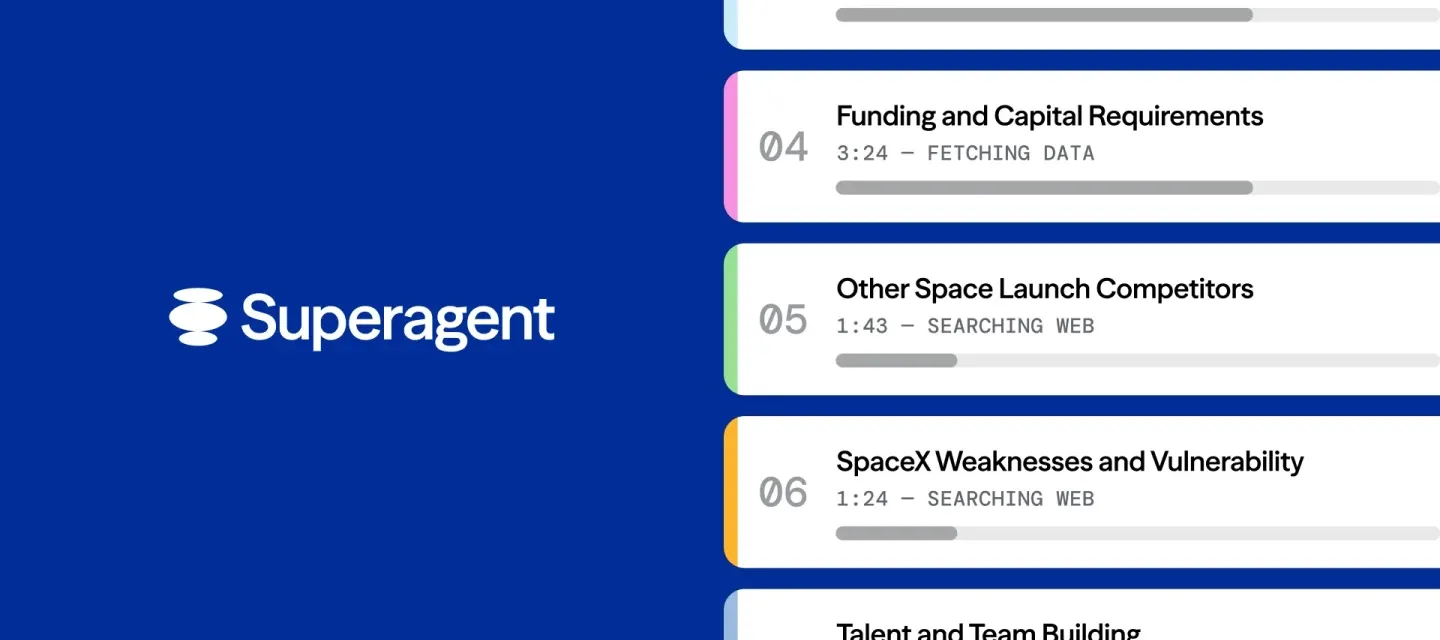
Airtable Superagent: The First Multi-Agent System That Delivers Finished Work

TL;DR: „Airtable Superagent is a standalone multi-agent system born from the DeepSky acquisition. A central orchestrator coordinates specialized agents in parallel with full context visibility. The result: finished, presentation-ready deliverables in minutes, not weeks. The classic consulting model is now officially challenged."
— Till Freitag🚨 Update April 2026: Superagent is shutting down. Airtable announced that Superagent will be discontinued. Everything users loved has been rebuilt into a new product: HyperAgent – a full platform for building and deploying agent fleets. New users get $1,000 in starter credits.
→ Read the HyperAgent Review · Go to the HyperAgent platform
30-Second Version
Airtable has launched Superagent – its first standalone product outside the core no-code platform. The system orchestrates multiple specialized AI agents in parallel to solve complex research tasks, delivering interactive, decision-ready reports instead of chat responses.
Built on technology from DeepSky (formerly Gradient), acquired by Airtable in October 2025. Uses models from OpenAI, Anthropic, and Google for different sub-tasks.
Airtable CEO Howie Liu puts it simply:
"You're not prompting an AI. You're orchestrating a team."
The McKinsey Killer in a Box
Before we dive into the tech, let's talk about the real disruption.
Superagent doesn't replace a chatbot. It replaces a consulting team.
What McKinsey, BCG, or Bain deliver in 4–12 weeks – stakeholder interviews, market analyses, competitive benchmarks, packaged in 200-page decks – Superagent produces in minutes. Not as a text dump, but as interactive, filterable, presentation-ready artifacts.
Howie Liu describes the ambition clearly:
"The output isn't raw material. It is the deliverable."
This is exactly what we've been preaching for months: We are the Anti-McKinsey for AI. The difference: where we deploy human senior experts who deliver in weeks, Superagent deploys agent fleets that deliver in minutes. Both make the classic consulting model obsolete – just at different levels.
Three examples from Howie Liu's announcement:
- Market expansion: Ask Superagent where your US-based premium athleisure brand should expand first in Europe → you get an interactive market analysis with demographic breakdowns, competitive presence mapped visually, and filterable expansion timelines
- Investment analysis: Evaluate Google as a 3-year investment opportunity → structured assessment with earnings call citations, defensibility analysis against OpenAI/Anthropic with side-by-side comparisons, and risk factors you hadn't considered
- Pitch preparation: Brief on Wells Fargo's AI strategy before pitching your compliance product → regulatory posture, recent AI investments with deal details, and specific pain points your product addresses
Or as Howie puts it: "What if every task you tackled came with New York Times-quality data visualization? With Superagent's multi-agent architecture, it's the default."
What Is Superagent?
Superagent is neither a chatbot nor a plugin. It's a multi-agent system for research tasks – a standalone product that operates independently from Airtable's core platform.
The workflow:
- Submit a task: Describe a complex research question
- Planning: The orchestrator breaks the task into parallel workstreams
- Parallel execution: Specialized agents work simultaneously on different aspects – one analyzes financials, another the competitive landscape, another reviews news and management
- Synthesis: Results are compiled into an interactive, decision-ready report
Howie Liu highlights the difference from traditional chat products:
"Instead of a sequential summary built by one agent working through tasks one at a time, Superagent deploys a coordinated team to investigate multiple dimensions simultaneously."
Example: Ask "Analyze Company X for investment purposes." Superagent breaks this into: research the team, review funding history, analyze the competitive landscape – all in parallel, all with sources.
The Technical Innovation: Context-Aware Orchestration
What sets Superagent apart from other multi-agent approaches is the orchestrator's context visibility. Earlier systems used simple model routing – an intermediary filtering information between models. Superagent goes further:
- Full visibility: The orchestrator sees the entire execution path – initial plan, individual steps, sub-agent results
- Self-correction: When a research path doesn't work, the orchestrator recognizes it and tries a different approach – without repeating the same mistake
- Clean context: Sub-agents deliver cleaned results without "polluting" the main context
Howie Liu: "It ultimately comes down to how you leverage the model's self-reflective capability."
Professional-Grade Sources
Superagent pulls from premium data sources like FactSet, Crunchbase, SEC filings, and earnings transcripts. Insights are verified, cited, and traceable – a fundamental difference from ChatGPT research that primarily relies on web scraping.
Open-Ended Agent Harness
Howie Liu describes the architecture as deliberately open:
"Unlike older agents that follow rigid, hard-coded paths, Superagent uses a flexible architecture that gives agents autonomy to navigate different approaches, coordinate with each other, backtrack when needed, and adapt to what each specific task requires."
Why Airtable Bets on Data Semantics
Perhaps the most important insight from Superagent's development: data quality beats prompt engineering.
Airtable built an internal analysis tool to figure out what actually works with agents. The result:
Most of the effort went into data semantics, not the agent harness. Agents benefit massively from good data structure.
Three areas were critical:
- Structuring data so agents can find the right tables and fields
- Clarifying what fields mean – semantically, not just technically
- Ensuring agents can reliably use the data in queries and analysis
This is an argument for relational databases like Airtable over document stores – and a clear strategic advantage.
Our Analysis: Three Strategic Layers
Layer 1: From Data Tool to Intelligence Layer
Airtable is repositioning itself. The no-code platform stays for structured workflows. Superagent addresses unstructured research – an entirely new market. Together, they form a dual format covering the entire information workflow.
Howie Liu sees a natural complementarity:
"There's a natural complementarity – almost a yin and yang – between the structured data and application layer that Airtable provides and the autonomous, coordinated intelligence that Superagent delivers."
Layer 2: The DeepSky Bet Pays Off
DeepSky (formerly Gradient) brought expertise in long-context models and multi-agent orchestration. The fact that Superagent launched just months after the acquisition shows: Airtable didn't just acquire technology – they acquired a complete team with a ready product. Complementing the team is David Azose as CTO, who previously led ChatGPT's business products at OpenAI.
Layer 3: Against the Valuation Crisis
Airtable's valuation dropped from $11.7B (2021) to approximately $4B on secondary markets. Superagent is the answer: a new revenue model beyond the core platform that positions Airtable in the high-growth "AI Agents" category.
From Superagent to HyperAgent: The Evolution (Update April 2026)
Airtable made it official: Superagent is being shut down. The team has rebuilt everything users loved into a new, far more comprehensive product: HyperAgent – a full platform for building and deploying agent fleets. New users get $1,000 in starter credits.
This confirms what we already outlined here: Superagent was a proof of concept; HyperAgent is the platform.
| Aspect | Superagent | HyperAgent |
|---|---|---|
| Focus | Research & Analysis | Enterprise Agent Deployment |
| Scope | Individual complex tasks | Fleets of specialized agents |
| Skills | Implicit (via sub-agents) | Explicitly learnable and improvable |
| A/B Testing | ❌ | ✅ Built-in |
| Fleet Management | ❌ | ✅ Central control |
| Evaluation | Internal quality assurance | LLM-as-Judge rubrics |
Where Superagent proves that multi-agent systems work, HyperAgent will prove that they scale. Skills that improve with every run. A/B tests for prompts, models, and tools. Centralized monitoring of all agents. That's the infrastructure companies need when moving from one agent to ten, fifty, or a hundred.
→ Read our full HyperAgent analysis
The End of the 200-Page Deck
Howie Liu articulates the paradigm shift unambiguously:
"We've been talking about agents for two years, but what we had even a year ago weren't real agents. They were workflows: predefined series of steps with some LLM calls mixed in. Now we have true multi-agent systems."
And further:
"Agents don't just help you work. They do the work."
For the consulting industry, this means: the business model of complexity – which we analyzed here – faces its greatest disruption yet. When a multi-agent system delivers a competitive analysis in 5 minutes that a 6-person consulting team would have taken 6 weeks to produce, the question is no longer whether consulting will change, but how fast.
The future doesn't belong to the largest team, but to the best orchestration. Whether through human experts like us – or through agent fleets like Superagent and HyperAgent.
Comparison: Superagent vs. Other Approaches
| Aspect | Airtable Superagent | ChatGPT Deep Research | Perplexity Pro |
|---|---|---|---|
| Architecture | Multi-agent with central orchestrator | Single-agent with tool use | Single-agent with web search |
| Output | Interactive reports | Text-based reports | Source-based answers |
| Context management | Full orchestrator visibility | Within single context window | Search-based |
| Models | OpenAI + Anthropic + Google | GPT-5 | Proprietary |
| Sources | FactSet, Crunchbase, SEC, Earnings Transcripts | Web research | Web research |
| Strength | Complex multi-aspect research | Deep dive into a topic | Fast, source-based answers |
What's Still Missing?
Superagent is impressive, but still young:
- No Airtable integration – yet. Howie announces: "You'll soon be able to invoke Superagent directly from your Airtable bases"
- Limited sources – currently primarily FactSet, Crunchbase, and SEC – expansion planned
- No self-scheduling – only responds to queries, doesn't act proactively (that's coming with HyperAgent)
- Enterprise pricing unclear – exact costs and quotas haven't been transparently communicated
What This Means for Companies
- Prioritize data semantics: Before deploying agents, invest in clean data structures – it delivers more value than any prompt tuning
- Take orchestration seriously: "Just stitching LLMs together" isn't enough – a central orchestrator with planning capability is essential
- Multi-agent as the new standard: The question is no longer whether, but how teams of specialized agents collaborate
- Question your consulting spend: Do you really need 6 consultants for 12 weeks – or a well-orchestrated agent workflow?
We help companies evaluate multi-agent architectures and find the right orchestration approach – whether with Superagent, HyperAgent, or custom architecture. → Book a consultation
Further Reading
Related Articles

Agent Swarm Architectures Compared: Kimi K2.5 vs. Airtable HyperAgent vs. CrewAI
Three fundamentally different approaches to multi-agent AI: model-native swarms, platform orchestration, and developer f…
Read more
Antigravity in Practice: Multi-Agent Pipelines for Mid-Market Clients
Antigravity moves multi-agent pipelines from lab toy to production tool. A hands-on architecture walkthrough from active…
Read more
HyperAgent Field Notes #3: From a Single Role to a Fleet
One productive role becomes three. And suddenly the interesting question isn't 'does the role work?' but 'are the roles …
Read morePaperclip: If OpenClaw Is the Employee, Paperclip Is the Company
Paperclip is open-source infrastructure that lets you run an entire AI company — org chart, budgets, approvals, audit tr…
Read more Deep Dive
HyperAgent Competitors 2026: Who plays in the same league – and why Globster looks suspiciously similar
HyperAgent isn't alone. Globster looks suspiciously similar in the interface, Manus goes the autonomous solo route, Lind…
Read more
HyperAgent Field Notes #2: From Skill to Deployable Role
The watchlist skill from Field Notes #1 becomes a real role: with Slack trigger, budget cap, and permission scope. This …
Read more
HyperAgent Field Notes #1: Setup, First Skill, and the Lesson from Day One
We are closed-beta partners at HyperAgent. First field note from the trenches: what happens in the first 60 minutes, whi…
Read more
Make vs. Claude Code vs. OpenClaw – Picking the Right Orchestration Layer (2026)
Make.com, Claude Code, or OpenClaw? Three tools, three layers of the stack. Here's when to pick which orchestration tool…
Read more
Perplexity Computer: 19 AI Models, One System – The End of Single-Model Thinking
Perplexity just launched Computer – a multi-model agent that orchestrates 19 AI models to complete complex workflows aut…
Read more