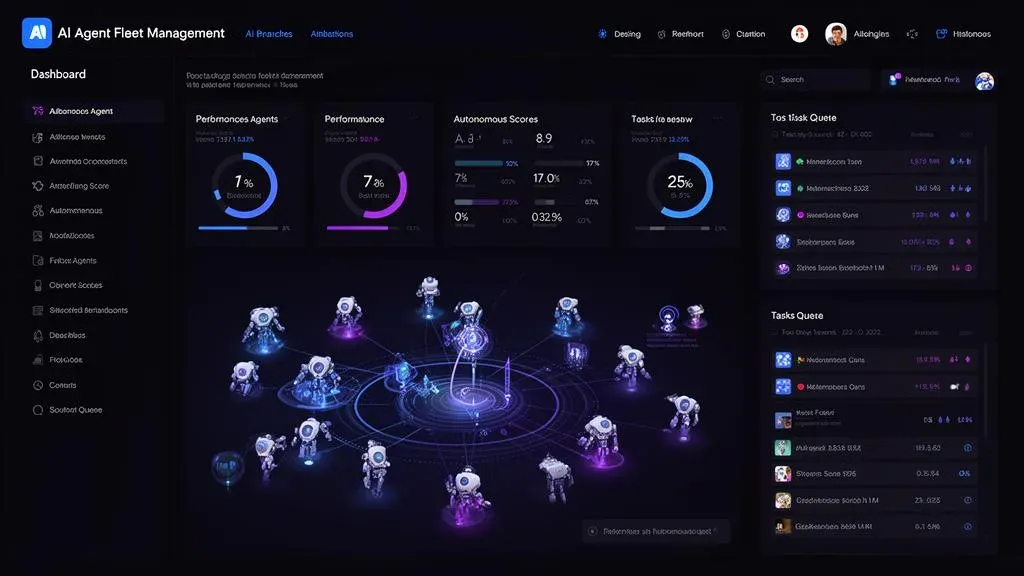
HyperAgent Review 2026: The Agent Platform for Teams Ready to Scale AI

TL;DR: „HyperAgent isn't a chat app with plugins – it's a platform for teams building, training, and scaling entire agent fleets. Impressive vision, but still in early access."
— Till FreitagPersonal note: We are part of the closed beta of HyperAgent and are excited to follow the platform from day one. We share our practice notes in the HyperAgent Field Notes series and on the HyperAgent tool page.
In 30 Seconds
HyperAgent positions itself as the complete platform for deploying AGI-level agents. While tools like ChatGPT or Manus AI solve individual tasks, HyperAgent wants to orchestrate entire agent fleets – with learnable skills, A/B testing, and fleet management.
The core thesis: Intelligence is no longer the bottleneck. Harnessing it is.
What Is HyperAgent?
HyperAgent is a platform that enables teams to configure, train, and deploy AI agents as autonomous workers. Each agent gets:
- Frontier models as its foundation (GPT-4, Claude, Gemini)
- Tools like browser, shell, code execution, image/video generation, and enterprise integrations
- Skills – reusable capabilities that improve with every run
- Roles – pre-configured agent packages with triggers for automatic activation
Quick Facts
- Team: Howie Liu (CEO of Airtable) as founder
- Status: Early Access / Waitlist
- Focus: Enterprise Agent Deployment & Fleet Management
- Differentiator: Skill system + agent fleets + LLM-as-Judge evaluation
The 4 Pillars of HyperAgent
1. Out-of-the-Box Agent Power
HyperAgent doesn't start from zero. The agent immediately has access to browser, shell, file system, code execution, and hundreds of integrations. This sets it apart from ChatGPT, where you need to activate and configure plugins first.
2. Learnable Skills
The most exciting feature: Skills codify how work gets done. A skill can be:
- How you use the Stripe API for refunds
- How your due diligence framework operates
- How press releases are written in your voice and process
Skills automatically improve through suggested refinements after every run. The system even recommends new skills when the agent identifies valuable patterns.
3. Deployable Roles
A tested agent becomes a role: system prompt, skills, tool access, model selection, budget limits – all bundled. This role can be deployed to Slack with triggers and act proactively.
4. Fleet Management
The enterprise feature: Monitor all agents centrally – usage, performance, cost. Every run is scored with LLM-as-Judge against configurable eval rubrics. And: A/B testing for any change to models, prompts, skills, or tools.
HyperAgent vs. Manus AI vs. Lindy vs. ChatGPT
| Feature | HyperAgent | Manus AI | Lindy | ChatGPT |
|---|---|---|---|---|
| Autonomy | High – proactive agents with triggers | High – autonomous task execution | Medium – pre-configured workflows | Low – responds to prompts |
| Learnable Skills | ✅ Core feature | ❌ | ❌ | ❌ (Custom GPTs are static) |
| Multi-Agent | ✅ Fleet Management | ❌ Single agent | ✅ Teams of Lindies | ❌ |
| A/B Testing | ✅ Built-in | ❌ | ❌ | ❌ |
| Enterprise Integrations | Hundreds + Slack deployment | Web, Telegram, WhatsApp | 3,000+ integrations | Plugins, GPT Actions |
| Evaluation | LLM-as-Judge rubrics | Manual | Manual | Manual |
| Availability | Early Access / Waitlist | Public (credit-based) | Public (from $49/mo) | Public (from $20/mo) |
| Pricing | Not yet announced | Credits (from $0) | From $49/month | From $20/month |
Where HyperAgent Wins
- Skill system: No other tool offers learnable, self-improving capabilities
- Fleet management: Central overview of all agents – essential for teams running 10+ agents
- A/B testing: Systematic optimization instead of trial-and-error
- Evaluation: LLM-as-Judge makes agent quality measurable
Where HyperAgent (Still) Falls Short
- Availability: Waitlist only – no instant access
- Pricing transparency: No public pricing yet
- Track record: New to market, no known production references
- Solo users: Overengineered for someone who just wants to get a task done quickly
Mapping to the 5 Building Blocks of an AI Agent
Measured against the 5 building blocks of an AI agent, HyperAgent covers all of them:
- Runtime: Multi-model routing with frontier models ✅
- Channels: Slack deployment with trigger system ✅
- Memory: Skill system as implicit long-term memory ✅
- Tools: Comprehensive tool suite out-of-the-box ✅
- Self-Scheduling: Proactive agents with configurable triggers ✅
That's rare. Most platforms are strong in 2–3 building blocks and have gaps in the others.
Who Is HyperAgent For?
Ideal for:
- Teams building agent fleets – sales, support, research in parallel
- Companies with recurring processes – that can be codified into skills
- Ops teams that want to systematically measure and optimize agent performance
Not ideal for:
- Solo users who need quick research → Manus AI or ChatGPT
- Teams without budget who want to start immediately → Lindy or ChatGPT
- Simple workflow use cases → Make or n8n will do
Conclusion
HyperAgent is the most ambitious agent platform I've seen in 2026. The combination of learnable skills, fleet management, and LLM evaluation puts it conceptually above everything else on the market.
But: It's early access. No public pricing. No known production references. The vision is compelling – the execution still needs to prove itself.
Three takeaways:
- Skills as differentiator – teams that can translate process knowledge into AI skills gain a real competitive edge
- Fleet management is becoming standard – individual agents aren't enough, teams need orchestration
- Evaluation is mandatory – without measurable quality, agent deployment is gambling
As closed-beta participants we will test the platform intensively over the coming weeks and share our experience here – from setup over the first skills to fleet scaling. Stay tuned.
→ HyperAgent tool overview → HyperAgent Field Notes #1: Setup & First Skill → HyperAgent Field Notes #2: From Skill to Deployable Role → HyperAgent Field Notes #3: From Role to Fleet → Learn more about Agentic Engineering → The 5 Building Blocks of an AI Agent → Manus AI Review
Related Articles
 Deep Dive
HyperAgent Competitors 2026: Who plays in the same league – and why Globster looks suspiciously similar
HyperAgent isn't alone. Globster looks suspiciously similar in the interface, Manus goes the autonomous solo route, Lind…
Read more
Manus AI Review 2026: What the Autonomous AI Agent Actually Delivers – and Where It Falls Short
Manus AI promises autonomous task execution – code, research, data analysis, all without babysitting. We tested the AI a…
Read more
HyperAgent Field Notes #3: From a Single Role to a Fleet
One productive role becomes three. And suddenly the interesting question isn't 'does the role work?' but 'are the roles …
Read more
HyperAgent Field Notes #2: From Skill to Deployable Role
The watchlist skill from Field Notes #1 becomes a real role: with Slack trigger, budget cap, and permission scope. This …
Read more
HyperAgent Field Notes #1: Setup, First Skill, and the Lesson from Day One
We are closed-beta partners at HyperAgent. First field note from the trenches: what happens in the first 60 minutes, whi…
Read more
Personal AI Assistants 2026 – Market Overview, Frameworks & What Actually Works
From Manus AI to Lindy to Viktor – the personal AI agent market is exploding. We map the ecosystem into three categories…
Read more
Make vs. Claude Code vs. OpenClaw – Picking the Right Orchestration Layer (2026)
Make.com, Claude Code, or OpenClaw? Three tools, three layers of the stack. Here's when to pick which orchestration tool…
Read more
No-Code Agent Development – What Is It, Really?
Building AI agents without code? No-Code Agent Development makes that possible. We break down what it means, which tools…
Read more
monday.com MCP: All Available Tools and Integrations Overview
monday.com offers two powerful MCP servers – Platform MCP and Apps MCP – plus native integrations for Claude, Cursor, Ch…
Read more