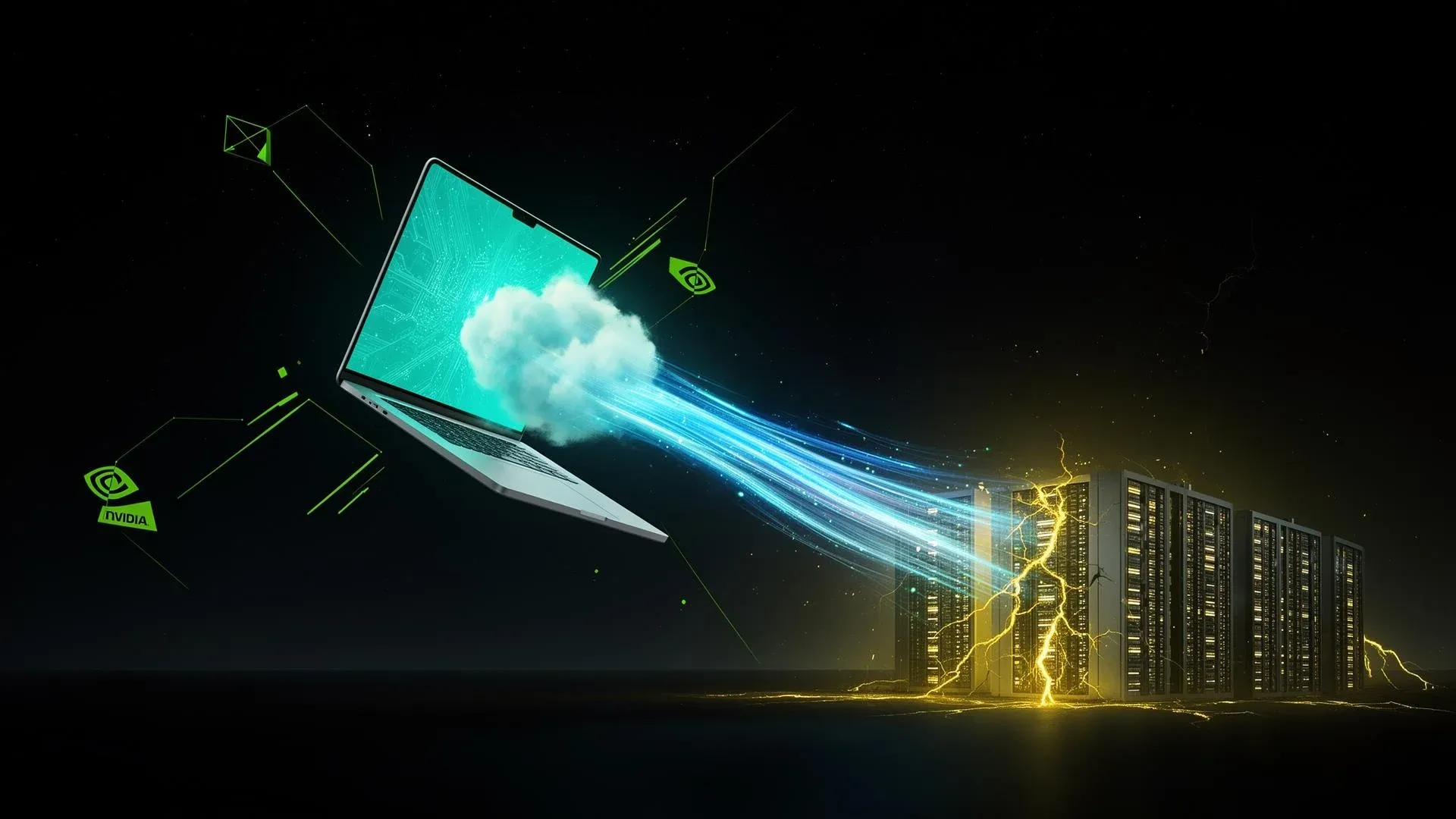
NVIDIA RTX Spark: When the Laptop Becomes the AI Cloud – Local AI First Gets Real

TL;DR: „With the RTX Spark platform, NVIDIA brings DGX-Spark-class inference straight into Windows laptops. For developers, agencies and the upper mid-market, Local AI First becomes a realistic default architecture: GDPR without DPA marathons, predictable token cost, sub-100 ms latency. Hyperscaler dominance just got its first real cracks."
— Till FreitagWhat Shifted This Week
NVIDIA announced the RTX Spark platform – and what insiders had been expecting since DGX Spark is now happening: the same class of local AI performance moves from a mini-desktop straight into the Windows laptop.
That sounds like a hardware story. It isn't. It's an architectural decision that will shift the default stack of many companies over the next 12–18 months.
✅ DGX Spark was the proof: workstation-class local AI inference, Ubuntu-based (DGX OS), for techies. ✅ RTX Spark is the distribution: same performance class, deeply integrated into Windows, for 100× more devices.
The Specs in Plain Words
Anyone still thinking „local LLM" automatically means „toy" should look at the numbers:
| Metric | Cloud LLM today | RTX-Spark-class local |
|---|---|---|
| Inference throughput (text) | ~50–150 tokens/s per user | ~1,700 tokens/s local |
| Latency (time-to-first-token) | 200–800 ms (network + queue) | <50 ms (PCIe-direct) |
| Model size | up to 1T+ parameters remote | up to ~70B parameters quantized locally |
| Data location | provider's US/EU cloud | RAM/SSD of the device |
| Variable cost | $/token | 0 (hardware already paid) |
| Offline capable | ❌ | ✅ |
| GDPR processing contract | DPA + TIA required | not applicable (local) |
Yes, 1,700 tokens/s locally is real. That's DGX-Spark-class in a notebook form factor, fed by an RTX Spark GPU with a dedicated tensor pipeline, fast unified memory and a Windows driver/runtime integration that keeps models pinned in GPU memory.
For what this looks like in practice: Local LLMs with Ollama benchmarks.
The Cloud-Killer Factor: Data Sovereignty & Cost Control
Why should companies in 2026 still send sensitive customer data and trade secrets across external servers when the local hardware reads text prompts at 1,700+ tokens per second?
Three hard arguments:
1. GDPR Without the DPA Marathon
As soon as a prompt never leaves the device, you can drop data processing agreements, transfer impact assessments, SCCs, and the US-cloud risk dance. That's not a compliance edge – that's an entire compliance category gone.
Details: OpenClaw Self-Hosting & GDPR and Privacy Router with OpenClaw.
2. Variable Cost Goes to Zero
A productive in-house workload with ~10M tokens/day per employee racks up three-figure per-person monthly bills on frontier models. Locally: one-time hardware investment, then electricity.
Run the math in our AI Token Cost Calculator. Pricing reality on the hyperscaler side: OpenClaw pricing shock.
3. Latency & Offline Capability
Agents that triage in the background, run code reviews or transcribe sales calls need sub-100 ms latency. You cannot get that reliably through the cloud – over PCIe you can. And on a train, on a plane, in a customer office without solid wifi: only local works at all.
What This Means for the Hyperscalers
The hyperscaler dominance is showing its first deep cracks. Not because the cloud goes away – but because the default shifts:
- Before: „We use a foundation model in the cloud, local only when strictly necessary."
- Soon: „We run locally, cloud only when strictly necessary (scaling, specialty models, huge context windows)."
This is exactly the same motion we already see on the agent layer – see Microsoft Scout runs on OpenClaw: even hyperscalers now build their flagship products multi-vendor, open and runtime-agnostic.
Enterprise scale will still need the cloud (massive throughput, frontier GPT/Claude-class models, huge context windows). But for developers, agencies and the upper mid-market, the rule from here on is: Local AI First.
What a Local-AI-First Stack Looks Like in 2026
In concrete terms: a clean four-layer architecture.
| Layer | Component | Example |
|---|---|---|
| Hardware | Local GPU/tensor unit | NVIDIA RTX Spark notebook, DGX Spark |
| Runtime | Local inference server | Ollama, llama.cpp, vLLM, NIM |
| Gateway | Tool/permission layer | OpenClaw, self-hosted |
| Routing | What stays local, what goes cloud? | Privacy Router |
Going deeper per layer:
- Runtime comparison: Agent runtime comparison and Agent sandboxing compared
- Agents as a whole construct: The 5 Building Blocks of an AI Agent
- Who does what in the market: Copilot vs. OpenClaw vs. Claude and Make vs. Claude Code vs. OpenClaw
✅ Important: RTX Spark is the hardware layer. To turn it into a real stack you need a gateway layer on top (permissions, audit, tool routing) and a privacy router that decides at runtime: process locally or send to the cloud after all.
What Companies Should Do Now
Three concrete steps – not a McKinsey roadmap, just builder reality:
- Hardware pilot: Get 2–3 RTX Spark notebooks or DGX Spark units. Not for „later" – for this sprint. Benchmark workloads: which prompts run locally at acceptable quality?
- Data classification: Which data must never leave the machine? Those workloads move first. Helpful: autonomous AI agents and governance.
- Build routing logic: Instead of „all ChatGPT" or „all local" → route by sensitivity, latency and model need. Exactly the pattern from the Privacy Router guide.
Companies that skip these three steps in 2026 are building their AI architecture on a melting hyperscaler default.
Bottom Line
▶️ RTX Spark isn't „yet another GPU release". It's the moment Local AI First flips from „tech demo" to „realistic default architecture" for the mid-market.
NVIDIA understands that the future of AI doesn't live only in gigantic, power-hungry server farms – but distributed, on the devices of the people actually using it.
Who still needs a cloud instance when the laptop on your lap does the same job – GDPR-clean, low-latency, no token bill?
Designing your 2026 AI architecture and trying not to get stuck in the hyperscaler trap? Talk to us – we build Local-AI-First stacks that take your compliance, latency and cost requirements seriously.
More on this topic: OpenClaw Self-Hosting & GDPR · Local LLMs with Ollama benchmarks · Privacy Router with OpenClaw · OpenClaw pricing shock · Microsoft Scout runs on OpenClaw · What is OpenClaw? · The 5 Building Blocks of an AI Agent · Agent runtime comparison · Autonomous AI agents and governance · AI Token Cost Calculator
Related Articles
Gemma 4: Frontier Intelligence Goes Laptop-Sized – The Hype Is Real
Google's Gemma 4 delivers GPT-4 level intelligence in 14 GB. 85 tokens per second on consumer hardware, 256K context, na…
Read more
OpenClaw Self-Hosting Guide: GDPR-Compliant in 30 Minutes
Self-host OpenClaw with Docker, persistent storage, and local LLMs via Ollama – fully GDPR-compliant because no data eve…
Read more
Is Local AI Killing the AI-SaaS Startups? An Honest View From the Engine Room
Meetily takes meeting notes fully locally. Qwen runs on a laptop. RTX Spark hits notebooks in 2026. Are all the AI-wrapp…
Read more
Gemma 4 12B Coder: Local Code Generation Becomes the Default
Google ships the Gemma 4 12B Coder — the specialized coding variant of the Gemma 4 stack. 12B parameters in GGUF format,…
Read more
PewDiePie's Odysseus: The real question isn't AI sovereignty – it's the AI workplace
PewDiePie's open-source project Odysseus hit 30,000 GitHub stars in 48 hours. The more interesting question behind it: w…
Read more Deep Dive
Enterprise Gateway Layer 2026: LiteLLM, Portkey, Cloudflare, Kong, AWS Strands & Privacy Router
Enterprises need an LLM gateway today – Microsoft Scout is only announced. LiteLLM, Portkey, Cloudflare AI Gateway, Kong…
Read moreSelf-Hosted & Privacy Layer 2026: Ontheia, Anything LLM & Privacy Router
If you take GDPR seriously, there's no way around self-hosting. Ontheia, Anything LLM, NanoClaw and the Privacy Router c…
Read more
Globster: monday.com Enters the Personal AI Agent Game – on NVIDIA's NemoClaw
monday agent labs just launched Globster: personal AI agents built on OpenClaw, secured by NVIDIA's NemoClaw runtime. Wh…
Read more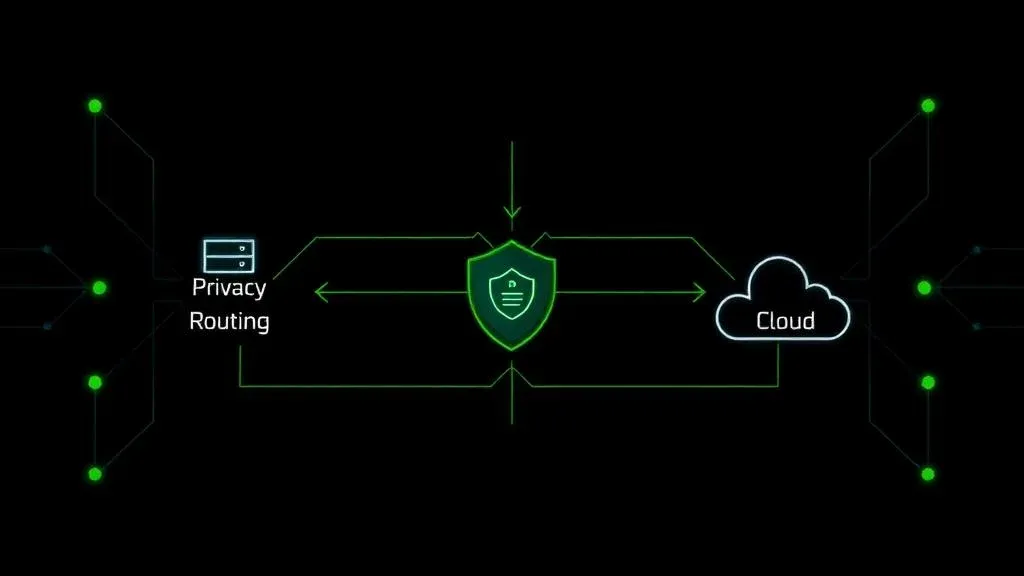
NemoClaw: NVIDIA's Privacy Router and What It Means for Agent Architecture
NVIDIA enters the Claw ecosystem with NemoClaw – and brings a concept that could reshape agent architecture: Privacy Rou…
Read more