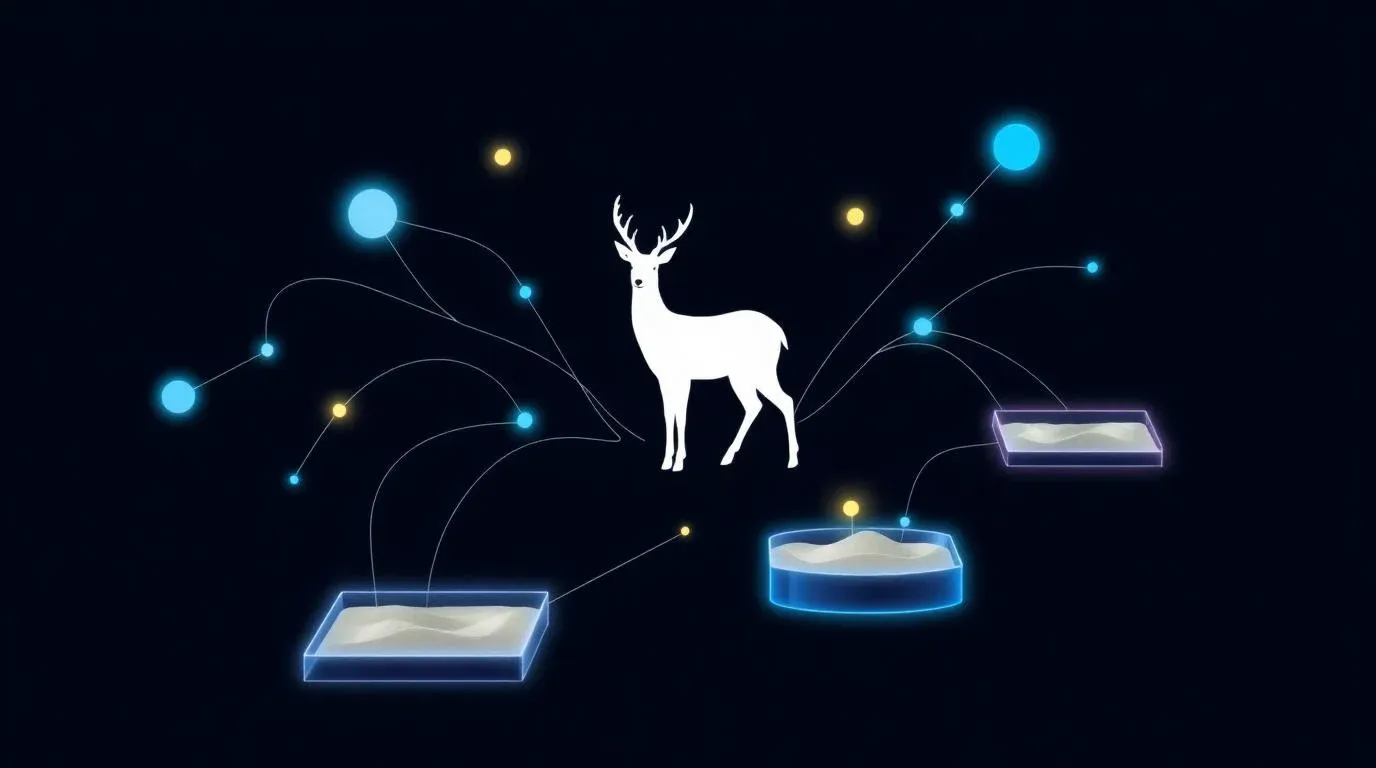
DeerFlow 2.0: ByteDance's 68k-Star Super-Agent Harness That Ships Finished Artifacts

TL;DR: „DeerFlow 2.0 is ByteDance's 68k-star open-source super-agent harness: progressively-loaded skills, sandboxed sub-agents, persistent memory, six IM channels. Hand it a prompt, get back a finished deck, report, or video."
— Till FreitagThe Harness, Not the Model, Is the Product Now
For two years the conversation was about models. Who has the biggest context window, who tops MMLU, whose reasoning loop is tightest. That conversation is mostly over. The interesting work has moved one layer up: the harness.
A harness is what turns a model into something useful. Skill loading, sub-agent orchestration, sandbox isolation, memory, channel routing, artifact handoff. The boring infrastructure that decides whether you get a chatbot or a coworker.
DeerFlow 2.0 is the most complete open-source answer to that problem right now. ByteDance shipped it, 68k GitHub stars, and the architecture is worth understanding even if you never run it.
What Actually Ships in the Box
Built-in skills, loaded progressively
DeerFlow ships skills for research, report generation, slide decks, web pages, image generation, and video generation. None of them load eagerly. The harness pulls skill bundles on demand, which keeps the active context window lean even when the skill registry is enormous.
This is the same architectural bet Anthropic made with Agent Skills last quarter: skills as filesystem, not as system prompt. The model only sees what it needs when it needs it.
Sub-agents in isolated sandboxes
Every sub-agent runs in its own sandbox with filesystem access and bash. Not "function calls returning JSON" – actual processes with actual file handles. That's what makes "go build me a slide deck" a real workflow instead of a demo.
The isolation is the security model. A research sub-agent that goes off the rails can't touch the slide-gen sub-agent's working directory. This is the part most homegrown agent stacks get wrong – they share state, then they share blast radius.
Memory that persists across sessions
Sessions don't reset. State carries forward. You can hand DeerFlow a task on Monday, check on it Wednesday, and it still knows what you asked for. This sounds obvious until you've tried to build it on top of a stateless API.
Six channels in, artifacts out
Tasks come from a web UI, six IM channels including Slack and Telegram, or Claude Code via the claude-to-deerflow skill. That last one is the tell: DeerFlow assumes you're already running an agent (Claude Code) and want to delegate the long-running, artifact-producing work to a different harness with better infrastructure for it.
You get back a finished artifact. Not a transcript, not a tool call log – a deck, a report, a video.
Why the Architecture Matters
Most agent frameworks in 2026 still confuse the model with the product. They ship a wrapper around an API call and call it an agent. DeerFlow draws the lines correctly:
| Layer | What it does | Where most stacks fail |
|---|---|---|
| Channels | Receive tasks from humans or other agents | Hardcode one UI |
| Router | Decide which skill + sub-agent | Route to a single mega-prompt |
| Skills | Procedural knowledge + bundled scripts | Stuff everything in the system prompt |
| Sandboxes | Isolated execution per sub-agent | Share filesystem, share failure modes |
| Memory | Persist state across sessions | Treat every turn as fresh |
| Artifacts | Hand back something usable | Return a chat transcript |
You can build any single one of those layers in a weekend. Building all six so they actually compose is the work, and that's what 68k stars are paying for.
What This Means for Teams
If you're running production agents, DeerFlow is worth reading even if you don't deploy it:
- Skill-as-filesystem is the right pattern. If your agent's system prompt is longer than a page, you're doing it wrong.
- Sandbox per sub-agent is non-negotiable for anything touching files or shell. The "Always Allow" permission model some commercial products use is not a security model.
- Channels are an integration surface, not a UI choice. If your agent only works from one frontend, it isn't deployed – it's demoed.
- Memory is a product feature. Stateless agents are toys.
For our clients building internal agent platforms, this is the reference architecture conversation. You don't have to use DeerFlow, but if your design diverges from these six layers, you should know why.
The Bigger Pattern
There's a social-graph-based agent harness startup somewhere out there that's going to $1T over the next five years. The category is forming the same way mobile OSes formed in 2008 and cloud platforms formed in 2012: a few opinionated stacks, rapid divergence, then consolidation around two or three.
DeerFlow is the open-source pole. Anthropic's Agent Skills + Dispatch is the vertically-integrated commercial pole. The middle – LangGraph, CrewAI, every "agent framework" raising a Series A – is going to feel a lot of pressure over the next twelve months.
Pick the pole you can live with. The middle is the dangerous place.
→ Read our comparison of Claude Managed Agents, LangGraph, and CrewAI → Desktop Agents Showdown: Dispatch, Manus, Perplexity Computer, DIY → Agent Sandboxing approaches compared
Related Articles
Agent Harness as a Category: Why the Harness Is the New Product
The harness — skills, sandbox, subagents, memory, channel routing — is the real product layer above the model. A map of …
Read more
Agent Skills Are Becoming an Industry Standard: What Teams Need to Know
Agent Skills are reusable capabilities for AI agents – and they're becoming the new standard. What sets them apart from …
Read more
Coding-Agent Layer 2026: OpenCode, Aider, Continue.dev & Co. Compared
Deep dive into the coding-agent layer: which OpenClaw coding rival fits which workflow? OpenCode, Aider, Continue.dev, S…
Read more
Gemma 4 12B Coder: Local Code Generation Becomes the Default
Google ships the Gemma 4 12B Coder — the specialized coding variant of the Gemma 4 stack. 12B parameters in GGUF format,…
Read more
SearXNG: The Underrated Search Infrastructure for Agents
31.8k stars, AGPL-3.0, one self-hosted endpoint instead of the next commercial search API. Why SearXNG keeps showing up …
Read more
Lovable Skills: Repetition Turns Into Reusable Playbooks
Lovable just rolled out Skills – Anthropic's format for reusable agent instructions. What Skills are, how they differ fr…
Read more
superglue.ai – The AI-Native Integration Platform That Finally Connects Enterprise Systems
superglue.ai replaces brittle SQL scripts and cron jobs with AI-powered enterprise integrations. Open source, Y Combinat…
Read more
Claude Managed Agents: Anthropic's Play to Own the Agent Runtime
Anthropic launches Managed Agents in public beta – a hosted runtime that decouples the 'brain' from the 'hands.' No more…
Read more
Gemma 4: Frontier Intelligence Goes Laptop-Sized – The Hype Is Real
Google's Gemma 4 delivers GPT-4 level intelligence in 14 GB. 85 tokens per second on consumer hardware, 256K context, na…
Read more