AI First = People First: Why AI-Native Doesn't Mean Anti-Human


TL;DR: „AI First doesn't mean people out. It means: routine work out, so people can do what they were actually hired for – think, decide, create."
— Till FreitagThe Fear Nobody Talks About
In every meeting where we say "AI First," we see it in people's eyes. The unspoken question:
"Does that mean I'll be replaced?"
The fear is justified. Headlines are full of mass layoffs justified by "AI transformation." CEOs brag about how many positions they're eliminating thanks to AI. And LinkedIn is flooded with posts prophesying that 80% of all jobs won't exist in five years.
We think this is dangerous. Not because it's wrong – but because it answers the wrong question.
The right question isn't: "How many people can we replace with AI?" It's: "How can we use AI to make work more human?"
What "AI First" Actually Means for Us
AI First at Till Freitag isn't a technology statement. It's an organizational principle. It means:
Before a human takes on a repetitive task, we check whether AI can handle it.
That sounds trivial. The implication is radical.
| Without AI First | With AI First |
|---|---|
| Senior writes boilerplate code | AI generates, senior reviews |
| Analyst creates status reports | AI aggregates, human interprets |
| Designer builds 20 variants | AI generates, designer curates |
| PM maintains tickets manually | AI structures, PM prioritizes |
| Consultant researches for 3 days | AI provides foundation, consultant deepens |
In every case, the human remains. But the work changes. Away from routine, toward judgment. Away from production, toward curation. Away from busy work, toward deep work.
The Fallacy of the "AI Replaces Humans" Crowd
The narrative "AI replaces humans" is based on a fundamental fallacy: it views work as a set of tasks to be checked off.
But work is more than tasks.
Work is:
- Understanding context that no prompt can capture
- Nurturing relationships that require trust
- Making decisions that presuppose values
- Taking responsibility that no AI can bear
- Being creative – not in the sense of "generate an image," but "recognize a problem nobody has articulated yet"
AI can automate tasks. AI cannot do the things that make work valuable.
AI is the tool. The human is the craftsperson. Without the craftsperson, the tool is useless.
What AI First Looks Like in Practice
We Don't Write Boilerplate Code Anymore
Why should a developer with 15 years of experience spend time writing CRUD endpoints? AI-native development means: the machine generates the standard, the human focuses on architecture, edge cases, decisions.
Result: Our developers spend 70% of their time thinking and 30% typing. Two years ago, that ratio was reversed.
We Automate Internal Processes
Status reports, time tracking, documentation – everything that keeps us from actual work, we've automated. Not perfectly, not 100%. But enough that no one on our team wastes their time on administration.
We Invest the Saved Time in People
The time AI saves us, we don't invest in "more output." We invest it in:
- Learning: Everyone on the team has dedicated learning time
- Exchange: More pair programming, more code reviews, more discussions
- Creativity: Space for experiments no client project would fund
- Life: We work efficiently so we don't have to work weekends
The Ethical Dimension
We can't talk about AI First without talking about responsibility.
Who Benefits?
When a company uses AI to lay off 50% of its workforce and maximize profit – that's not "AI First." That's "Profit First with AI as an excuse."
AI First in the sense of People First means:
- Productivity gains are shared – with the team, not just shareholders
- Nobody gets replaced who adapts – we invest in training, not terminations
- Technology serves people – not the other way around
Our Responsibility as Consultants
When we build AI solutions for clients, we always ask: Who is affected? Not just the client, but the people who will work with the system.
A chatbot that makes customer service "more efficient" but degrades service agents to prompt appendages? We don't build that.
An automation that takes repetitive work off case workers' plates and gives them time for complex cases? That's our sweet spot.
What This Means for the Industry
The AI debate is currently dominated by two extremes:
- The tech utopians: "AI will make everything better, trust the technology"
- The Luddites: "AI destroys jobs and must be regulated"
Both are wrong. The truth is more uncomfortable and nuanced:
AI is a tool whose impact depends on the people who wield it. In the hands of companies that see people as cost factors, AI becomes a downsizing instrument. In the hands of companies that see people as value creators, AI becomes a multiplier.
We've decided which side we're on.
The Proof: Our Results
Since we started working AI First:
- Project duration halved – not through overtime, but efficiency
- Not a single employee laid off – hired new ones instead
- Quality increased – because people have more time for important decisions
- Work-life balance improved – because routine work no longer runs until 10 PM
This isn't PR. This is our daily reality. This article is the fourth part of our manifesto series:
More from the Manifesto
All eleven principles that define how we work. Read in any order – they reinforce each other.
Related Articles
AI First = People First – Why Augmentation Is the Future of Work
AI First sounds like technology first. For us, it means: people first. Why augmentation wins and how we live that at Til…
Read more
Scale Impact, Not Headcount: Why We Don't Want to Grow Endlessly
Growth isn't a goal in itself. We scale impact, not headcount – and here's why that's the better strategy.…
Read more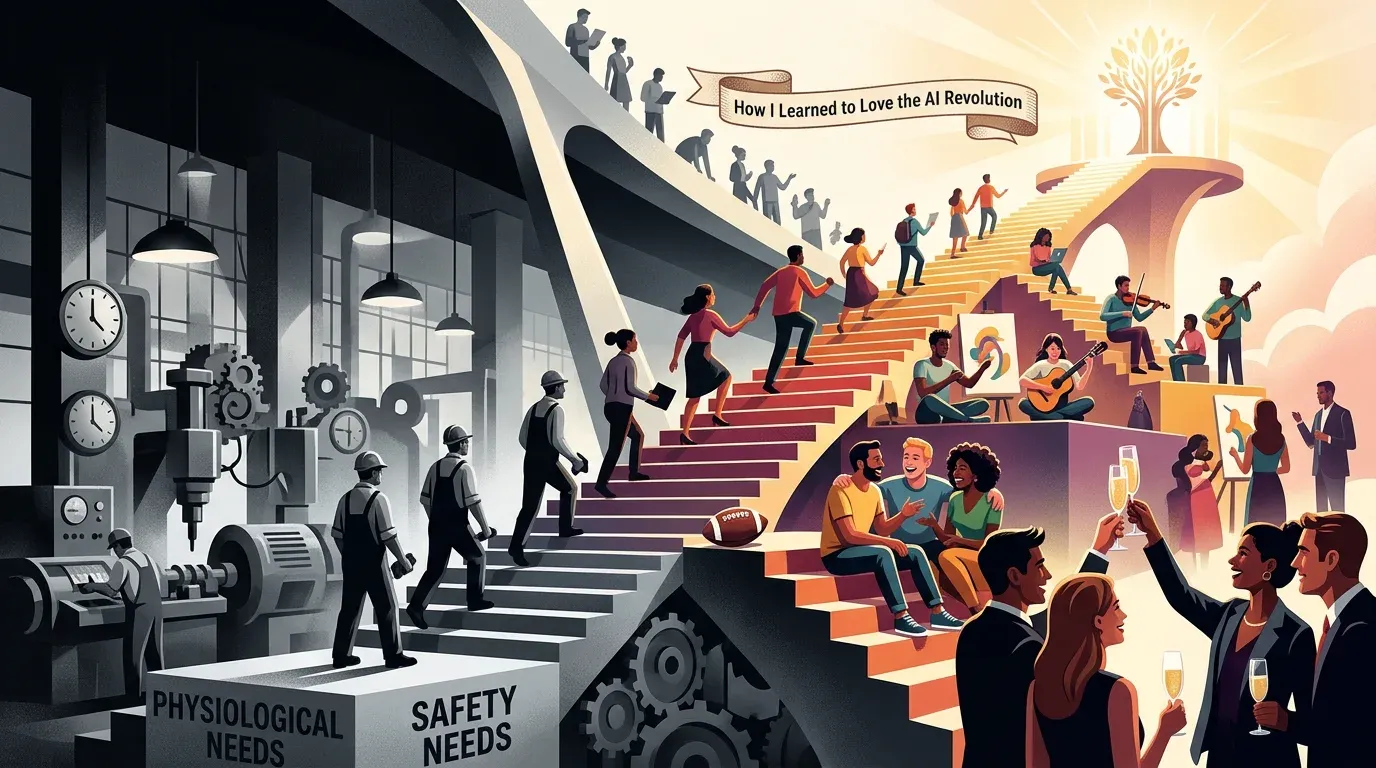
How I Learned to Love the AI Revolution
AI isn't killing jobs – it's freeing us from the wrong ones. Why history shows that panic is the worst advisor.…
Read more
We Believe in Europe and the Power of Balance
We believe in Europe. In cultural diversity. In the power of balance. And against the extremes – no matter which directi…
Read moreWe Care: Why Attitude Matters More Than Skills
We care. For our customers, partners, employees, society, nature and ourselves. Sounds soft. Is hard. And it decides who…
Read moreWork in Progress: Why This Manifesto Is Never Done
Better done than perfect. Don't work for assholes. Imperfect = Perfect. The last chapter of our manifesto is also a warn…
Read more
Senior-Only: Why We Don't Put Juniors on Client Projects
The classic consulting model sells senior partners and delivers junior analysts. At Till Freitag, everyone on your proje…
Read moreCulture & Mindset – How to Get Your Team Ready for the AI Era
Introducing AI tools is easy. Creating the culture for it is the real challenge. How to get your team ready for Working …
Read more
Scale Impact, Not Headcount – How Small Teams Grow Disproportionately with AI-First
More impact without more headcount? Here's how small teams scale disproportionately with an AI-First approach, automatio…
Read more